
作者:Mark Rafter 博士(Dr. Mark A. Rafter)
本文是我们正在连载的中国艺术、文化与文化交流系列报道中的又一篇。
2026年8月9日,一场题为“清风雅韵”(Elegant Breeze and Refined Charm)的中国扇画与书法艺术盛会在Xiaoxiao Gufang·Borui Huangjing艺术空间悄然展开。这是一个私密的场所,从我走进来的那一刻起,空气中突然弥漫着一股多彩记忆的芬芳,把我带回我意大利祖父在纽约州北部的农场。在那里,我第一次听到马可·波罗的冒险故事和一些鲜有人知、甚至无人听过的内情。我的名字有一部分来自祖父,在一次促膝长谈中,他用每一个字让我着迷了好几个小时。然后,他把“藏宝图”给了我,并告诉我,马可·波罗再也没能回去,他思念着他的第二挚爱:中国,而我将是那个替马可·波罗回到中国的人。走进这个私密的环境,就像走进一座长满蔬菜和果树的丰茂花园。唯一的例外是一片竹林,它立刻让我对中国的成都和大熊猫生出思乡之情。这里没有喧嚣,只有艺术与友谊的优雅,有艺术、水墨、美食、美酒和欢笑。作为这样一个场合的私人活动,现场大约有75到100人,其中许多是来自中国和美国的文化艺术界人士、收藏家和艺术爱好者,他们如约相聚,共赴一场中国文化艺术美学的优雅聚会。
我参加华人社区活动时,通常只是一名记者,我每周的英文受众触达超过12亿,远大于大多数当地中文媒体和新闻机构的触达。但在这次活动上,我戴着好几顶帽子:记者、去年由Jin Lin Wang任命的美国中国艺术博物馆美国主任,以及现代马可·波罗。Marco的中国媒体朋友Dong Hongxing是全美电视台(All America Television)著名的资深记者,也是已成功举办37年的洛杉矶亚洲小姐选美的组织者,他从美国大学联盟松竹梅奖学金颁奖典礼的繁忙日程中抽出时间出席了这次活动。他对本文的贡献不可估量。
活动在主持人Li Li温暖醇厚的声音中徐徐开始。他优雅地说:“一把扇子,在它小小的空间里,可以包罗山川河流;一幅画,在它小小的画布上,可以承载中国文人千年的美学和精神。”他的话语柔和却深深动人。在中国传统文化中,扇子远不只是一件纳凉的工具。它与诗词、书法和绘画交织在一起,形成一种小而深邃的文化真实。当这份优雅的中国文化艺术魅力跨越太平洋来到洛杉矶时,它携带的远不只是一场艺术展示,它代表着一次文化相遇,一场不只是文化与文化之间、更是深深动人的艺术文化体验。“一把扇子,在它精致的扇面小小空间里作画,可以体现中国艺术文化文人千年的美学和精神。这场在洛杉矶举行的‘清风雅韵’扇画书法活动,让Jin Lin Wang得以放映幻灯片,向在场所有人传授中国扇画文化的美学,同时在朋友、水墨和欢笑的芬芳中,架起一座连接东方与西方的桥梁。”
这个美丽私密场所的主人、Xiaoxiao Gufang·Borui Huangjing首席执行官Coral女士面带微笑致欢迎辞。她说:“一个高品质的文化空间不仅是人们相聚的场所,更重要的是,它让来自不同领域的人通过文化建立连接,并让优秀的艺术有机会被更多人看见、感知和珍藏。”她的目光温柔而坚定,仿佛在说:“让中国扇画艺术像一缕清风,拂动更多海外人士的心。”
艺术大师、美中丰台商会会长、美中经贸文化促进会会长、丰台美术委员会会长Zhu Junying先生在致辞中表达了他的感受:“文化的生命力不仅在于传承,也在于交流。在海外,中国书画进入不同文化背景的社会环境,实际上是在为理解中国文化、认识中国文化艺术美学架设一座桥梁。”Kevin,我称之为异母的亲爱的兄弟,他认为,艺术交流最好的方式是让不同文化背景的人在没有事先安排的情况下被美打动。传奇美国拍卖行Jingxi的后人Xu Xiyuan先生从艺术收藏与传播的角度分享了他的见解:“一件艺术品的价值不仅在于它被创作的那一刻,也在于它如何被发现、被收藏、被研究,并最终如何继续穿越时间传承下去。”Xiyuan的话像一根细线,把创作、收藏和传播这三颗珍珠串在一起,让所有人看到,艺术的生命就像一串精美的珍珠,一环扣一环。
相关阅读:卡罗琳公主在王宫蓝厅向13位文化人士颁授文化功绩勋章
美国商会联合会长、美中经贸文化艺术协会会长Sun Wei先生对社会各界推动华人社区的文化交流表示感谢。他说:“在洛杉矶这座多元文化交汇的城市,华人社区组织在文化连接中发挥着至关重要的作用。一场文化活动要真正产生影响,不仅需要艺术家的创作,还需要社会各界的共同参与和推动。”著名媒体人、美中商务促进会顾问Marco最初用中式英语(Chinglish)发言,为观众开辟了一条文化连接的通道。他不是对观众说话,而是以非常个人的方式对朋友们说话,并从跨文化交流的角度提出他的看法。Marco说,这个环境让他想起了祖父的农场。Marco还表达了他对Kevin、Lucy、Jinlin Wang以及在场许多其他人的感激和深厚友谊。Marco说:“JinLin不仅是一位杰出的艺术家,还是一位非常罕见的修复专家,他修复过著名的千年艺术品,甚至包括明代的作品。在中美交流中,艺术、商业、文化、经济和贸易不仅是政府与政府之间的桥梁,更是人民与人民之间的桥梁。真正持久的交流,最终源于人民之间更深的理解和相互欣赏。”我拥有很多中国艺术品和古董,大多数是礼物。让我建议一下:如果您热爱艺术和文化,请联系我们系列报道中的艺术家,寻访他们的艺术。Marco希望,通过这样的文化活动,更多来自不同文化背景的朋友能够看见、体验和理解中国文化艺术独特的精神魅力。
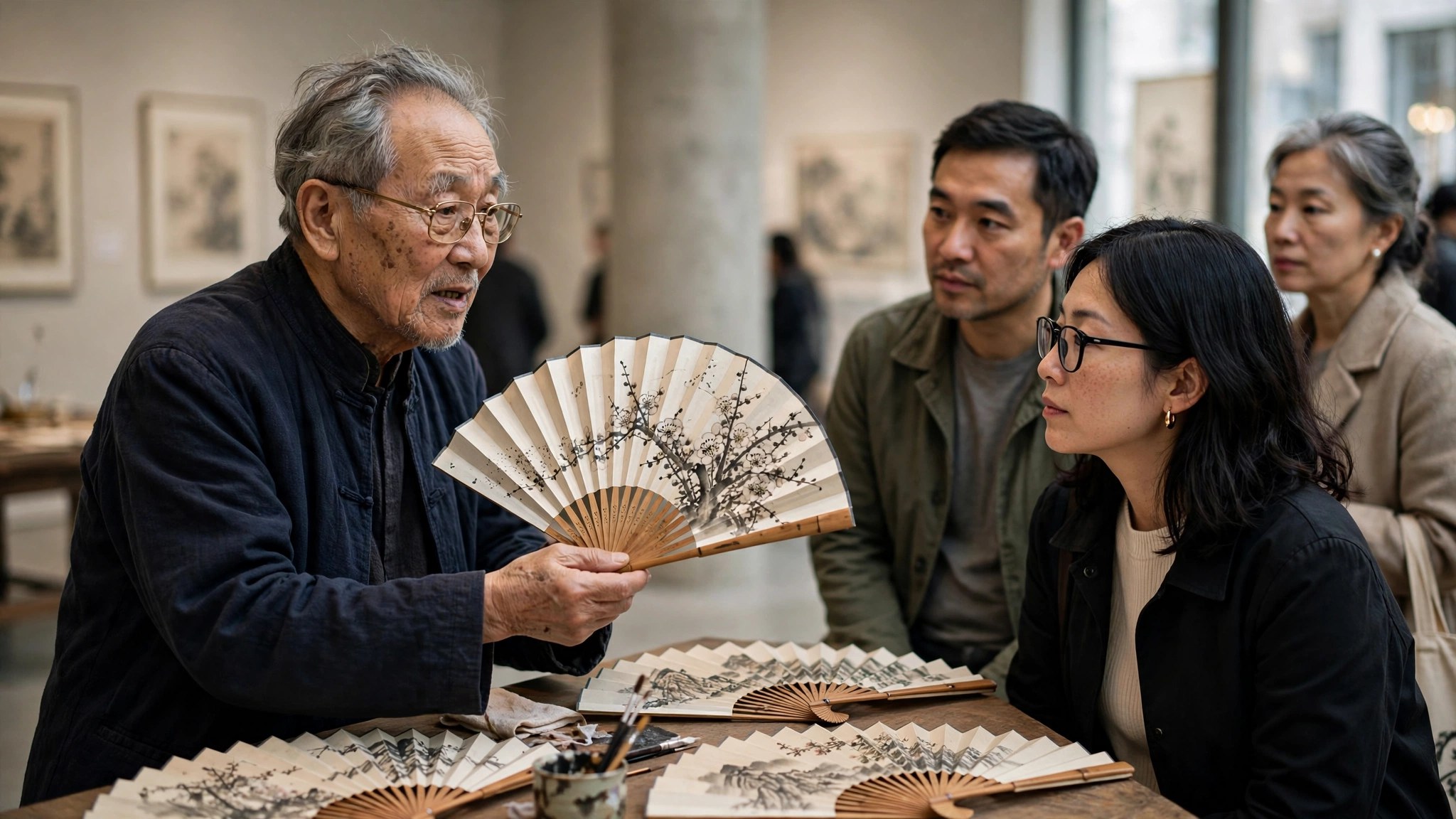
王金林讲解扇画艺术
论坛的核心是美国中国艺术博物馆馆长、扇面书画艺术家Wang Jinlin(王金林)先生的分享环节。他站在台上,语气平静却饱含深情:“许多朋友的第一印象可能是‘美、优雅、有中国味’。但如果您只停留在‘欣赏一幅画’的层面,那您离理解中国扇画艺术还很远。”JinLin轻声问道:“为什么中国古人喜欢在扇子上题诗作画?为什么一把小小的扇子能成为中国书画中一个独立而重要的门类?一把扇子如何从日常用品逐渐走进文人的书房、走进书画艺术,甚至成为中国传统文化的重要象征?”他的讲解像一扇缓缓打开的门,让在场的每一位嘉宾走进那把扇子所描绘的山水和世界。
在所有人的热切期待中,馆长JinLin Wang和Zhu Junying会长一起拿起毛笔,轻轻地在洁白无瑕的扇子上落墨。在空白的扇面上,山水和优雅从墨迹中逐渐浮现。教授沉浸于中国书画的魅力之中,这种魅力不仅在于最终的作品,一切都是艺术家长期经验积累的表达。嘉宾们屏住呼吸,仿佛能听见墨在纸上轻轻晕开的声音。那一刻,时间似乎慢了下来,只剩下墨与心意的交融。人们围坐在一起,一边用餐,一边讨论“中国扇画书法的艺术价值、它的海外传播,以及传统艺术如何在当代继续传承和创新”的主题。
这场研讨会不只是一场艺术展览。它是一场关于通过扇画、书法、历史、收藏和文化进行文化传承的深刻对话,也是一场持续的人民与人民之间的文化交流。作为现代马可·波罗,我认识到,搭建桥梁也许并不总是要求把同一种语言说得完美无缺。有时,它只需要愿意用心去尝试,并传递对中国文化和中国人民真诚的热爱。这次活动连接了如此多的记忆:一个在纽约州北部祖父农场上的男孩收到一张与马可·波罗有关的藏宝图;几十年后,同一个男孩,如今在一个华裔美国人社区里被称为现代马可·波罗,站在一座被中国艺术和朋友环绕的私人宅邸中,想起那座农场,并受邀发言。宝藏从来不是那张地图。宝藏一直是旅程,以及沿途发现的友谊、艺术、文化和理解。当我最初去中国寻找与马可·波罗有关的宝藏时,我没有发现金子或银子。最终发现的真正宝藏是:最大的宝藏是友谊。对我来说,这次活动不只是又一次采访任务。它似乎正是那段旅程的又一章。它是藏宝图上的又一站。
相关阅读:2026硅谷AI电影节在比佛利山庄举行 颁出13项大奖
English
By Dr. Mark A. Rafter
This is another article in our ongoing series exploring Chinese art, culture and cultural exchange.
On August 9, 2026, a grand event of Chinese fan painting and calligraphy art, entitled “Elegant Breeze and Refined Charm,” quietly unfolded at the Xiaoxiao Gufang·Borui Huangjing Art Space. This was a private place, and from the moment I walked in, the air was suddenly filled with a fragrance of colorful memories that took me back to my Italian grandfather’s farm in upstate New York, where I first was told the Adventures of Marco Polo and inside stories few, if any, others ever heard. I was partially named after my grandpa, and in a one-on-one he held me spellbound by every word for hours. Then he gave me “the treasure map” and told me that Marco Polo never got to go back and longed for his second love, CHINA, and that I would be the one to go back to China for Marco Polo. Walking into this private setting was like walking into a plush garden filled with vegetables and fruit trees. The only exception was an area with bamboo, which brought me an instant homesick feeling for Chengdu, China, and the Giant Pandas.
There was no hustle and bustle, only the elegance of art and friendship, with art, ink, food, wine and laughter. As a private event in such a setting, there were maybe 75 to 100 people present, many of whom were cultural and artistic figures, collectors, and art lovers from China and the United States who gathered as scheduled for an elegant reunion of Chinese Cultural Art aesthetics. Often when I attend Chinese Community Events, I am there simply as a journalist with a 1.2 billion-plus English audience reach per week that is much larger than the reach of most local Chinese media and press. At this event, I was wearing several hats: as a journalist/reporter, as a USA Director of the American Chinese Art Museum appointed last year by Jin Lin Wang, and as The Modern-Day Marco Polo.
Dong Hongxing, Marco’s Chinese Media Friend, a renowned senior reporter for All America Television, is the organizer of the Miss Asian Los Angeles Pageant, which has been successfully held for 37 years, and took time out of his busy schedule from the American College Alliance Pine, Bamboo and Plum Scholarship Award Ceremony to attend the event. His contribution to this article is invaluable.
The event began gently with the warm, mellow voice of host Li Li. He elegantly said, “A fan, within its small space, can encompass mountains and rivers; a painting, on its small canvas, can carry the aesthetics and spirit of Chinese literati for millennia.”
His words were soft yet deeply moving. In traditional Chinese culture, the fan is far more than just a tool for cooling oneself. It is intertwined with poetry, calligraphy and painting, forming a small yet profoundly deep cultural realism. When this elegant Chinese Cultural Art charm crosses the Pacific Ocean to Los Angeles, it carries far more than just an artistic display; it represents a cultural encounter, a dialogue not just from culture to culture but, moreover, a deeply moving art culture experience. “A single fan, within its small space painting, on its delicate surface, can embody the aesthetics and spirit of Chinese art culture literati for millennia. This ‘Refined Breeze and Elegant Charm’ fan painting and calligraphy event in Los Angeles allows Jin Lin Wang to present a slide show and teach all present Chinese Fan Art Culture aesthetics while building a bridge connecting East and West amidst the fragrance of friends, ink and laughter.”
Ms. Coral, CEO of Xiaoxiao Gufang·Borui Huangjing, the owner of this beautiful private setting, delivered a welcoming speech with a smile.
She said, “A high-quality cultural space is not only a place for people to gather, but more importantly, it allows people from different fields to connect through culture, and gives excellent art the opportunity to be seen, perceived, and treasured by more people.” Her gaze was gentle yet firm, as if saying: “Let Chinese fan painting art, like a gentle breeze, touch the hearts of more people overseas.”
In his speech, Mr. Zhu Junying, a Master Artist and Chairman of the US-China Fengtai Chamber of Commerce, and Chairman of the US-China Economic and Trade Cultural Promotion Association, and Chairman of the Fengtai Fine Arts Committee, expressed his feelings:
“The vitality of culture lies not only in its inheritance, but also in its exchange. Overseas, the entry of Chinese calligraphy and painting into social environments with different cultural backgrounds is actually building a bridge for understanding Chinese culture and recognizing Chinese Cultural Art aesthetics.” Kevin, I call my dear Brother of a different mother, believes that the best way for art to communicate is to allow people from different cultural backgrounds to be moved by beauty without prior arrangement.
Mr. Xu Xiyuan, a descendant of the legendary American auction house Jingxi, shared his insights from the perspective of collecting and disseminating art: “The value of a work of art lies not only in the moment of its creation, but also in how it is discovered, collected, studied, and ultimately continues to be passed down through time.” Xiyuan’s words, like a fine thread, string together the three pearls of creation, collection, and dissemination, allowing everyone to see that the life of art is like a fine string of pearls, link by link.
Mr. Sun Wei, Co-Chairman of the American Chamber of Commerce and President of the US-China Economic, Trade, Cultural and Artistic Association, expressed his gratitude to all sectors of society for promoting cultural exchanges within the Chinese community. He said, “In Los Angeles, a city where diverse cultures converge, Chinese community organizations play a vital role in cultural connection. For a cultural event to truly have an impact, it requires not only the creation of artists but also the joint participation and promotion of all sectors of society.”
Marco, a renowned media figure and advisor to the US-China Business Promotion Association, spoke initially in Chinglish, creating a pathway of cultural connection to the audience. Rather than speaking to the audience, he spoke to friends in a very personal way and offered his perspective from the angle of cross-cultural exchange. Marco shared that the setting brought back memories of his grandfather’s farm. Marco also shared his appreciation and great friendship with Kevin, Lucy, Jinlin Wang and many others in the room. Marco stated, “JinLin was not only a distinguished artist but was a very rare restoration specialist who had restored famous 1,000-year-old art pieces even from the Ming Dynasty. In the exchange between China and the US, art, business, culture, economics and trade serve as a bridge not only government to government but greater people to people. Truly lasting exchanges ultimately stem from a deeper understanding and mutual appreciation between people.” I own a lot of Chinese art and antiques. Most were gifts. Let me suggest if you love art and culture contact the artist in our series and seek their art. Marco hopes that through such cultural activities, more friends from diverse cultural backgrounds can see, experience and understand the unique spiritual charm of Chinese Cultural Art.
The core of the forum was a sharing session by Mr. Wang Jinlin, Director of the American Chinese Art Museum and a fan-shaped calligraphy and painting artist. Standing on the stage, his tone was calm yet deeply emotional: “Many friends’ first impression might be ‘beautiful, elegant, and with a Chinese flavor.’ But if you only stay at the level of ‘appreciating a painting,’ you are far from understanding the art of Chinese fan painting.” JinLin gently asked: “Why did the ancient Chinese like to inscribe poems and paint on fans? Why can such a small fan become an independent and important category in Chinese calligraphy and painting? How did a fan gradually move from a daily necessity into the study of literati, into the art of calligraphy and painting, and even become an important symbol of traditional Chinese culture?” His explanation was like a slowly opening door, allowing every guest present to step into the landscapes and worlds depicted on that fan.
The Director JinLin Wang and Chairman Zhu Junying, to the great anticipation of all present, picked up their brushes together and gently applied ink to the pristine white fan. On the blank sheet of paper, the landscape and elegance gradually emerged from the ink. The professor engaged in the charm of Chinese calligraphy and painting, which lies not only in the final artwork; all are expressions of the artists’ long-term accumulation of experience. The guests held their breath, as if they could hear the ink gently spreading on the paper. At that moment, time seemed to slow down, leaving only the fusion of ink and heartfelt intentions. People gathered around and sat while dining and discussing the theme of “the artistic value of Chinese fan painting and calligraphy, its overseas dissemination, and how traditional art can continue to be inherited and innovated in the contemporary era.”
This seminar was more than just an art exhibition. It was a profound dialogue on cultural inheritance through fan painting, calligraphy, history, collecting and culture, and the continued people-to-people exchange of culture.
As the Modern-Day Marco Polo, I have learned that perhaps building bridges doesn’t always require speaking the same language perfectly. Sometimes it simply requires caring enough to try and to convey a sincere love for Chinese Culture and Chinese People. The event connected so many memories: a boy on his grandfather’s farm in upstate New York receives a treasure map connected to Marco Polo; decades later, that same boy, now known within a Chinese American community as the Modern-Day Marco Polo, is standing at a private estate surrounded by Chinese art and friends, remembering that farm while being invited to speak. The treasure was never really the map. The treasure has been the journey and the friendships, art, culture and understanding discovered along the way. When I originally went to China in search of the treasure connected with Marco Polo, I didn’t discover gold or silver.
The real treasure ultimately discovered was that the greatest treasure was friendship.
This event, for me, wasn’t just another assignment. It seemed like another chapter of precisely that journey.
It was another stop on the treasure map.
本文英文版最初发表于 News Today World,作者 Mark Rafter 博士。






















Be First to Comment