
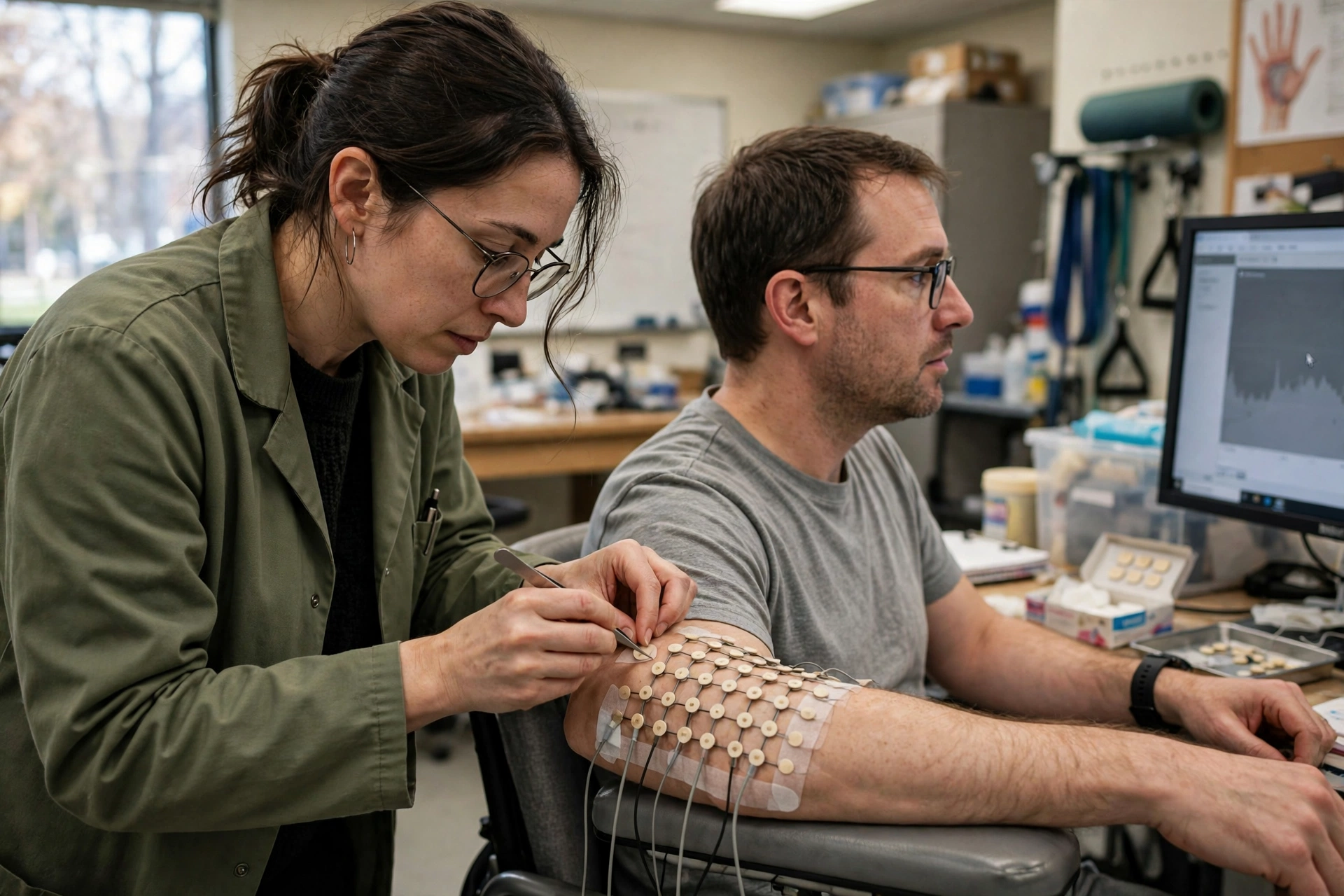
三名因严重脊髓损伤而失去全部手部功能的人,使用佩戴在前臂皮肤上的传感器控制了电脑光标、玩电子游戏,并驾驶了虚拟轮椅。这项研究发表在《自然-人类行为》杂志上,尚帕利莫基金会于2026年11月25日作了介绍。整个系统没有植入任何装置,它读取不再运动的肌肉发出的微弱电信号,并将这些信号转化为指令。
这一结果与该领域长期以来的一个假设不同。严重脊髓损伤后,大脑与损伤部位以下肌肉之间的一些连接往往仍然存在。当一个人试图移动一只无法移动的手时,这些残存的通路仍能在前臂肌肉中产生微弱的电活动。临床医生能够检测到这种活动,但大多数研究人员认为它太微弱、太杂乱,无法成为可靠的控制信号,因此研究转向了大脑植入物或放置在脊髓上的刺激器。
痉挛使问题更加困难。高达70%的脊髓损伤者伴有痉挛,这意味着一些运动神经元会自行持续放电,背后没有任何意图。这种背景噪声会掩盖一个人试图发出的自主信号。一个无法区分两者的控制系统,会在使用者想静止时移动,在使用者想移动时静止,对任何人都没有实际用处。本站关于英国圣诞品牌拉普兰在纽约亿万富翁大道开设首家美国门店的报道关注一家门店的开业,而这项工作的开端发生在诊所里,规模虽小,意义却不同。
研究团队用密度解决了噪声问题。他们将多达192个电极的高密度网格缠绕在前臂上,并运行分解算法,实时将综合肌肉信号拆分为单个运动神经元的活动。运动神经元是将最终指令传递给一组肌肉纤维的细胞。一旦信号按神经元逐个分离,软件就能保留参与者能够控制的神经元,舍弃自行放电的神经元。剩下的就是一个干净的多维控制信号,它来自一块完全没有可见运动的肌肉。
三名参与者都受了严重损伤,没有手部功能。其中一名参与者也没有手部感觉。戴上传感器后,根据基金会对研究的介绍,他们几乎立即学会了在屏幕上二维导航光标。他们玩了改编版的乒乓和贪吃蛇,这两款游戏要求稳定的方向控制,而不只是快速反应。他们还驾驶虚拟轮椅通过屏幕上的路线,选择这项任务是因为轮椅控制是许多患者表示最想恢复的能力之一。
这项研究由胡安-阿尔瓦罗-加列戈领导,他在伦敦帝国理工学院工作期间完成了这项研究,现在在里斯本尚帕利莫基金会主持神经网络控制实验室。合作者来自东南大学和国王学院医院。参与招募参与者的医生兼博士后研究员维沙尔-劳吉说,看着参与者用曾被告知永远不会再工作的肌肉做事情,令人非常感动。
全世界约有2000万人患有脊髓损伤,恢复手部功能一直被评为他们最优先的恢复目标。这一排序解释了为什么一项只有三名参与者的概念验证会引起远超其规模的关注。一只能握住杯子或操作手机的手,会改变一个人无需他人帮助就能做的事情。这项研究并没有带来那种抓握能力,它带来的是对屏幕的控制,这是通往目标的一步,研究人员也是用这样的措辞来描述它的,而不是更大的说法。本站关于我为什么热爱纽约:从第五大道到中央公园的文章同样从日常活动出发,讨论一座城市对人的实际意义。
这种方法与植入手术的价格也不同。皮肤上的传感器可以在一次诊所就诊中佩戴,一天结束时取下,损坏时更换。加列戈说,该系统可以做成穿在衣服下面的可穿戴设备。研究团队的博士后研究员杨星辰说,团队下一步希望将这项技术整合到手表等轻便可穿戴设备中,使其能够实现大规模康复应用。团队的博士生西亚拉-吉布斯提到了再下一步:在更长时间内稳定控制,并从数字界面走向物理界面,例如可以恢复真实运动的外骨骼。
加列戈已将这项工作带到里斯本。在尚帕利莫基金会,他正与约翰-克拉考尔的认知运动界面实验室合作,研究中风后的手部康复。那是一个规模大得多的患者群体,其中大约十分之九在中风几周后无法伸手的人,永远无法恢复那项功能。脊髓研究中使用的游戏在那种环境下也可以作为训练工具,因为练习控制残存连接的患者,每次尝试都能得到反馈。基金会尚未公布中风项目第一项研究的开始日期,那个日期将是里斯本实验室下一个具体的里程碑。
English
Three people who had lost all hand function after severe spinal cord injury controlled a computer cursor, played video games and steered a virtual wheelchair using sensors worn on the skin of the forearm, in a study published in Nature Human Behaviour and described by the Champalimaud Foundation on November 25, 2026. Nothing was implanted. The system read faint electrical signals from muscles that no longer move and turned them into commands.
The result runs against a long-standing assumption in the field. After a serious spinal cord injury, some connections between the brain and the muscles below the injury often survive. When a person tries to move a hand that cannot move, those surviving pathways can still produce weak electrical activity in the forearm muscles. Clinicians could detect that activity, but most researchers judged it too faint and too messy to serve as a dependable control signal, so the work went toward implants in the brain or stimulators placed on the spinal cord instead.
Spasticity made the problem harder. Up to 70 percent of people with spinal cord injury live with it, and it means some motor neurons fire on their own, continuously, without any intention behind the firing. That background noise can bury the voluntary signal a person is trying to send. A control system that cannot tell the two apart will move when the user wants stillness and stay still when the user wants movement, which is of little use to anyone.
The team got around the noise with density. They wrapped high-density grids of up to 192 electrodes around the forearm and ran decomposition algorithms that split the combined muscle signal into the activity of single motor neurons, in real time. Motor neurons are the cells that carry the final instruction to a muscle fiber group. Once the signal is separated neuron by neuron, the software can keep the neurons a participant can control and discard the ones firing on their own. What remains is a clean, multi-dimensional control signal built from a muscle that shows no visible movement at all.
All three participants had severe injuries that left them with no hand function. One participant also had no hand sensation. With the sensors fitted, they learned to navigate a cursor in two dimensions on a screen almost immediately, according to the foundation’s account of the study. They played adapted versions of Pong and Snake, two games that ask for steady directional control rather than quick reflexes alone. They also steered a virtual wheelchair through an on-screen course, a task chosen because wheelchair control is one of the first things many patients say they want back.
The study was led by Juan Alvaro Gallego, who did the work while at Imperial College London and now runs the Neocybernetics Lab at the Champalimaud Foundation in Lisbon. Collaborators came from Southeast University and King’s College Hospital. Vishal Rawji, a doctor and postdoctoral researcher involved in recruiting the participants, said it was incredibly moving to watch participants do things with muscles they had been told would never work again.
Assistive technology has had a good month on this site, and the pattern in the coverage is consistent. Devices that read the body closely keep getting better at it, much as an image model that checks its own output improves by examining its work instead of guessing. Here the checking happens neuron by neuron, hundreds of times, before a cursor moves a single pixel.
Readers following the week’s retail news, where Lapland opened its first American store on Billionaires’ Row, will find a different kind of opening here, in a clinic rather than a shop floor. About 20 million people worldwide live with spinal cord injury, and regaining hand function is consistently rated their highest recovery priority. That ranking explains why a proof of concept with three participants draws attention well beyond its size. A hand that can grip a cup or operate a phone changes what a person can do without asking for help. The study does not deliver that grip. It delivers control of a screen, which is a step on the way, and the researchers describe it in those terms rather than larger ones.
The approach also sits at a different price point from implant surgery. Sensors on the skin can be fitted in a clinic session, removed at the end of the day, and replaced if they fail. Gallego said the system could be built into a wearable worn under clothes, and Xingchen Yang, one of the postdoctoral researchers on the study, said the team next wants to fold the technology into light wearables such as watches so it can reach a large-scale rehabilitation application. Ciara Gibbs, a PhD student on the team, named the step after that: stabilising the control over longer periods and moving from a digital interface to a physical one, such as an exoskeleton that could restore real movement.
Gallego has carried the work with him to Lisbon. At the Champalimaud Foundation he is working with John Krakauer’s Cognitive-Motor Interface Lab on hand rehabilitation after stroke, a much larger patient group where roughly nine out of ten people who cannot extend a hand a few weeks after a stroke never regain that function. The games used in the spinal cord study double as training tools in that setting, because a patient practising control of the surviving connections gets feedback on every attempt. The foundation has not announced a start date for the stroke programme’s first study, and that date is the next concrete milestone for the Lisbon lab.
本报道同时见于News Today World、Newsy USA、The American Newsroom、American Morning Post、Revista Minutos、Le Miroir Français。




























Be First to Comment