
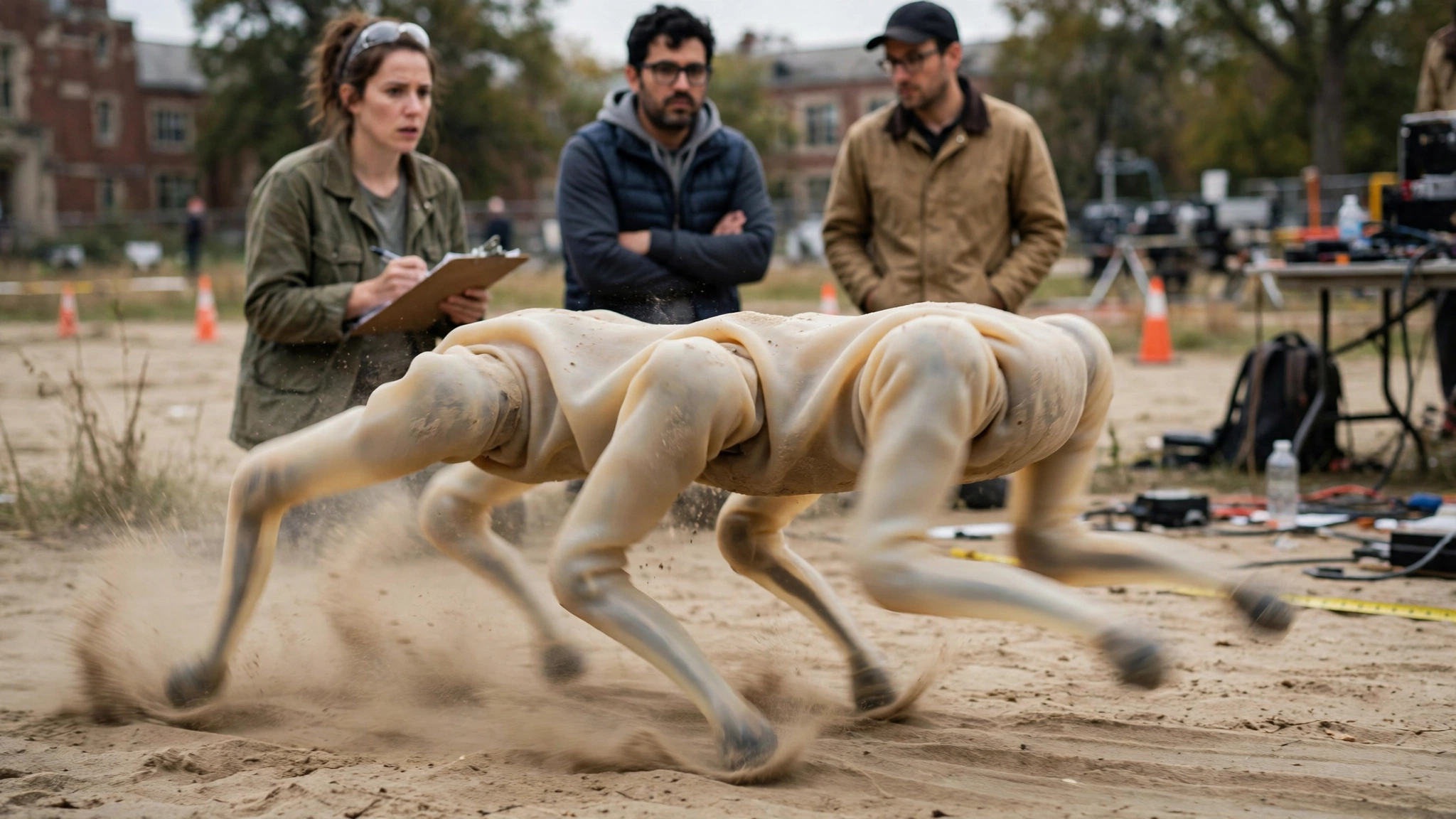
加州大学圣地亚哥分校的工程师造出了一台六腿机器人,奔跑速度最高可达每秒4.72米,略高于每秒5码,而且完全不含任何电子元件。雅各布斯工程学院的团队在2026年11月18日的《科学·机器人学》上详细介绍了这台机器,学校称它是完全由软材料制成的最快机器人。
这台机器人由单一材料一次3D打印完成。其柔软的身体内部是一组相连的腔室、阀门和管道。当加压空气流经这个网络时,腿就动起来。机器本身没有电路板,没有电池,也没有电机。目前它靠一根管子连接压缩空气源运行,比如一台标准的空气压缩机。
从2022年的每秒4厘米到2026年的每秒4.72米
起点很慢。该实验室的第一台3D打印气动机器人于2022年开发,2025年在《先进智能系统》上发表,速度为每秒4厘米,约1.5英寸。它的速度受限于其柔软结构能承受的气压和气流。新机器人的速度是那台机器的100多倍。
本站相关报道:亚马逊Prime Air在纳什维尔附近的朱丽叶山开通无人机配送、YYForce人形机器人Six Seven在新加坡诺富特酒店担任礼宾员、优步、Nuro与Lucid在旧金山湾区启动全无人驾驶出租车测试。
翟逸晨曾是该实验室的博士后研究员,他与生物启发机器人与设计实验室的迈克尔·T·托利教授共同领导了这项工作。翟逸晨说,第一台行走机器人展示了可能性,但太慢了,团队希望突破这个限制,并找到了一种让新机器人快100倍的方法。这篇题为《在桌面上打印强大的软体机器人》的论文,数字对象标识符为10.1126/scirobotics.aei1264,报告的估计机械功率输出为169瓦。
软体身体里的复合蒸汽机
提高压力是通往速度的明显路线,而它带来了一个问题。机器人及其内部结构必须变得更大、更强,才能承受更高的压力和更快的气流。在非常高的压力下,机器还会浪费能量,把仍然蕴藏着大量能量的空气直接排出。解决办法来自复合蒸汽机,这种设计让蒸汽依次在几个腔室中膨胀,而不是一次用尽。
机器人用空气玩了同样的把戏。加压空气在身体里循环两次。它先通过较小的、为阀门供能的高压腔室,再通过较大的、驱动腿部的低压腔室。翟逸晨说,关键挑战是把一个久经考验的方案,即复合蒸汽机,放进一台由单一材料一次打印成型的软体奔跑机器人中。他称这是朝着可以在桌面上用廉价材料打印的复杂而强大的机器人迈出的一步。
团队的测试场地比实验室地面更宽。团队让它在混凝土、砾石、草坪、覆盖物和沙子上奔跑。它跑下了楼梯。它游了泳,并在水下保持工作。
根据论文的发现,这一设计还可以用自来水代替空气作为工作流体。这一细节拓宽了这类机器可以运行的环境,因为驱动力是流体中的压力,而不是任何电气的东西。这项工作由美国国家科学基金会资助。翟逸晨和托利被列为与这项工作相关的一项临时专利申请的发明人。
测试计划在地面种类上很彻底。在混凝土上机器人展示了最高速度,在砾石和草坪上,它在脚下会移动的地面上保持移动。沙子对任何有腿的机器都是艰难的测试,因为每一步都会下陷,覆盖物更糟,因为碎片会移动和钩挂。机器人两者都应付了。跑下楼梯在每一步都增加冲击,这考验柔软的打印身体能否承受反复的撞击而不让腔室之间的接合处撕裂。游泳和在水下行走则从另一个方向考验密封,水压向内推,气压向外推。
一台没有电子元件的机器可以去电子元件难以工作的地方,学校指出了高辐射或强磁场环境中的科学侦察,以及灾害响应和太空探索。团队的下一步是使用更少压缩空气的设计,这样便携气罐可以取代管子,外加可以转向和处理物体的版本。
English
Engineers at the University of California San Diego have built a six-legged robot that runs at up to 4.72 meters per second, a little more than 5 yards per second, and contains no electronics at all. The team at the Jacobs School of Engineering detailed the machine in the November 18, 2026 issue of Science Robotics, and the university describes it as the fastest robot made entirely of soft materials.
The robot is 3D-printed in one go from a single material. Inside its soft body sits a connected set of chambers, valves and tubes. When pressurised air flows through that network, the legs move. There is no circuit board, no battery and no motor in the machine itself. For now it runs on a tether to a source of compressed air, such as a standard air compressor.
From 4 centimeters a second in 2022 to 4.72 meters in 2026
The starting point was slow. The lab’s first 3D-printed, air-powered robot, developed in 2022 and written up in 2025 in Advanced Intelligent Systems, managed 4 centimeters per second, about 1.5 inches. Its speed was capped by the air pressure and airflow its soft structures could handle. The new robot runs more than 100 times faster than that machine.
Yichen Zhai, a former postdoctoral researcher in the lab, led the work with Professor Michael T. Tolley in the Bioinspired Robotics and Design Laboratory. Zhai said the first walking robot showed what was possible but was too slow, and that the team hoped to beat the limit and found a way to make the new robot 100 times faster. The paper, titled Printing powerful soft robots on a desktop, lists a DOI of 10.1126/scirobotics.aei1264 and reports an estimated mechanical power output of 169 watts.
The compound steam engine inside a soft body
Raising the pressure was the obvious route to speed, and it created a problem. The robot and its internal structures had to grow bigger and stronger to take higher pressures and faster airflow. At very high pressure the machine also wasted energy, blowing out air that still held plenty of it. The fix came from the compound steam engine, a design that lets steam expand through several chambers in turn instead of spending it in one pass.
The robot uses the same trick with air. Pressurised air circulates twice through the body. It passes first through smaller, high-pressure chambers that power the valves, then through larger, low-pressure chambers that drive the legs. Zhai described the key challenge as putting a time-tested solution, the compound steam engine, into a soft running robot that prints in a single piece from a single material. He called it a step toward complex and powerful robots that can be printed on a desktop with inexpensive materials.
Speed records in very different fields made this week’s news, from Jeeno Thitikul’s third straight CME title and the LPGA money record on the golf course to a robot on a laboratory floor in La Jolla. The robot’s test course was wider than a laboratory floor, though. The team ran it on concrete, gravel, lawn, mulch and sand. It ran down stairs. It swam, and it kept working underwater.
The design can also run on tap water as its working fluid instead of air, according to the paper’s findings. That detail widens the settings where a machine of this type could operate, since the moving force is pressure in a fluid rather than anything electrical. The work was funded by the National Science Foundation. Zhai and Tolley are named as inventors on a provisional patent application connected to the work.
The test programme was thorough about surfaces. On concrete the robot showed its top speed, and on gravel and lawn it kept moving over ground that shifts underfoot. Sand is a hard test for any legged machine because each step sinks, and mulch is worse, since the pieces move and snag. The robot handled both. Running down stairs adds impact at every step, which tests whether a soft printed body can take repeated knocks without tearing at the joints between its chambers. Swimming and walking underwater test the seals in the other direction, with water pressure pushing in while air pressure pushes out.
Printing the whole machine in one pass from one material changes the repair story as well. A conventional robot is an assembly of parts from different suppliers, and a broken part can end a field deployment. A printed robot can, in principle, be reprinted. The paper’s title makes that point with the words on a desktop, and the lab’s use of inexpensive material points the same way. The 169 watts of estimated mechanical power output gives other robotics teams a number to compare against their own soft machines, most of which trade power for softness and end up with very little of either.
A machine with no electronics can go where electronics struggle, and the university points to scientific reconnaissance in places with high radiation or strong magnetic fields, along with disaster response and space exploration. That range recalls the field science in yesterday’s report on two new tardigrade species from Senghor Seamount, where the working environment sits far from any repair bench. The team’s next steps are designs that use less compressed air, so a portable cartridge could replace the tether, plus versions that can steer and handle objects.
这篇报道也发表于News Today World, Revista Minutos, Le Miroir Francais, American Morning Post。






















Be First to Comment