
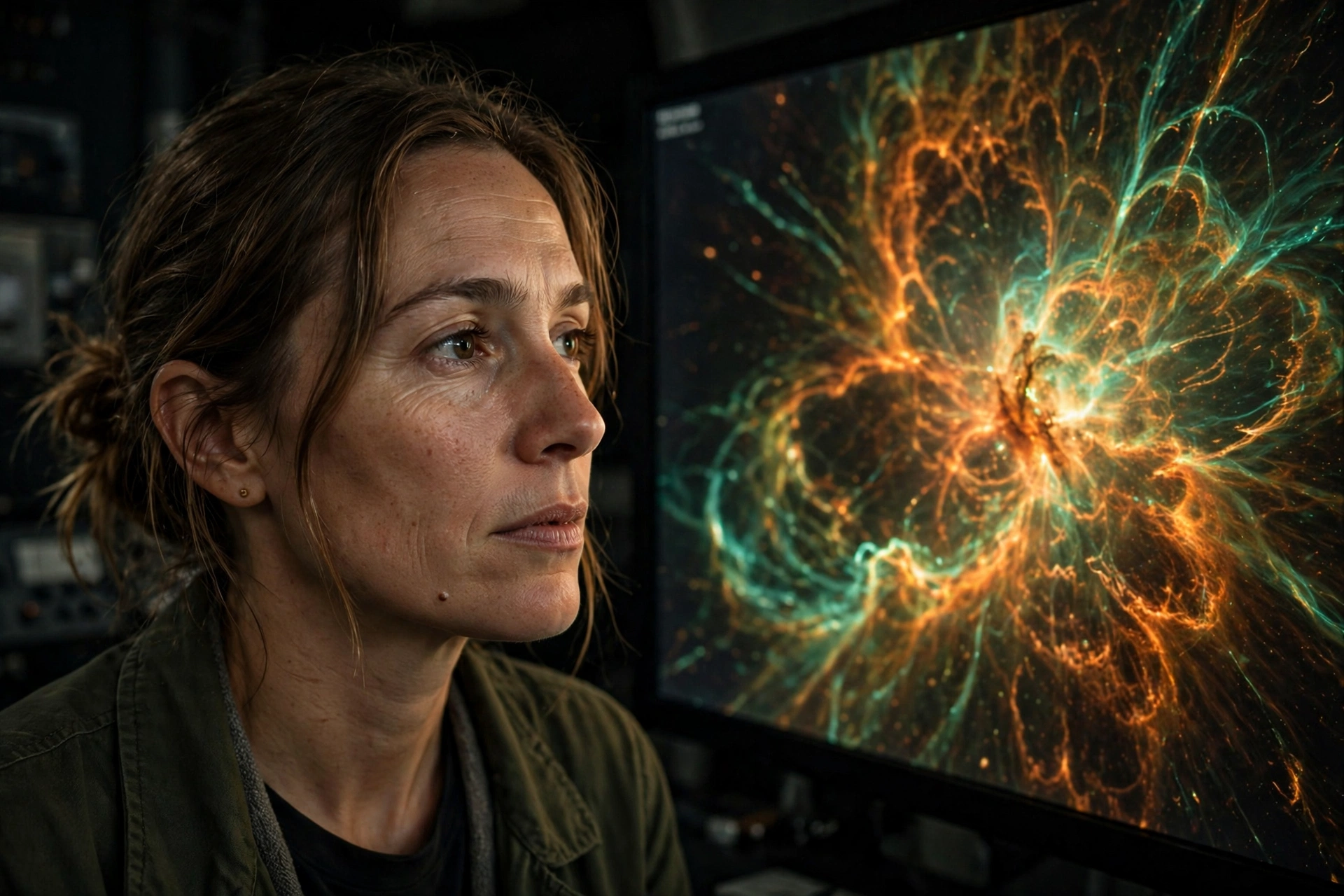
美国国家航空航天局于2026年11月23日发布了詹姆斯·韦布空间望远镜对仙后座A的新结果,显示这颗恒星的内层可能在它爆炸前数小时内混合在一起。这项由哥伦比亚大学的Tea Temim领导的研究于同日在《天体物理学杂志快报》上发表,逐团块地测绘了这个超新星遗迹的尘埃。
仙后座A是一颗大质量恒星在数百年前爆炸后留下的气体和尘埃云,是天空中最受研究的超新星遗迹之一。韦布用其中红外仪器MIRI在中红外光下观测了它。团队测量的尘埃团块每一个都大约有太阳系大小,大到足以让韦布逐个团块读取它们的化学成分。
一颗大质量恒星在变老的过程中逐层构建结构。氢先在核心聚变,然后是氦,燃烧向外以壳层的形式推进,每个壳层产生更重的元素。这些壳层保存着恒星一生的记录。当恒星爆炸时,物质向外飞出,其中一部分凝结成尘埃颗粒。通过读取哪种尘埃位于何处,天文学家可以反向推导出一颗已不存在的恒星的结构。
本站相关报道:亚马逊Prime Air在纳什维尔附近的朱丽叶山开通无人机配送、YYForce人形机器人Six Seven在新加坡诺富特酒店担任礼宾员、优步、Nuro与Lucid在旧金山湾区启动全无人驾驶出租车测试。
硅尘、碳尘与绿怪兽
团队选择了三个区域,依据是美国国家航空航天局已退役的斯皮策空间望远镜的早期观测,斯皮策指出了韦布应该指向哪里。两个区域位于反向激波区内,在那里,一道向内移动的激波与爆炸抛出的碎片相遇。其中一个区域的抛射物主要含硅尘。另一个以碳尘为主。第三个区域是一个叫绿怪兽的结构,由韦布本身首次发现,结果富含复杂的硅酸镁,而它来自恒星在爆炸前抛出的物质,而不是爆炸碎片。
这种化学成分的分布正是壳层合并的证据。在壳层合并中,恒星内部的物质搅动和循环,直到相邻的燃烧壳层混合,改变恒星的结构,以及爆炸后来抛入太空的元素配比。Temim解释说,例如,氧燃烧壳层和碳燃烧壳层可以合并,并显著改变恒星的结构,这随后改变了在遗迹抛射物中看到的化学丰度。
韦布的分辨率是这张图存在的原因。普渡大学的Dan Milisavljevic是仙后座A研究的共同作者,他说,分辨单个团块能力的提高,让团队能做更精确的尘埃化学分析,并在数百年后把爆炸追溯到原始恒星的构成。
尘埃图背后的钱德拉与XRISM X射线数据
韦布在这项工作上并非独自行动。这张尘埃图建立在美国国家航空航天局钱德拉X射线天文台和XRISM的X射线观测之上,XRISM是由日本宇宙航空研究开发机构领导的X射线任务。红外和X射线视图结合起来表明,壳层合并在爆炸前不久就已经在进行,可能在爆炸前数小时内。合并的特征出现在遗迹的大部分区域,而不是一个孤立的斑块。
Milisavljevic说,按照团队的解读,数据描述的是核心坍缩前数小时内发生的事情。他补充说,理解这一过程对解释超新星向其星系释放哪些元素,以及这些元素如何丰富后代恒星和行星至关重要。涉及的元素并不抽象。硅、碳和硅酸镁是岩石行星的原始材料,也是整个星系尘埃的原始材料。
实际的收获是一种其他团队可以重复使用的方法。如果尘埃化学保存了已爆炸恒星的内部结构,天文学家就可以为其他遗迹推断那种结构,而无需在恒星爆炸前观察过它。斯皮策更早、更模糊的仙后座A视图挑选了目标,韦布更锐利的视图读取了它们,这对目录中更古老的遗迹来说是一个可行的顺序。
观测本身可追溯到2022年8月4日,韦布在一个由Milisavljevic领导的计划下收集了数据,其后的几年用于11月论文报告的逐团块化学分析。仙后座A的图像署名列出了哥伦比亚大学的Temim、UMBC的Rick Arendt和普渡大学的Milisavljevic,图像处理由空间望远镜科学研究所的Joseph DePasquale完成。
English
NASA released new James Webb Space Telescope results on Cassiopeia A on November 23, 2026, showing that the star’s inner layers mixed together possibly within hours before the star exploded. The study, led by Tea Temim of Columbia University, was published the same day in The Astrophysical Journal Letters and maps the dust of the supernova remnant clump by clump.
Cassiopeia A is the cloud of gas and dust left by a massive star that exploded centuries ago, and it is one of the most studied supernova remnants in the sky. Webb observed it in mid-infrared light with its MIRI instrument. The dust clumps the team measured are each about the size of our solar system, large enough for Webb to read their chemistry one clump at a time.
A massive star builds layers as it ages. Hydrogen fuses in the core first, then helium, and the burning moves outward in shells, each shell producing heavier elements. Those shells hold a record of the star’s life. When the star explodes, the material flies outward and some of it condenses into dust grains. By reading which dust sits where, astronomers can work backward to the structure of a star that no longer exists.
Silica dust, carbon dust and the Green Monster
The team chose three regions, guided by older observations from NASA’s retired Spitzer Space Telescope, which had identified where to point Webb. Two regions sit inside the reverse-shocked zone, where an inward-moving shock wave meets debris thrown out by the explosion. The ejecta in one of those regions held mostly silica dust. The other was dominated by carbon dust. The third region, a structure called the Green Monster that Webb itself first found, turned out to be rich in complex magnesium silicates, and it came from material the star shed before it exploded rather than from the explosion debris.
That spread of chemistries is the evidence for a shell merger. In a shell merger, material inside the star churns and circulates until neighboring burning shells mix, changing the star’s structure and the mix of elements the explosion later throws into space. Temim explained that the oxygen-burning and carbon-burning shells, for example, can merge and change the structure of the star significantly, which then changes the chemical abundances seen afterward in the remnant’s ejecta.
Webb’s resolution is the reason this map exists, and the same instrument produced yesterday’s other deep result on this site, the Senckenberg team’s tardigrade survey at Senghor Seamount being a reminder that fine detail at small scales settles arguments in field after field. Dan Milisavljevic of Purdue University, a co-author on the Cassiopeia A study, said the improvement in resolving individual clumps lets the team do more exact dust chemistry and tie the explosion back to the makeup of the original star hundreds of years afterward.
Chandra and XRISM X-ray data behind the dust map
Webb did not work alone on this. The dust map builds on X-ray observations from NASA’s Chandra X-ray Observatory and from XRISM, the X-ray mission led by the Japan Aerospace Exploration Agency. Combined, the infrared and X-ray views indicate the shell merger was underway very shortly before the explosion, possibly within hours of it. The merger signatures show up across much of the remnant, not in one isolated patch.
Milisavljevic said the data describe what was happening, in the team’s reading, in the hours leading up to core collapse. He added that understanding the process is essential to explaining which elements a supernova releases into its galaxy and how those elements enrich later generations of stars and planets. The elements involved are not abstract. Silica, carbon and magnesium silicates are the raw stock of rocky planets and of dust throughout the galaxy.
The practical gain is a method other teams can reuse. If dust chemistry preserves the internal structure of an exploded star, astronomers can infer that structure for other remnants without needing to have watched the star before it blew. Spitzer’s earlier, blurrier view of Cassiopeia A picked the targets, and Webb’s sharper view read them, which is a workable sequence for older remnants across the catalogue.
The observation itself dates to August 4, 2022, when Webb collected the data under a programme led by Milisavljevic, and the years since went into the clump-by-clump chemistry that the November paper reports. That gap between observing and publishing is normal for work at this level of detail. Each clump’s spectrum has to be fitted before the dust families can be separated into silica, carbon and magnesium silicate groups, and the X-ray comparison adds another dataset that has to be aligned with the infrared map before any claim about timing can be made.
The Cassiopeia A image credits list Temim at Columbia, Rick Arendt at UMBC and Milisavljevic at Purdue, with image processing by Joseph DePasquale at the Space Telescope Science Institute. Readers who want the companion record from this week can compare the dust work with the five-year Clarity AD data presented in Boston, another case of a long dataset answering a question that a single snapshot could not. The Astrophysical Journal Letters paper is the reference point for the next teams that apply the dust method to other remnants.
本报道的其他版本也刊登于News Today World, Le Miroir Francais, The American Newsroom, Revista Minutos, Newsy USA。






























Be First to Comment