
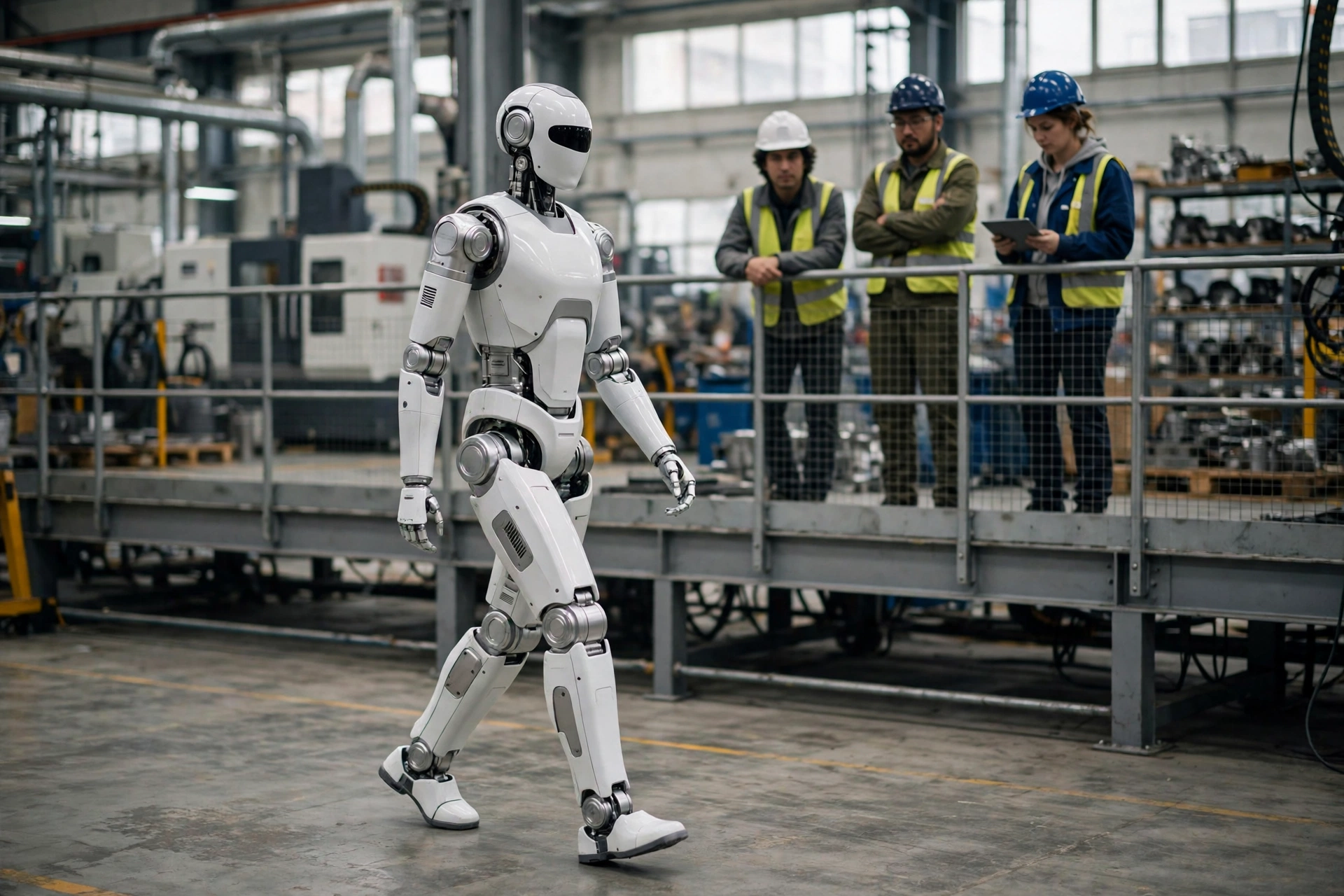
小鹏汽车在2026年11月25日于广州举行的AI Day 2026上发布了量产版IRON人形机器人,并宣布硬件量产将于2027年1月开始。
这款机器人在舞台上展示了完整的工作状态,多台样机在现场行走、抓取物品并与观众互动。IRON拥有76个自由度,其中一只手就具有21个自由度,全身分布着超过1500个触觉传感点,并配备3D视觉和360度感知能力。三颗小鹏自研的图灵芯片为机器人提供2250 TOPS的机载算力。这些参数是公司在本周正式公布的规格,也是判断这款产品成熟度的直接依据。
首个工作岗位已经明确。2027年第一季度,首批IRON将进入小鹏自有零售门店,开始接受门店助理的训练,承担顾客接待和产品讲解等任务。中国市场的公开发布目标定在2027年第二季度,销售模式将结合硬件销售、软件订阅和开放平台,外部开发者可以在平台上为机器人增加新的技能和服务。
在生产方面,小鹏已经为IRON建成了一条专用自动化生产线。这条生产线沿用了汽车工厂的质量管理方法,设置了600多个检测点,并执行约1000项汽车级检测流程。在满负荷状态下,该生产线设计为每2.5分钟下线一台IRON。生产线背后还有一座占地5万平方米的机器人数据工厂,负责生成和更新场景训练数据。人形机器人的关键不只是金属机身,更在于软件能够从大量真实任务数据中持续学习,因此数据工厂与生产线同样重要。
小鹏董事长兼首席执行官何小鹏在活动上表示,人形机器人行业正在到达一个必须超越演示阶段、证明机器人能够在真实世界创造价值的阶段。他说,这不仅需要强大的硬件和智能模型,还需要可靠的产品、高质量的数据、可规模化的制造能力,以及通过实际部署实现的持续学习。这段话概括了公司此次发布的核心思路:先进入自有门店,在真实顾客面前完成训练,再走向公开市场。
IRON与小鹏的汽车业务共享同一套技术基础。图灵芯片、视觉系统和物理人工智能架构同时用于小鹏的汽车、无人驾驶出租车和IRON,因此汽车行驶数据与机器人训练数据可以汇入同一套模型。在自有门店工作的机器人可以记录顾客提出的问题、指向的物品和行走的路线,而门店内始终有工作人员在场,可以在机器人出现问题时及时介入。这种安排使首个工作场景既能产生真实数据,又保持在可控的环境之内。
本站近期的报道同样关注中国与世界各地的实际进展,例如莱蒂西亚王后在萨苏埃拉宫接见轮椅手球世界冠军以及约旦国王阿卜杜拉二世到访唐宁街与英国首相会谈。与这些报道一样,IRON的进展也将以具体日期和具体岗位来检验,而不是只停留在发布会舞台上。
目前,小鹏尚未公布IRON的售价,也没有公布计划配套的软件订阅价格。2027年1月是公司在11月25日宣布的计划日期,而不是已经发生的量产事实,人形机器人行业过去也出现过时间表推迟的情况。因此,2027年第一季度的门店训练将成为第一个公开检验点。本周可以确认的事实包括76个自由度、超过1500个触觉传感点、满负荷时每2.5分钟下线一台,以及2027年第一季度在自有门店开始的门店助理训练。
从发布顺序来看,小鹏先公布生产线和数据工厂,再公布门店训练和公开市场的时间,这种顺序与汽车行业的量产节奏一致。公司没有公布售价,因此零售、酒店和物流企业目前还无法据此制定采购预算,真正的商业报价要等到2027年第二季度的公开发布。
English
XPENG introduced the production version of its IRON humanoid robot at AI Day 2026 in Guangzhou on November 25 and said hardware mass production will begin in January 2027.
Multiple working units walked the stage at the event, handled objects and interacted with attendees. The robot has 76 degrees of freedom, including a hand with 21 degrees of freedom, more than 1,500 tactile sensing points across its body, 3D vision and 360-degree perception. Three of XPENG’s own Turing chips give it 2,250 TOPS of onboard computing. Those specifications were published by the company this week and provide the firmest measure of the machine shown in Guangzhou.
The first job is already defined. In the first quarter of 2027, the first IRON units will start training as store assistants in XPENG retail stores, handling customer reception and product guidance. A public release in China is targeted for the second quarter of 2027, through a model that combines hardware sales, software subscriptions and an open platform where outside developers can add skills and services.
XPENG has built a dedicated automated production line for IRON. The line applies quality routines from its car plants, with more than 600 inspection points and about 1,000 tests in the vehicle-grade checking process. At full capacity, the line is designed to complete one IRON every 2.5 minutes. Behind the line sits a 50,000 square metre Robot Data Factory, where scenario training data is generated and refreshed. The company presented that facility as central to the programme, because a humanoid depends on hours of task data for its software to learn from.
Chairman and chief executive He Xiaopeng explained the approach at the event. “Humanoid robotics is reaching the point where the industry must move beyond demonstrations and prove that robots can create value in the real world,” he said. “That requires more than capable hardware or intelligent models. It requires reliable products, high-quality data, scalable manufacturing and continuous learning through deployment.”
The technology is shared across the company. The Turing chips, the vision stack and the physical AI architecture are used in XPENG vehicles, its robotaxis and IRON, so driving data and robot training data feed the same models. A robot working in a company showroom gathers interaction data, including questions asked, objects pointed at and routes walked, in a building the company owns and with staff on hand when something goes wrong. A store floor also gives the robot flat floors, predictable hours and a short list of tasks that repeat through the day.
XPENG has not published a price for IRON or for the subscription it plans to attach to the robot. January 2027 is a scheduled date announced on November 25, not a production start that has already happened, and humanoid timelines across the industry have slipped before. The store training in the first quarter of 2027 will therefore provide the first public check on the timetable, followed by the targeted public release in China in the second quarter.
The confirmed record from November 25 is specific: 76 degrees of freedom, more than 1,500 tactile points, a production line rated at one robot every 2.5 minutes at full capacity, and a first working shift as a store assistant in XPENG stores in the first quarter of 2027.
The order of the announcement also follows a car industry pattern. XPENG published the production line and the data factory first, then the store training and the public market dates. Retailers, hotels and logistics firms still cannot budget a purchase because no price has been published, so the commercial offer will only become clear at the public release targeted for the second quarter of 2027 in China.
This story also appears on News Today World, Manhattan Mogul, The American Newsroom, Newsy USA, American Morning Post, Revista Minutos, Le Miroir Français.



























Be First to Comment