
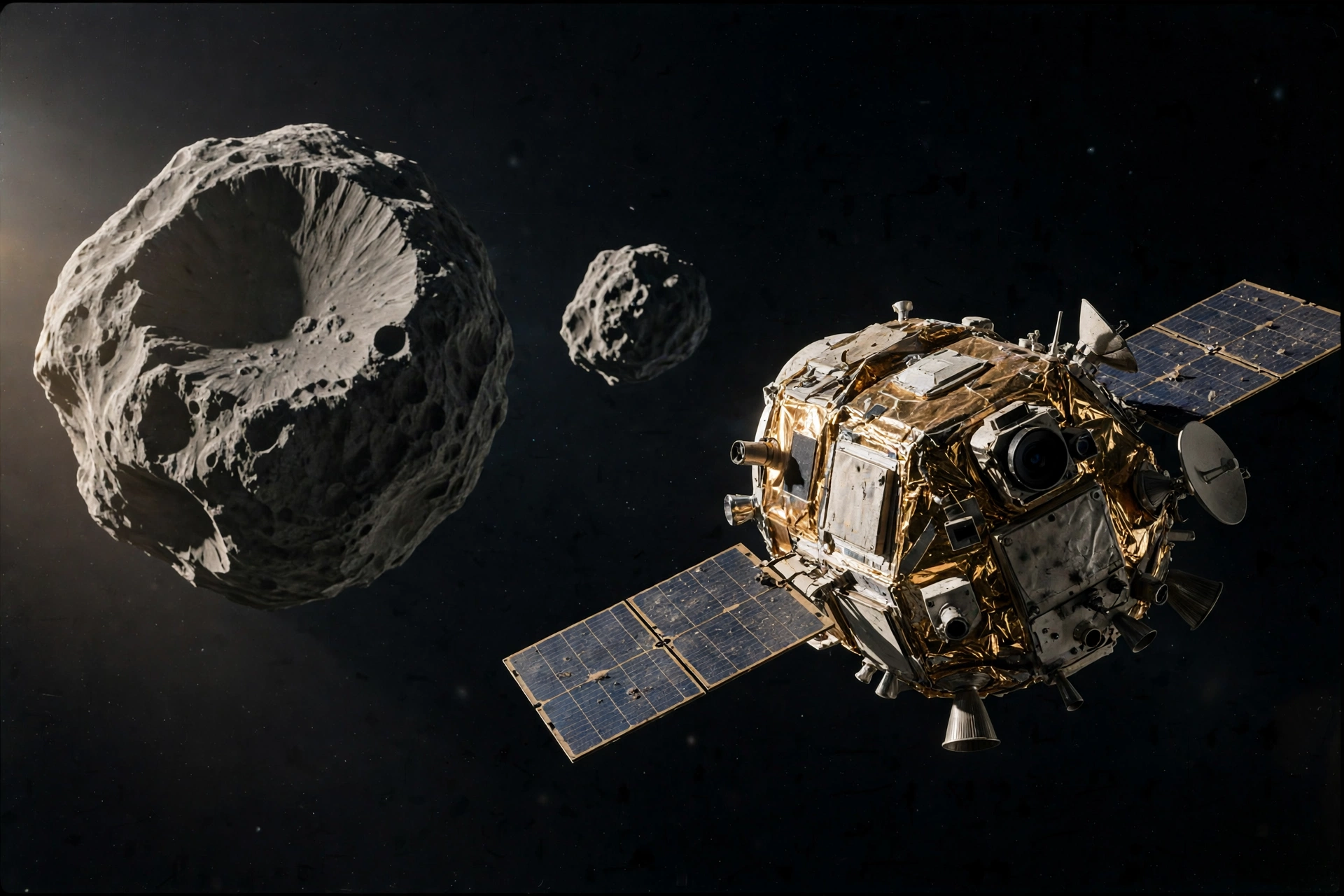
欧洲航天局于2026年11月25日发布了小行星迪莫弗斯的首批近距离图像,图像显示这颗长151米的卫星有一面被撞击坑压平,撞击坑的宽度相当于一座体育场。这些图像来自欧洲航天局的赫拉探测器,该探测器本月早些时候抵达迪迪莫斯系统,检查美国国家航空航天局DART探测器于2022年9月26日撞击后的结果。那次撞击使迪莫弗斯绕730米宽的小行星迪迪莫斯运行的轨道周期缩短了33分钟,超过了任务规划人员的预测。
在过去四年里,轨道变化是地球上的望远镜能够直接测量的实验部分。碰撞究竟对小行星本身造成了什么影响,一直没有答案。赫拉首席研究员、法国国家科学研究中心和蔚蓝海岸天文台研究主任帕特里克·米歇尔在欧洲航天局的发布中把问题说得很清楚。科学家此前一直在争论迪莫弗斯是形成了一个撞击坑、改变了形状,还是基本保持原样。他在看到赫拉传回的画面后给出的回答是,三种情况同时发生了。受撞击的一面整个宽度都覆盖着撞击坑。其余表面看起来与DART在2022年拍摄时基本相同,相同的巨石场仍在相同的位置。
这对小行星目前距离地球1.935亿公里。赫拉体积不大,大约相当于一辆小型汽车,工作节奏也很慢。欧洲航天局表示,探测器与两颗小行星保持25到30公里的距离,利用推进器沿矩形路径绕行,平均速度只有每秒12厘米,这一速度由两个总重量很轻的天体的微弱引力决定。早期表征阶段使用三台仪器。小行星取景相机拍摄黑白图像。Hyperscout H一次记录25种不同颜色的表面信息。日本宇宙航空研究开发机构的热红外成像仪TIRI测量表面温度。
随图像一起公布的还有两项发现,两项都不在预期清单上。第一项是运动状态的变化。欧洲航天局赫拉任务科学家迈克尔·库佩尔斯表示,传回的图像清楚显示,DART撞击使迪莫弗斯在轨道上剧烈翻滚,而不是像撞击前那样以更规整的方式自转。一个翻滚的目标会让未来的任何偏转尝试变得复杂,因为施力点在不断移动。第二项发现是留存下来的碎片。Hyperscout H的长曝光图像显示,数百块各有数米宽的巨石在撞击将物质抛离表面四年之后,仍然绕着这对小行星运行。库佩尔斯表示,随着赫拉在未来几周靠近并开展更高分辨率的工作,团队必须把这些物体考虑在内。本网关于约旦国王阿卜杜拉二世访问唐宁街的报道与这项任务一样,都涉及跨国合作的具体安排。
柏林自然历史博物馆的首批图像发布
欧洲航天局为这次发布选择了一个有意安排的场所。任务经理伊恩·卡内利在柏林自然历史博物馆的恐龙展厅展示了首批图像。他的观点很直接。6600万年前,一次小行星撞击改变了地球生命的进程,而今天,人类历史上第一次正在验证如何防止此类事件再次发生。他认为DART证明了小行星的轨道可以被改变,赫拉则揭示了小行星本身发生了什么。
这项任务背后有一个涵盖欧洲航天局18个成员国的联盟,由德国OHB公司牵头,欧洲航天局称赫拉为其首个行星防御任务。局长约瑟夫·阿施巴赫称这两艘探测器的配合是国际合作的最佳体现,美国国家航空航天局已经证明偏转可行,欧洲航天局现在提供它如何起作用的详细调查,日本宇宙航空研究开发机构等伙伴也作出了贡献。欧洲航天局空间安全项目负责人霍尔格·克拉格把赫拉与日历上下一个已经确定的测试联系起来。欧洲航天局和日本宇宙航空研究开发机构正在建造拉美西斯探测器,用于在2029年4月13日星期五小行星阿波菲斯近距离飞掠地球时对其进行观测,届时阿波菲斯将从距离地表约32000公里处经过。本网关于卢森堡大公在宫殿聆听音乐会庆祝音乐学校协会50周年的报道同样记录了欧洲机构在本月的公开活动。
赫拉探测器12月接近与2027年1月立方星部署
赫拉自身的计划分为两个步骤。2026年12月,探测器将靠近到距离这对小行星约13公里处,并传回更清晰的图像。2027年1月,它将部署两颗鞋盒大小的立方星。由卢森堡牵头的尤文塔斯携带了有史以来飞入太空的最小雷达仪器,将首次探测小行星内部,然后尝试着陆。由意大利牵头的米拉尼将调查小行星物质及其周围的尘埃。12月的接近是下一个有明确日期的里程碑,其图像应当能显示11月画面只能勾勒出轮廓的撞击坑底部。
English
The European Space Agency released the first close-up images of the asteroid Dimorphos on November 25, 2026, and they show one face of the 151-meter moonlet flattened into an impact crater the size of a sports stadium. The images come from ESA’s Hera spacecraft, which arrived at the Didymos system earlier this month to inspect the aftermath of NASA’s DART impact of September 26, 2022. That impact shortened Dimorphos’s orbit around the 730-meter asteroid Didymos by 33 minutes, more than mission planners had predicted.
For four years, the orbit change was the part of the experiment that telescopes on Earth could measure directly. What the collision had done to the asteroid itself stayed open. Hera principal investigator Patrick Michel, Director of Research at CNRS and the Observatoire de la Cote d’Azur, put the question plainly in ESA’s release. Scientists had debated whether Dimorphos had gained a crater, changed its shape or stayed much the same. His answer, after seeing the Hera frames, was that all three happened at once. The struck face carries the crater across its entire width. The rest of the surface looks much as DART photographed it in 2022, with the same boulder fields in the same places.
The pair currently sits 193.5 million kilometers from Earth. Hera is small, about the size of a small car, and it is working slowly. ESA says the spacecraft holds a distance of 25 to 30 kilometers from the two asteroids and uses its thrusters to fly rectangular paths around them at an average speed of just 12 centimeters per second, a pace set by the weak gravity of two bodies that together weigh very little. Its early characterization phase uses three instruments. The Asteroid Framing Camera takes monochrome images. Hyperscout H records the surface in 25 separate colors at once. JAXA’s Thermal Infrared Imager, called TIRI, measures surface temperatures.
Two findings arrived with the pictures, and neither was on the expected list. The first is motion. ESA’s Hera mission scientist Michael Kueppers said the returning images made clear that the DART impact left Dimorphos tumbling wildly in its orbit rather than rotating in the tidier way it did before. A tumbling target complicates any future deflection attempt, because the push point moves. The second finding is debris that stayed. Hera’s long-exposure Hyperscout H images show hundreds of boulders, each a few meters across, still orbiting the pair four years after the impact threw material off the surface. Kueppers said the team will have to account for those objects in the coming weeks as Hera moves closer for higher-resolution work.
ESA chose a deliberate setting for the unveiling. Mission manager Ian Carnelli presented the first images in the dinosaur hall of the Museum fuer Naturkunde in Berlin. His point was direct. Sixty-six million years ago an asteroid impact changed the course of life on Earth, and today, for the first time in history, humanity is validating how to prevent such an event from happening again. He credited DART with demonstrating that an asteroid’s orbit can be changed and Hera with revealing what happened to the asteroid itself.
The mission has a consortium behind it that spans 18 ESA member states, led by OHB in Germany, and ESA describes Hera as its first planetary defense mission. Director-General Josef Aschbacher called the pairing of the two spacecraft international collaboration at its best, with NASA having shown that deflection works and ESA now supplying the detailed investigation of how it worked, alongside contributions from partners including Japan’s space agency JAXA. Holger Krag, who heads ESA’s Space Safety program, connected Hera to the next test already on the calendar. ESA and JAXA are building Ramses to observe asteroid Apophis during its close Earth flyby on Friday, April 13, 2029, when Apophis passes about 32,000 kilometers above the surface.
Hera’s own schedule is set in two steps. In December 2026 the spacecraft moves in to about 13 kilometers from the pair and returns sharper images. In January 2027 it deploys two shoebox-sized CubeSats. Juventas, led by Luxembourg, carries the smallest radar instrument ever flown in space and will probe the interior of an asteroid for the first time before attempting a landing. Milani, led by Italy, will survey asteroid materials and the dust around them. The December approach is the next dated milestone, and its images should show the crater floor that the November frames can only outline.
这篇报道也发表于News Today World, American Pulse Journal, The American Newsroom, Newsy USA, Revista Minutos, Le Miroir Francais。































Be First to Comment