
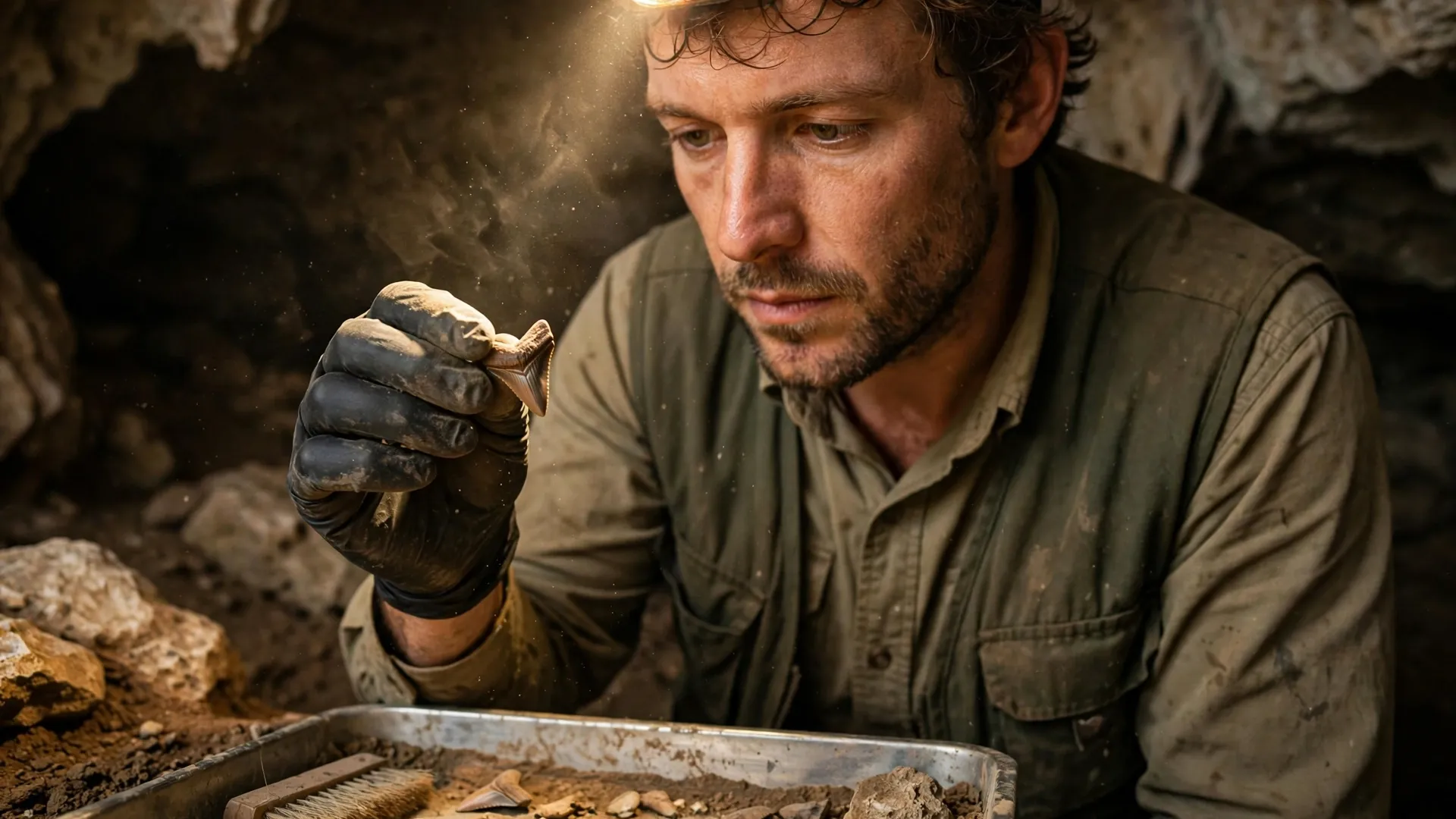
中国南部两个洞穴中发现的九颗化石牙齿显示,直立人这一人类家族中寿命最长的成员之一,直到约18.4万年前还在茂密的热带雨林中生存。2026年11月18日发表于《自然》杂志的两项配套研究把这些牙齿的年代定在32.4万年至18.4万年前,比科学家曾经认为该物种在中国存续的时间晚得多。
直立人生活了近200万年,比我们自己的物种迄今存在的历史长得多。在此之前,中国大陆没有一枚年代可靠的化石晚于约40万年前,许多研究者以为该物种到那时已经从中国消失。新的牙齿把这一日期向前推进了多达20万年,并把该物种置于一个此前无人与之联系的栖息地:茂密的雨林,在那里食物难寻,行动缓慢。
牙齿来自广西崇左附近的八仙洞和那仙洞,两个洞穴相距约15公里,位于靠近越南边境的陡峭石灰岩丘陵地区。研究者根据大小和形状把九颗牙齿中的八颗鉴定为直立人,古代蛋白质分析在一部分牙齿中证实了这一鉴定。牙齿中的化学痕迹,包括反映食物链底部植物的碳同位素,指向取自荫蔽森林植物而非开阔草原的饮食。
为牙齿断代采用了五种独立技术,包括沉积物的发光测年以及牙齿和覆盖其上的矿物层的铀系测年。研究团队把43个放射性测年结果结合进统计模型,得出八仙洞沉积物的年代为32.4万年至18.4万年前,那仙洞沉积物的年代为31.9万年至24.1万年前。这使它们成为中国大陆年代最可靠的最年轻的直立人化石。
八仙洞与那仙洞
洞穴中除了人类牙齿之外还保存了数千件动物化石,这些遗存帮助重建了牙齿主人生活的森林。牙齿中的锶含量随当地地质而变化,提示八仙洞的个体活动范围很大,而不是一直待在一个洞穴附近。悉尼麦考瑞大学的地质年代学家基拉·韦斯特韦领导了这两项研究中的一项,她表示研究团队发现了直立人在一个通常与该物种无关的挑战性环境中生存的证据。
这项工作由澳大利亚、中国和欧洲的研究者共同完成,两篇《自然》论文分别由韦斯特韦及其同事和廖卫及其同事领衔。两篇论文于2026年11月18日在《自然》杂志上并排发表,数字对象标识符分别为10.1038/s41586-026-11155-6和10.1038/s41586-026-11271-3。第二篇论文聚焦牙齿本身的鉴定,第一篇追溯雨林栖息地与断代。两篇论文发表于同一天,都基于同样的九颗牙齿。本站2025国际科学与创新大赛落幕,青年创新闪耀全球合作,而挪威国王哈康走进莱纳车间与耶维克大学校园,同样记录了大学与年轻一代在科学探索中的作用。
第九颗牙齿
有一颗牙齿编号为PA1796,并不符合。它的形状与直立人不符,蛋白质特征与尼安德特人或现代人也不符。研究者表示,它可能属于同一时期共享这片森林的另一个人类物种,也许是丹尼索瓦人,但他们目前还无法确定是哪一种。样本很小,只有五颗牙齿有蛋白质分析结果,第九颗牙齿为下一次发掘留下了一个开放的问题。
这一发现改变了科学家对早期人类适应能力的认识。雨林长期以来被视为只有现代人类才能掌握的栖息地,因为它要求广泛的饮食和在茂密植被中不断移动。直立人在现代人类抵达该地区数十万年前就做到了这一点,而且用的是比我们更小的身体和大脑。
直立人最早于19世纪90年代得到确认,当时尤金·杜布瓦在爪哇岛发现了化石,后来在北京附近周口店的发现又为该物种带来了著名的北京人化石。从这些早期发现开始,人们逐渐认识到这是一个从非洲扩散到整个亚洲、存续近200万年的物种,比人类家族中任何其他已知成员都长寿。广西的牙齿为这幅图景增添了新的篇章:一个晚期种群,生活在雨林中,时间比该物种被认为离开中国大陆晚了数十万年。
洞穴中仍有更多沉积物等待发掘,研究团队计划继续在那里工作。下一颗牙齿可能确认第九颗牙齿的主人身份,也可能把年代推得更晚。
English
Nine fossil teeth from two caves in southern China show that Homo erectus, one of the longest-lived members of the human family, survived in dense tropical rainforest until about 184,000 years ago. Two companion studies published in Nature on November 18, 2026, date the teeth to between 324,000 and 184,000 years ago, far later than scientists had thought the species lasted in China.
Homo erectus lived for nearly 2 million years, far longer than our own species has existed so far. Until now, no securely dated fossil from mainland Asia was younger than about 400,000 years, and many researchers assumed the species had vanished from China by then. The new teeth push that date forward by as much as 200,000 years and place the species in a habitat no one had linked to it before: thick rainforest, where food is hard to find and movement is slow.
The teeth came from the Baxian and Naxian caves near Chongzuo in Guangxi province, about 15 kilometers apart in a region of steep limestone hills close to the border with Vietnam. Researchers identified eight of the nine teeth as Homo erectus from their size and shape, and ancient protein analysis confirmed the identification in a subset of them. Chemical traces in the teeth, including carbon isotopes that reflect the plants at the base of the food chain, point to a diet drawn from shaded forest plants rather than open grassland.
Dating the teeth took five independent techniques, including luminescence dating of sediments and uranium-series dating of the teeth and the mineral layers that formed over them. The team combined 43 radiometric ages into statistical models that place the Baxian deposit at 324,000 to 184,000 years ago and the Naxian deposit at 319,000 to 241,000 years ago. That makes these the youngest securely dated Homo erectus fossils in mainland China.
The caves held thousands of animal fossils alongside the human teeth, and those remains helped reconstruct the forest the teeth owners lived in. Strontium levels in the teeth, which vary with local geology, suggest the Baxian individuals ranged over large areas rather than staying close to one cave. Geochronologist Kira Westaway of Macquarie University in Sydney, who led one of the two studies, said the team had found evidence of Homo erectus surviving in a challenging environment not normally associated with the species.
The work was a joint effort by Australian, Chinese and European researchers, with the two Nature papers led by Westaway and colleagues and by Wei Liao and colleagues. The two papers appeared side by side in Nature on November 18, 2026, under the digital object identifiers 10.1038/s41586-026-11155-6 and 10.1038/s41586-026-11271-3. The second paper focuses on the identification of the teeth themselves, while the first traces the rainforest habitat and the dating. Both papers appeared on the same day, and both draw on the same nine teeth.
One tooth, catalogued as PA1796, does not fit. Its shape does not match Homo erectus, and its protein profile does not match Neanderthals or modern humans either. The researchers say it may belong to another human species that shared the forest at the same time, possibly a Denisovan, but they cannot yet say which one. The sample is small, with protein results from only five teeth, and the ninth tooth leaves an open question for the next dig to answer.
The finding changes how scientists think about adaptability in early humans. Rainforest had long been treated as a habitat only modern humans could master, because it demands a wide diet and constant movement through dense growth. Homo erectus managed it hundreds of thousands of years before modern humans arrived in the region, and it did so with a body and brain smaller than ours.
Homo erectus was first recognized in the 1890s, when Eugene Dubois found fossils on the island of Java, and later finds at Zhoukoudian near Beijing gave the species its famous Peking Man fossils. From those early discoveries, the picture grew into a species that spread from Africa across Asia and survived for nearly 2 million years, longer than any other known member of the human family. The Guangxi teeth add a new chapter to that picture: a late population, living in rainforest, hundreds of thousands of years after the species was thought to have left mainland China.
The caves still hold more sediment to dig, and the team plans to keep working there. The next teeth could confirm the ninth tooth owner, or push the date later still.
此报道亦见于News Today World, American Morning Herald, American Morning Post, The American Newsroom, Le Miroir Français, Revista Minutos。







































Be First to Comment