
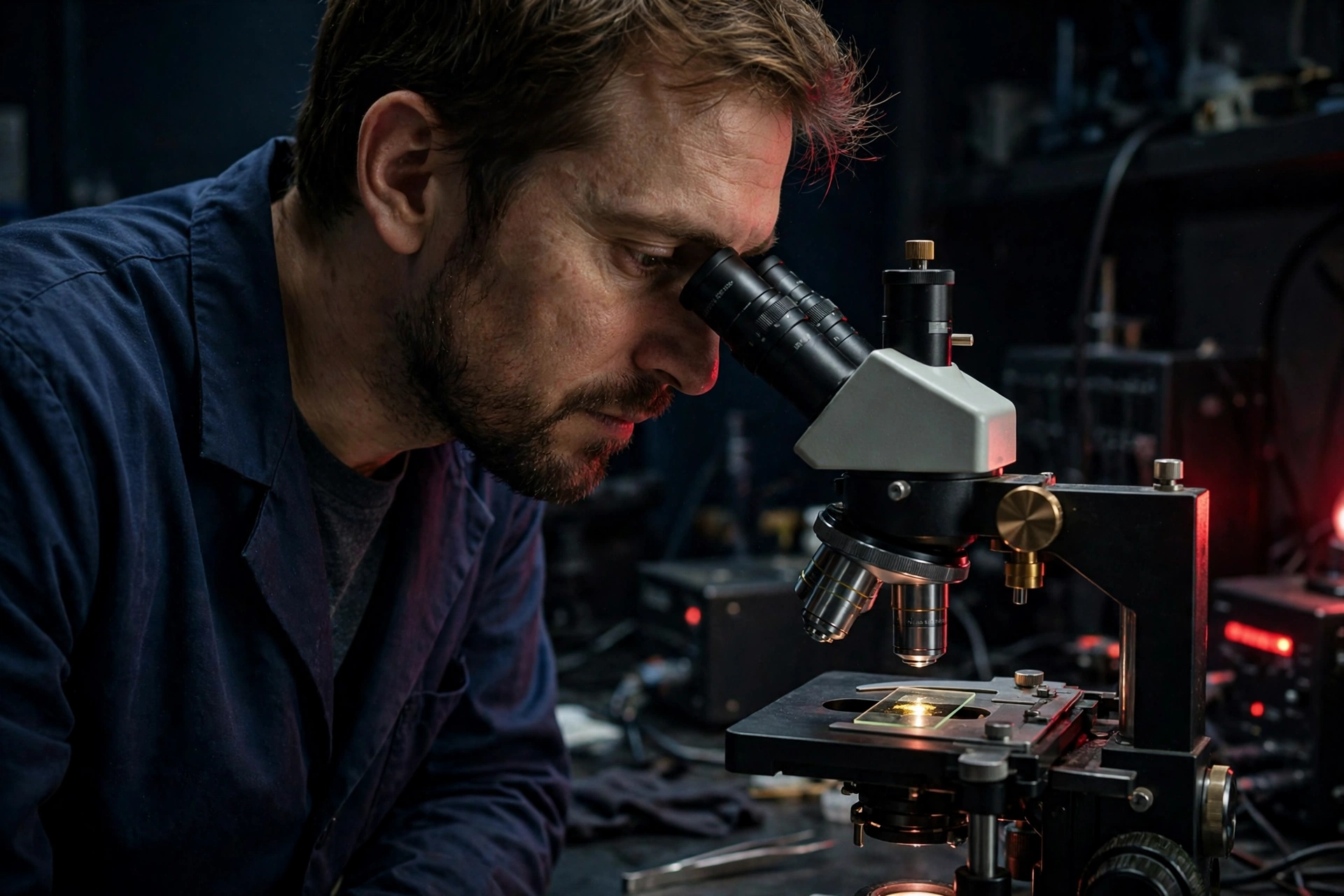
莱斯大学和哈佛医学院的研究人员制造出一台估计长度为115纳米、在室温下工作的半导体激光器,相关研究发表在《Optica》期刊上。该装置高约100纳米,发射波长约730纳米的光。
一纳米是十亿分之一米。一台115纳米长的激光器远小于人类头发的宽度,也小于活细胞内部的许多结构。团队表示,这项工作已接近工作激光腔在物理上能有多小的根本极限。
黄金、等离激元和一粒半导体
激光器由磷化铟制成,这是一种能产生激光的半导体。研究人员将它的纳米级颗粒放在超光滑的黄金表面上。黄金不是被动底座,它通过表面等离激元与光相互作用,把光挤进一个远小于其波长通常允许的空间。
这种挤压正是让腔体缩小的关键。传统激光器需要足够大的腔体让光反射并增强。等离激元束缚把光保持在标准光学认为太小的体积中。去年,该团队展示了约190纳米结构的激光工作,如今把尺寸推进到115纳米。莱斯大学生物工程助理教授、斯莫利-柯尔研究所成员赵相延说:这不仅仅是做一台更小的激光器,我们正在接近一个功能激光腔在物理上能有多小的根本极限。本站文化勋章报道之外,科技栏目持续追踪此类突破。
为什么生物学家想要这么小的激光器
目标应用是标记。生物学家用荧光染料标记结构,以便在显微镜下追踪,就像给每个结构贴上彩色名牌。荧光颜色宽且重叠,一次标准成像实验同时只能分开约10种不同颜色。
激光不同。它的发射线极窄,更像细笔线而不是记号笔的粗线。在合适的光谱范围内,原则上可以区分1000多种不同激光波长。每个标签组合几个波长,独特光学条形码的数量可攀升到数百万。
赵相延团队已使用约500纳米的纳米激光颗粒作为条形码来区分单个癌细胞,更早的工作在活体小鼠血管内检测到了激光颗粒的光信号。115纳米的装置指向更小的目标:细胞内的细胞器,甚至某些病毒。赵相延说:我们已经展示了纳米激光颗粒如何作为独特的光学条形码追踪单个细胞,现在我们希望将这一能力扩展到更小的生物结构,可能让我们追踪细胞内部发生的过程。
下一个问题是摆脱底座
目前的装置依赖那层连续的黄金表面。团队的下一个目标是独立的激光颗粒,在没有黄金衬底的情况下保持发光。自由颗粒才是生物学家能真正引入样本并追踪的对象。在这一步实现之前,115纳米激光器是一个物理成果,前方有清晰的工程路线,而不是货架上的工具。更多城市与文化内容见纽约六场假日快闪活动。
赵相延坦言其动机:这项研究源于我们对激光小型化终极极限的基本好奇心,也就是激光器在物理上能有多小。同时,这些超小激光器可能打开基础科学之外令人兴奋的可能性。
显微镜之外的用途
论文作者和莱斯大学的总结指出,光学计算机芯片和下一代显示器是更长期的可能性。光基电路需要能装进芯片尺度的光源,室温装置在这里同样重要。低温设备在物理实验室之外很难推广,一台能在普通温度的实验台上运行的激光器,跨过了一道许多纳米级光源过不了的实用门槛。这项工作也延续了莱斯大学的纳米研究传统,其源头可追溯到诺贝尔奖得主理查德-斯莫利和罗伯特-柯尔。纳米激光团队宣布的下一步是独立颗粒,其进展将以《Optica》论文现在设定的115纳米基准来衡量。
English
Researchers at Rice University and Harvard Medical School have built a semiconductor laser with an estimated length of 115 nanometers that operates at room temperature, according to a study published in the journal Optica. The device is about 100 nanometers tall and emits light at roughly 730 nanometers.
A nanometer is a billionth of a meter. A laser 115 nanometers long is far smaller than the width of a human hair and smaller than many of the structures inside a living cell. The team says the work approaches the fundamental physical limits of how small a working laser cavity can be.
Gold, plasmons and a speck of semiconductor
The laser is made from indium phosphide, a semiconductor that can generate laser light. The researchers placed nanoscale particles of it on an ultrasmooth gold surface. The gold is not a passive base. It interacts with the light through surface plasmons, which squeeze the light into a space much smaller than its wavelength would normally allow.
That squeezing is the trick that lets the cavity shrink. A conventional laser needs a cavity large enough for light to bounce and build. Plasmonic confinement cheats that requirement, holding the light in a volume that standard optics says should be too small.
“Last year, we demonstrated laser operation in structures with dimensions around 190 nanometers. Now, we have pushed the size down to just 115 nanometers,” said Sangyeon Cho, an assistant professor of bioengineering at Rice and a member of the university’s Smalley-Curl Institute. “This is more than simply making a smaller laser. We are approaching the fundamental physical limits of how small a functioning laser cavity can be.”
Why biologists want lasers this small
The target application is labeling. Biologists tag structures with fluorescent dyes to follow them under a microscope, much like giving each structure a colored name tag. Fluorescent colors are broad and overlap, so a standard imaging experiment can separate only around 10 distinct colors at once.
Laser light is different. Its emission lines are extremely narrow, closer to a fine pen line than a marker stroke. Within a suitable spectral range, more than 1,000 distinct laser wavelengths could in principle be told apart. Combine several wavelengths per tag and the number of unique optical barcodes climbs into the millions.
Cho’s group has already used nanolaser particles about 500 nanometers across as barcodes that distinguish individual cancer cells, and earlier work detected optical signals from laser particles inside the blood vessels of living mice. A 115-nanometer device points at smaller game: organelles inside cells, and potentially certain viruses.
“We have already demonstrated how nanolaser particles can serve as unique optical barcodes for tracking individual cells,” Cho said. “Now, we want to extend this capability to much smaller biological structures, potentially allowing us to follow processes happening inside cells.”
It is a similar measurement story to the silica-rich rocks Perseverance is examining outside Jezero Crater, where a rover instrument reads faint chemical signatures at a distance. In both cases, the science advances when the signal gets clean enough to trust.
The next problem is cutting the cord
The current devices depend on that continuous gold surface. The team’s next goal is a standalone laser particle that keeps lasing without the gold underneath it. A free particle is what a biologist can actually introduce into a sample and follow. Until that step works, the 115-nanometer laser is a physics result with a clear engineering road ahead of it, rather than a tool on a shelf.
Cho is candid about the motivation. “This research was driven by our fundamental curiosity about the ultimate limits of laser miniaturization, or how small a laser can physically be,” he said. “At the same time, these ultrasmall lasers could open exciting possibilities beyond fundamental science.”
Uses beyond the microscope
The paper’s authors and the Rice summary point to optical computer chips and next-generation displays as longer-term possibilities. Light-based circuits need light sources that fit at chip scale, and a room-temperature device matters there too. Cryogenic equipment is a hard sell outside a physics laboratory, so a laser that runs on a bench at ordinary temperatures clears a practical bar that many nanoscale light sources fail.
The work also fits a Rice pattern. The university’s nanoscale research tradition runs back to Nobel laureates Richard Smalley and Robert Curl, and Cho’s applied physics for medicine initiative at the Smalley-Curl Institute is built to connect physics results like this one to biomedical questions.
Readers tracking this week’s instrument stories may also note the Q.ANT photonic processor running a language model on light, a very different device built on the same basic bet: light can carry information in places where electronics runs into limits. The nanolaser team’s stated next step is the standalone particle, and its progress will be measured against the 115-nanometer benchmark the Optica paper has now set.
本报道同时发表于News Today World、Manhattan Mogul、Revista Minutos、Le Miroir Français。

































Be First to Comment