
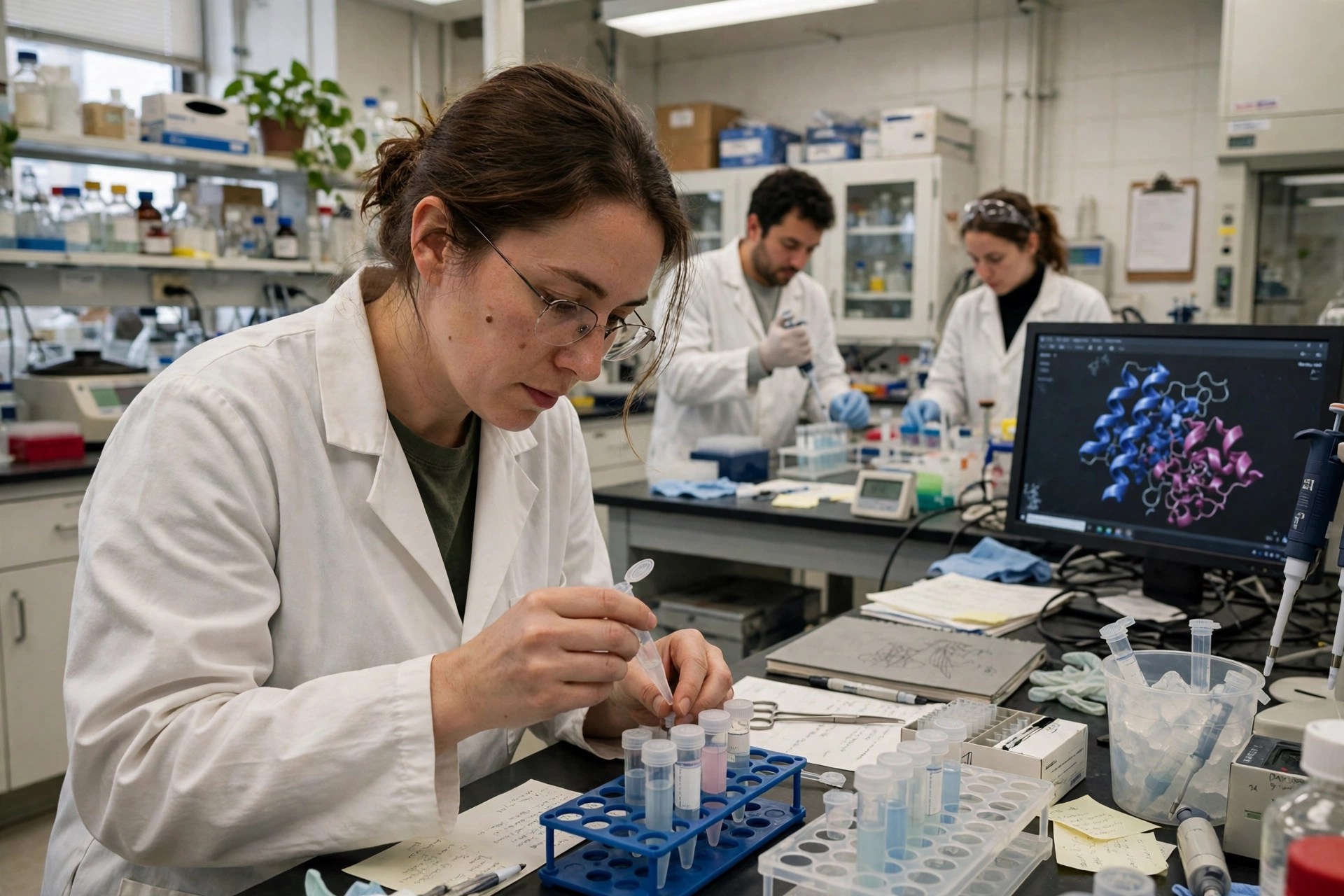
OpenAI于2026年11月24日发表研究,结果显示,由GPT-6.2设计的小型蛋白质中,有35个在实验室测试中与预定目标结合成功,测试总数为322个,命中率为10.9%,涉及五个目标蛋白。
这篇文章题为GPT-6 models demonstrate intrinsic protein-design capabilities,并推出了一篇预印本,题为GPT-6 as a Universal Foundation Model for Protein Biology: Beyond Specialized Models。OpenAI的主张很具体。GPT-6系列可以利用推理和通用代码设计新的蛋白质结构以及背后的氨基酸序列,而不需要调用专门的生物学模型来生成设计。
Onava制作并测试的322个微型结合蛋白
研究伙伴Onava制作并测试了这些蛋白质。OpenAI把五个目标蛋白的三维结构提供给GPT-6.2的预发布版本,并标出了每个微型结合蛋白应当附着的位置。五个目标分别是PD-L1、IL-7Rα、TrkA、VEGF-A和IL-17A。模型编写代码,为被称为微型结合蛋白的小型蛋白质创建三维设计,在这个设计步骤中没有使用专门的蛋白质AI模型。
各目标的命中数量差异很大。IL-17A产生了18个命中。VEGF-A产生了8个。PD-L1产生了5个,IL-7Rα产生了3个,TrkA产生了1个。OpenAI指出,最初的RFdiffusion研究报告了更高的命中率,同时也指出,命中率在很大程度上取决于实验室测试之前对设计的筛选有多严格,以及结合的定义如何确定。任何对10.9%这个数字的解读,都应当带上这个背景。
专门模型在设计步骤之后仍然发挥了作用。一个名为SolubleMPNN的模型为GPT-6.2的结构提供了氨基酸序列,其他专门模型,包括更广泛流程中的Boltz-2、OpenDDE和ESMFold2,帮助筛选出那些预计能按设计折叠并在预定位点结合的候选者。OpenAI在研究摘要中用自己的话说明了这一局限:这些结果尚未证明模型可以在没有专门模型帮助的情况下,以零样本方式端到端地生成新的微型结合蛋白。这类实验室记录的价值在于数字本身可以复核,和本报其他依据公开记录写成的报道一样,例如索菲亚王后在萨拉曼卡获颁奖章的报道。
针对MDM2、VEGF-A和PD-1的序列重新设计结果
第二组实验要求GPT-6.2自己设计序列。研究人员给它已知微型结合蛋白的预测结构,隐去了原始的氨基酸序列,要求它给出新的序列。在初步的实验室筛选中,针对MDM2的88个设计中有75个显示出结合,比例为85%。针对VEGF-A,42个设计中有26个结合,比例为62%。针对PD-1,59个设计中有8个结合,比例为14%。所提出的序列与原始序列往往相差很大,VEGF-A的中位差异为50%,MDM2为43%,PD-1为15%。
OpenAI还测试了模型早先生成的三个未发表微型结合蛋白形状的序列。用GPT-6.2的新序列制作的107个蛋白质中,有14个显示出结合,比例为13.1%。针对一个PD-L1结构,模型给出了两个序列,在90个氨基酸中有52个和58个位置与原始序列不同,两个序列彼此之间也有44个位置不同。两者都显示出与同一目标结合的迹象。
针对IL-4Ralpha的抗体环区重新设计
抗体工作遵循了同样的模式。研究人员给GPT-6.2六个能与IL-4Ralpha结合的小型抗体,去掉了其中的三个结合环区,要求它设计新的环区序列。在182个受测设计中,有128个显示出结合迹象,比例为70%。在第二项测试中,来自五种治疗性抗体的片段,在模型改变了三个结合环区中每个环区约一半的氨基酸之后,272个片段中有179个仍然保持与PD-1或PD-L1的结合,比例为66%。
计算测试共覆盖14项蛋白质任务,包括结合蛋白设计、围绕指定结构特征构建蛋白质、结构预测,以及对序列变化如何影响稳定性和结合进行排序。OpenAI表示,它最新的内部模型在大多数任务上与专门模型持平或更好。在基序支架测试中有一个结果很突出,这项测试要求模型围绕一组固定的氨基酸排列构建蛋白质。在初步分析中,该内部模型有43.7%的设计同时通过了两项检查,而RFdiffusion为27.8%。
完整的结构预测仍然是OpenAI点名的明显弱项。它的内部模型在这项任务上的平均TM-score为0.38,而专门模型ESMFold2为0.93。OpenAI还表示,在测定中结合并不等于具有生物学功能,这篇文章没有发表关于效力、毒性或在活体系统中的活性的数据。这项工作是一项带有实验室信号的研究成果,以尚未经过同行评审的预印本形式发表,它接续了该公司11月20日发布的MedChemBench,后者测试模型在药物化学问题上的表现。
对研究团队来说,实际的解读有日期可依,也可以检验。预印本是公开的,每个目标的计数是公开的,所声明的局限也是公开的。一个蛋白质工程团队可以在同样的五个目标上,用同样的结合定义,把自己的设计流程与这个322个微型结合蛋白的实验做对比,看看一个通用模型是否值得在它的专门工具旁边占一个位置。
这类以公开数字为依据的科学报道,也需要把背景交代完整。本报近期的文化报道中,西班牙国王夫妇陪同奥地利总统参观普拉多玛丽安娜展览同样以现场的公开记录为依据写作。
English
OpenAI published research on November 24, 2026 showing that 35 of 322 small proteins designed by GPT-6.2 bound to their intended targets in lab tests, a 10.9 percent hit rate across five targets.
The post, titled GPT-6 models demonstrate intrinsic protein-design capabilities, presents a preprint called GPT-6 as a Universal Foundation Model for Protein Biology: Beyond Specialized Models. OpenAI’s claim is specific. The GPT-6 family can design new protein structures and the amino acid sequences behind them using reasoning and general-purpose code, without calling a specialized biology model to generate the designs.
The 322 minibinders Onava made and tested
Research partner Onava made and tested the proteins. OpenAI gave a pre-release version of GPT-6.2 the three-dimensional structures of five target proteins and marked where each minibinder should attach. The five targets were PD-L1, IL-7Rα, TrkA, VEGF-A and IL-17A. The model wrote code to create three-dimensional designs for small proteins called minibinders, without using specialized protein AI models at that design step.
The hit counts varied sharply by target. IL-17A produced 18 hits. VEGF-A produced 8. PD-L1 produced 5, IL-7Rα produced 3, and TrkA produced 1. OpenAI notes that the original RFdiffusion study reported higher hit rates, and it also notes that hit rates depend heavily on how strictly designs are filtered before lab testing and on how binding is defined. That context belongs in any reading of the 10.9 percent figure.
Specialized models still played a role after the design step. A model called SolubleMPNN supplied amino acid sequences for the GPT-6.2 structures, and other specialized models, including Boltz-2, OpenDDE and ESMFold2 in the wider pipeline, helped select candidates predicted to fold as designed and bind at the intended site. OpenAI states the limit in its own words in the research summary: the results do not yet establish that the models can generate new minibinders end to end in a zero-shot setting without help from specialized models.
Sequence redesign results for MDM2, VEGF-A and PD-1
A second set of experiments asked GPT-6.2 to design sequences itself. Researchers gave it predicted structures of known minibinders, withheld the original amino acid sequences, and asked for new ones. In initial lab screens, 75 of 88 designs for MDM2 showed binding, a rate of 85 percent. For VEGF-A, 26 of 42 designs bound, or 62 percent. For PD-1, 8 of 59 bound, or 14 percent. The proposed sequences often differed from the originals, with a median difference of 50 percent for VEGF-A, 43 percent for MDM2 and 15 percent for PD-1.
OpenAI also tested sequences for three unpublished minibinder shapes the model had generated earlier. Of 107 proteins made from the new GPT-6.2 sequences, 14 showed binding, or 13.1 percent. For one PD-L1 structure, the model produced two sequences that differed from the original at 52 and 58 positions out of 90 amino acids, and the two differed from each other at 44 positions. Both showed signs of binding to the same target.
Antibody loop redesigns for IL-4Ralpha
The antibody work followed the same pattern. Researchers gave GPT-6.2 six small antibodies that bind IL-4Ralpha, with the three binding loops removed, and asked it to design new loop sequences. Of 182 designs tested, 128 showed signs of binding, or 70 percent. In a second test on fragments from five therapeutic antibodies, 179 of 272 fragments retained binding to PD-1 or PD-L1, or 66 percent, after the model changed about half the amino acids in each of three binding loops.
Computational tests covered 14 protein tasks in total, including binder design, building proteins around specified structural features, structure prediction and ranking how sequence changes affect stability and binding. OpenAI says its latest internal model matched or beat specialized models on most tasks. One result stands out in the motif scaffolding test, where the model had to build a protein around a fixed arrangement of amino acids. In a preliminary analysis, 43.7 percent of the internal model’s designs met both checks, against 27.8 percent for RFdiffusion.
Complete structure prediction remains the clear weakness OpenAI names. Its internal model posted an average TM-score of 0.38 on that task, against 0.93 for the specialized ESMFold2 model. OpenAI also states that binding in an assay is not biological function, and the post publishes no data on potency, toxicity or activity in a living system. The work is a research result with lab signals, published as a preprint that has not been peer reviewed, and it follows the company’s MedChemBench release on November 20, which tested models on medicinal chemistry problems.
The protein results sit in a week of model-for-science releases, including Gemini 4 agents cutting a quantum circuit cost in work published on November 24 and Webb dust mapping of Cassiopeia A published the same day. Each case pairs a model or instrument result with a checkable physical record, which is why the lab counts in the OpenAI post carry more weight than a benchmark table alone.
The practical read for research teams is dated and testable. The preprint is public, the per-target counts are public, and the stated limits are public. A protein engineering group can compare its own design pipeline against the 322-minibinder experiment on the same five targets, using the same definition of binding, and see whether a general model earns a place beside its specialized tools.
本报道的其他版本见 News Today World – Manhattan Mogul – The American Newsroom – Newsy USA – Revista Minutos – Le Miroir Francais。































Be First to Comment