
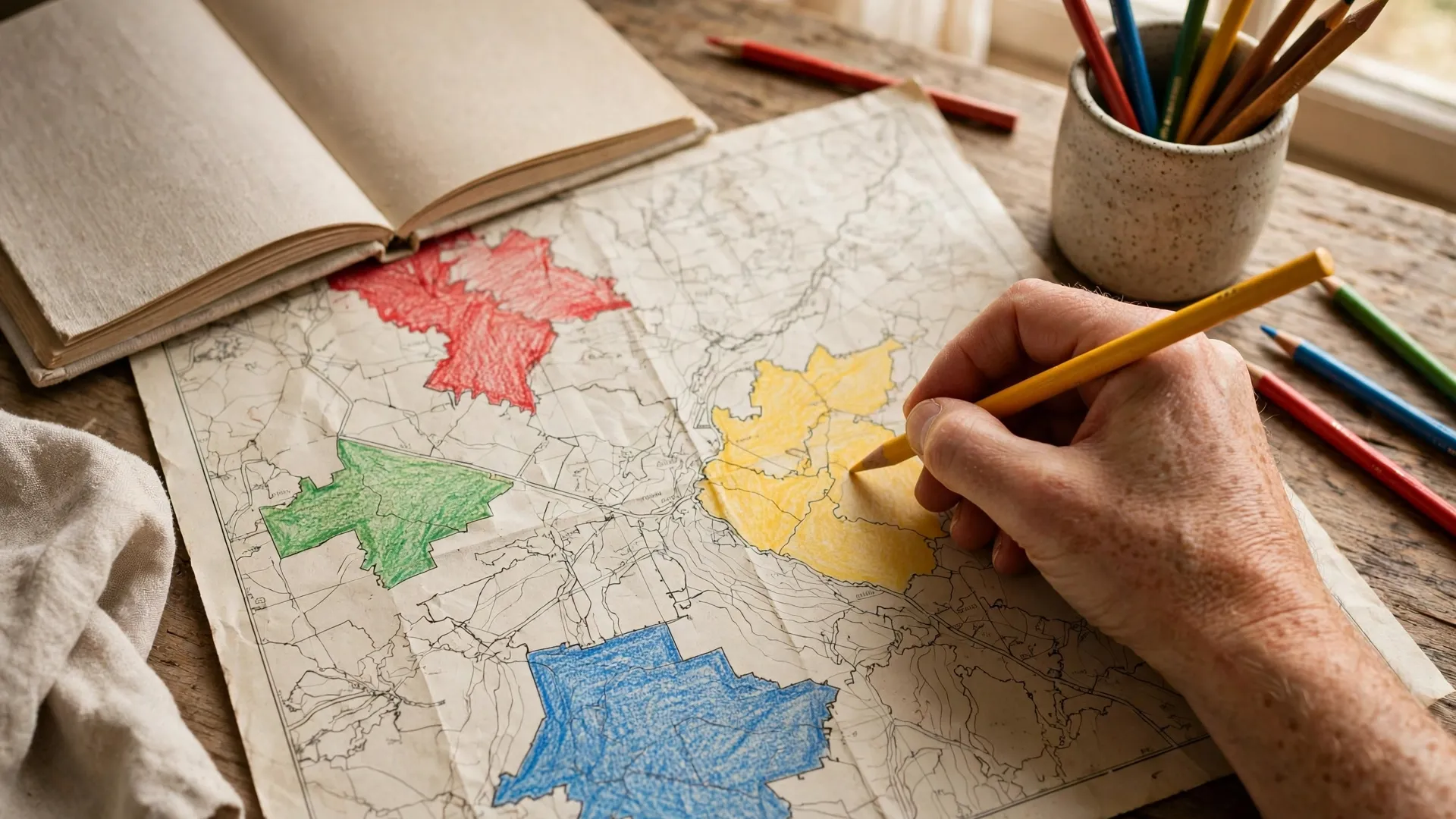
六位数学家找到了为任何地图涂上四种颜色的最快已知方法,这项工作赢得了FOCS 2026最佳论文奖。FOCS是理论计算机科学领域的顶级会议,于11月8日至11日在纽约举行。这个问题已有174年历史,新成果是30年来首次重大提速。
四色问题问的是一个简单的问题:每一张地图是否都可以用四种颜色涂色,使任何两个相邻区域都不共用一种颜色?弗朗西斯·格思里在1852年提出了这个问题,它在一个多世纪里一直没有答案。肯尼斯·阿佩尔和沃尔夫冈·哈肯在1976年证明四种颜色总是足够,他们的证明借助计算机检查了数百种情况。这个证明解决了问题本身,却留下了一个实际问题:计算机实际找到涂色方案能有多快?
最著名的已有方法可以追溯到1996年,当时罗伯逊、桑德斯、西摩和托马斯展示了如何用时间大致与区域数n的平方成正比的方法为一张有n个区域的地图涂色。对于一张有一百万个区域的地图,最坏情况下这意味着大约一万亿步。新论文由井上裕太、河原林健一、宫下敦行、博扬·莫哈尔、卡斯滕·托马森和米克尔·索鲁普撰写,把这一时间缩短到接近线性时间,大约为n乘以n的对数。
关键的洞见在于,地图中可简化的部分比任何人曾经证明的都要多得多。研究团队证明,每一个平面三角剖分都包含线性数量的可约构型,这些是小型的图案,可以先涂色,再放回地图中。因为如此多的图案同时出现,算法的每一轮都可以按固定比例缩小地图,而不是一次只去掉几个区域。
证明基于8202个构型,计算机花了数小时才检查完毕。这个数字很大,但远小于早期证明中使用的集合,正是论证的结构使提速成为可能。作者之一、哥本哈根大学的米克尔·索鲁普教授表示,新算法提供了一种快得多的地图涂色方法,会议评委也表示认同:这篇论文获得了FOCS 2026的最高奖项。
1976年阿佩尔和哈肯的证明是第一个在大量计算机帮助下证明的重要定理,当时招致批评,因为没有人能够手工检查每一个情况。罗伯逊和同事在1996年用更短的证明和实用的算法回应了部分批评,他们的二次时间方法作为最著名的已有方法保持了30年。新论文保留了计算机辅助的风格,但改变了其下的数学:它不再一次寻找一个可约图案,而是证明地图中总是同时包含许多这样的图案,因此算法可以在一次处理中清除大片区域,然后继续前进。
FOCS论文
这篇论文题为《具有线性数量可约构型与近线性时间涂色的四色定理》,2026年3月作为预印本发表在arXiv上,随后在会议上报告。作者分布在四个国家:井上裕太和宫下敦行在东京大学,河原林健一在东京的国立信息学研究所,莫哈尔在加拿大的西蒙弗雷泽大学,托马森在丹麦技术大学,索鲁普在哥本哈根大学。
这一成果属于理论,作者没有报告实现方案,也没有测量运行时间。它的价值在于揭示了平面图的结构,平面图是代表地图的数学对象,也在于其他研究者现在可以借鉴的证明技术。更快的地图涂色也有实际的近亲:分配无线电频率、安排考试和芯片布线都可以归结为涂色问题,针对一类图更快的求解方法可以改进其余问题使用的工具。本站2025国际科学与创新大赛落幕,青年创新闪耀全球合作,而挪威国王哈康走进莱纳车间与耶维克大学校园,同样记录了课堂与赛场上的科学探索。
同一组六位作者于2026年10月29日发表了一篇后续预印本,题为《线性时间四色平面图涂色》。它声称去掉了最后一个对数因子,达到线性时间,这将是最优的:任何算法都不可能比至少看每个区域一次做得更好。这篇论文是第一版预印本,尚未经过同行评审,它的线性时间界依赖于一种具有快速查表能力的特定计算模型,因此近线性的FOCS论文目前仍然是经过同行评审的成果。
作者表示,下一步是把理论变成其他人可以运行和测试的代码。在此之前,FOCS最佳论文仍然是通过一个自1852年以来一直挑战数学家的问题的最快已证明路径。
English
A team of six mathematicians has found the fastest known way to color any map with four colors, and the work won the Best Paper Award at FOCS 2026, the leading conference in theoretical computer science, held November 8 to 11 in New York. The problem is 174 years old, and the new result is the first major speedup in 30 years.
The four-color problem asks a simple question: can every map be colored with four colors so that no two neighboring regions share a color? Francis Guthrie posed it in 1852, and it stayed open for more than a century. Kenneth Appel and Wolfgang Haken proved in 1976 that four colors always suffice, with a proof that leaned on a computer to check hundreds of cases. That settled the question but left a practical one open: how fast can a computer actually find the coloring?
The best known method dated to 1996, when Robertson, Sanders, Seymour and Thomas showed how to color a map with n regions in time roughly proportional to n squared. For a map with a million regions, that meant about a trillion steps in the worst case. The new paper, by Yuta Inoue, Ken-ichi Kawarabayashi, Atsuyuki Miyashita, Bojan Mohar, Carsten Thomassen and Mikkel Thorup, cuts that to nearly linear time, roughly n times the logarithm of n.
The key insight is that maps contain far more simplifiable pieces than anyone had shown. The team proved that every planar triangulation holds a linear number of reducible configurations, which are small patterns that can be colored first and then put back into the map. Because so many such patterns appear at once, each round of the algorithm can shrink the map by a fixed fraction instead of removing a few regions at a time.
The proof rests on a set of 8,202 configurations that a computer checked over hours of running time. That is a large number, but it is far smaller than the sets used in earlier proofs, and the structure of the argument is what makes the speedup possible. Professor Mikkel Thorup of the University of Copenhagen, one of the authors, said the new algorithm provides a much faster way of coloring a map, and the conference judges agreed: the paper took the top prize at FOCS 2026.
The 1976 proof by Appel and Haken was the first major theorem proved with substantial computer help, and it drew criticism at the time because no human could check every case by hand. Robertson and his colleagues answered part of that criticism in 1996 with a shorter proof and a practical algorithm, and their quadratic-time method stood as the best known for 30 years. The new paper keeps the computer-assisted style but changes the mathematics underneath it: instead of hunting for one reducible pattern at a time, it shows that a map always contains many of them at once, so the algorithm can clear large sections in a single pass and move on.
The paper is titled The Four Color Theorem with Linearly Many Reducible Configurations and Near-Linear Time Coloring, and it appeared as a preprint on arXiv in March 2026 before its conference presentation. Its authors span four countries: Inoue and Miyashita at the University of Tokyo, Kawarabayashi at the National Institute of Informatics in Tokyo, Mohar at Simon Fraser University in Canada, Thomassen at the Technical University of Denmark, and Thorup at the University of Copenhagen.
The result is theory, and the authors report no implementation and no measured running times. Its value lies in the structure it reveals about planar graphs, the mathematical objects that stand in for maps, and in the proof techniques that other researchers can now borrow. Faster map coloring has practical cousins too: assigning radio frequencies, scheduling exams, and laying out chips all reduce to coloring problems, and a faster method for one family of graphs can sharpen the tools used for the rest.
The same six authors posted a follow-up preprint on October 29, 2026, titled Four-Coloring Planar Graphs in Linear Time. It claims to remove the last logarithmic factor and reach linear time, which would be optimal: no algorithm can do better than looking at each region at least once. That paper is a first-version preprint and has not yet been through peer review, and its linear-time bound depends on a specific model of computation with fast table lookups, so the near-linear FOCS paper remains the peer-reviewed result for now.
The authors say the next step is to turn the theory into code that others can run and test. Until then, the FOCS Best Paper stands as the fastest proven route through a problem that has challenged mathematicians since 1852.
本报道的其他版本也发表于News Today World, American Morning Herald, American Morning Post, The American Newsroom, Le Miroir Français, Revista Minutos。


































Be First to Comment