
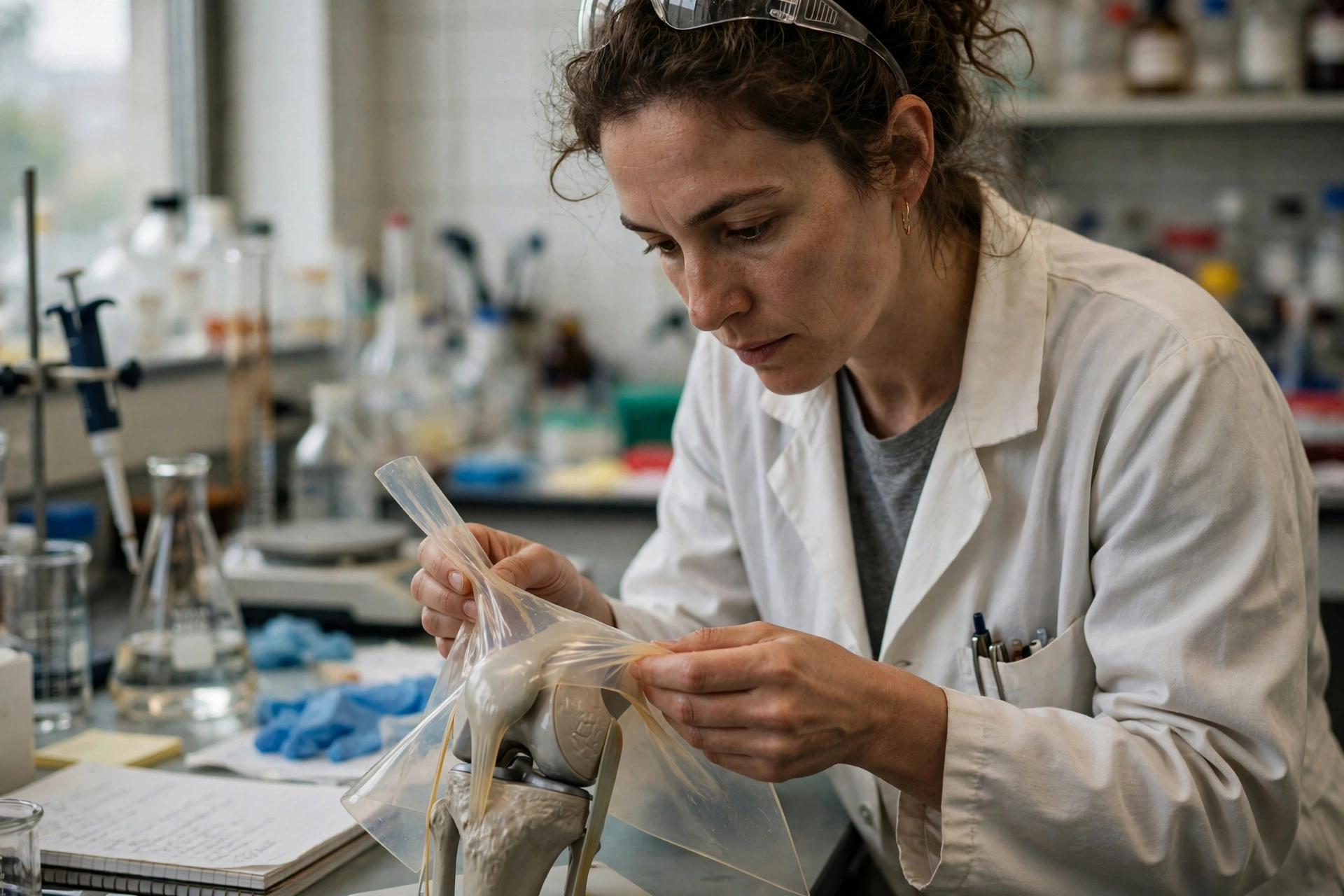
圣路易斯华盛顿大学研制的一种聚合物,在类似膝盖的柔性关节上弯折10000次后变得更强,该校于2026年11月20日宣布这一结果。相关研究11月5日在线发表于《自然-材料》,标题为《机械适应驱动适应环网络的非平衡网络重组与自增强》。大多数材料的走向相反。弯曲和应变会一点点把它们破坏,这正是关节、密封件和软性植入物会磨损的原因。这种华盛顿大学材料则会重组。被拉伸或弯折时,它内部的环状结构滑入新位置,恰好在受力的地方增强。
团队由华盛顿大学文理学院化学教授柯晨峰领导。共同作者包括研究生陈宇飞、白明亮和博士后研究员郑丹。柯晨峰说,他们的智能材料弯折和受力越多反而越强,它有人们从未见过的性质,能记忆、适应、学习和生长。这些环是环糊精,一种糖基化合物。聚合物本身是一种水凝胶,由可生物降解的糖晶体与聚乙二醇混合制成,聚乙二醇是许多健康产品中使用的化合物。水凝胶含有大量水分并保持柔韧,这使它成为贴近活体组织的材料的合理起点。本站读者也可查看天皇夫妇会见智利总统夫妇等报道。
柯的团队从身体中取经。胶原蛋白赋予皮肤强度和弹性,它同样在负荷下组织自身。柯晨峰说,一些最出色的智能材料存在于生物学中,他们以自然为灵感。在实验室测试中,水凝胶中的聚合物随弯折持续变得更均匀、更有组织,强度在应变发生处上升,其他地方不变。这种局部响应是外科医生可能最在意的细节。一种到处都坚硬的支撑材料在关节内部会造成自己的问题。一种在平静区域保持柔软、只在受力时变硬的材料,行为更接近它周围的组织。
10000次弯折测试是概念验证,不是产品试验。柯晨峰说,他们弯了10000次,材料表现正如预测。该材料已申请专利,与3D打印兼容,目前实验室产量较小,一次几十克。柯认为概念既已证明,产量可以扩大。可能的用途首先在骨科。柯提出,该聚合物可以支撑人工关节或帮助修复受损组织,他同时清楚自己领域的边界。他是化学家,不是骨科医生或医疗器械专家,他预计器械专家会发现他团队没想到的用途。他说,他们希望与华盛顿大学医学院及其他机构的专家合作探索可能性。这项工作得到美国国家科学基金会和美国能源部的支持。它也与柯更广泛的受自然启发材料计划相连。2025年4月,他在该校文理学院首届研究路演A&S Innovates上提出新一代智能织物。
该聚合物的直接下一步更具体。柯的实验室正在寻找临床和行业合作者,测试一种受力变强的材料首先适合用在哪里。资助记录能看出这一结果背后的计划规模。研究得到美国国家科学基金会2413579号和CAREER 2338747号资助,以及美国能源部DE-SC0012704号和DE-SC0022267号资助。这种力度的支持反映出,从医学到能源再到软体机器人,许多领域都与一种在负荷下适应的材料有关。水凝胶是实验室中熟悉的一类材料,这种熟悉在这里有帮助。因为它由糖晶体和聚乙二醇制成,两者都已用于健康产品,走向生物测试的路径从监管者和临床医生熟悉的成分开始。这种混合物的可生物降解特性对临时支撑也很重要,这类支撑要在体内完成工作,然后分解,而不是永远留存。柯2025年4月的智能织物提案指向医学之外的第二个方向。用在受力处自我增强的纤维织成的织物,可能改变防护服和运动装备的磨损方式,因为通常最先失效的区域正是会自我增强的区域。《自然-材料》论文涵盖化学与关节测试,柯说4月的路演显示同一化学体系可以用3D打印机制备,这正是小实验室从几十克走向可用数量的方式。本站其他报道包括阿尔贝二世与夏琳王妃出席国庆音乐会。
English
A polymer created at Washington University in St. Louis got stronger after being bent 10,000 times on a flexible, knee-like joint, the university announced on November 20, 2026. The study behind it was published online in Nature Materials on November 5, with the title “Mechanical adaptation drives out-of-equilibrium network reorganization and self-strengthening in adapt-ring networks.”
Most materials move in the opposite direction. Bending and strain break them down a little at a time, which is why joints, seals and soft implants wear out. The WashU material reorganizes instead. When it is stretched or bent, ring-shaped structures inside it slide into new positions and reinforce the exact places under strain.
Chenfeng Ke’s lab at Washington University
The team is led by Chenfeng Ke, a professor of chemistry in Arts and Sciences at Washington University. Co-authors include graduate students Yufei Chen and Mingliang Bai and postdoctoral researcher Dan Zheng. “Our smart material actually gets stronger the more it’s bent and strained,” Ke said. “It has properties we have never seen before. It can remember, adapt, learn and grow.”
The rings are cyclodextrin, a sugar-based compound. The polymer itself is a hydrogel made from a biodegradable blend of sugar crystals and polyethylene glycol, a compound used in many health products. A hydrogel holds large amounts of water and stays flexible, which makes it a plausible starting point for materials that sit against living tissue.
Ke’s group took its cue from the body. Collagen, the protein that gives skin its strength and elasticity, also organizes under load. “Some of the most impressive smart materials are found in biology,” Ke said. “We used nature for inspiration.” In the lab test, the polymers in the hydrogel became more uniform and more organized as bending continued, so strength rose where the strain was happening and nowhere else.
That local response is the detail surgeons may care about most. A support material that is rigid everywhere can cause its own problems inside a joint. One that stays soft in calm areas and firms up only under load behaves closer to the tissue around it. Readers who followed our America’s Best Doctors portrait of Dr. Paul O’Connor will recognize the same clinical instinct: match the intervention to the exact spot that needs it.
10,000 bends on a knee-like joint
The 10,000-bend test was a proof of concept, not a product trial. “We bent it 10,000 times, and the material performed just as we predicted,” Ke said. The material is patented, it is compatible with 3D printing, and so far the lab has produced it in small quantities, tens of grams at a time. Ke believes production can scale now that the concept has been demonstrated.
Possible uses sit in orthopedics first. Ke suggested the polymer could support artificial joints or help repair damaged tissue, and he was clear about the limits of his own field. He is a chemist, not an orthopedist or a medical device specialist, and he expects device experts to spot uses his team has not considered. “We want to work with experts at WashU Medicine and elsewhere to explore the possibilities,” he said.
The work was supported by the National Science Foundation and the U.S. Department of Energy. It also connects to Ke’s wider program on materials inspired by nature: in April 2025 he proposed a new generation of smart fabrics at A&S Innovates, the inaugural research pitch competition in Arts and Sciences at the university.
For a city that reads materials research alongside fashion, there is a neat crossover in this week’s New York Fashion Week 2027 royal host announcement, since smart fabrics were part of Ke’s earlier pitch. The immediate next step for the polymer is more concrete: Ke’s lab is now seeking clinical and industry collaborators to test where a material that strengthens under strain fits first.
The funding record gives a sense of the program behind the result. The study was supported by National Science Foundation awards 2413579 and CAREER 2338747, and by U.S. Department of Energy awards DE-SC0012704 and DE-SC0022267. Support at that level reflects how many fields have a stake in a material that adapts under load, from medicine to energy to soft robotics.
Hydrogels are a familiar class of material in laboratories, and that familiarity helps here. Because this one is built from sugar crystals and polyethylene glycol, both already used in health products, the path toward biological testing starts from ingredients regulators and clinicians know. The biodegradable character of the blend also matters for temporary supports, which are meant to do a job inside the body and then break down rather than stay forever.
Ke’s April 2025 smart fabrics proposal points to a second direction outside medicine. A fabric woven from fibers that strengthen where they are strained could change how protective clothing and sports equipment wear over time, since the areas that usually fail first would be the areas that reinforce themselves. The Nature Materials paper covers the chemistry and the joint test, and Ke said the April pitch showed the same chemistry could be produced with a 3D printer, which is how small labs move from tens of grams toward useful quantities.
这篇报道还发表于 News Today World, Newsy USA, The American Newsroom, Revista Minutos 和 Le Miroir Francais。


































Be First to Comment