
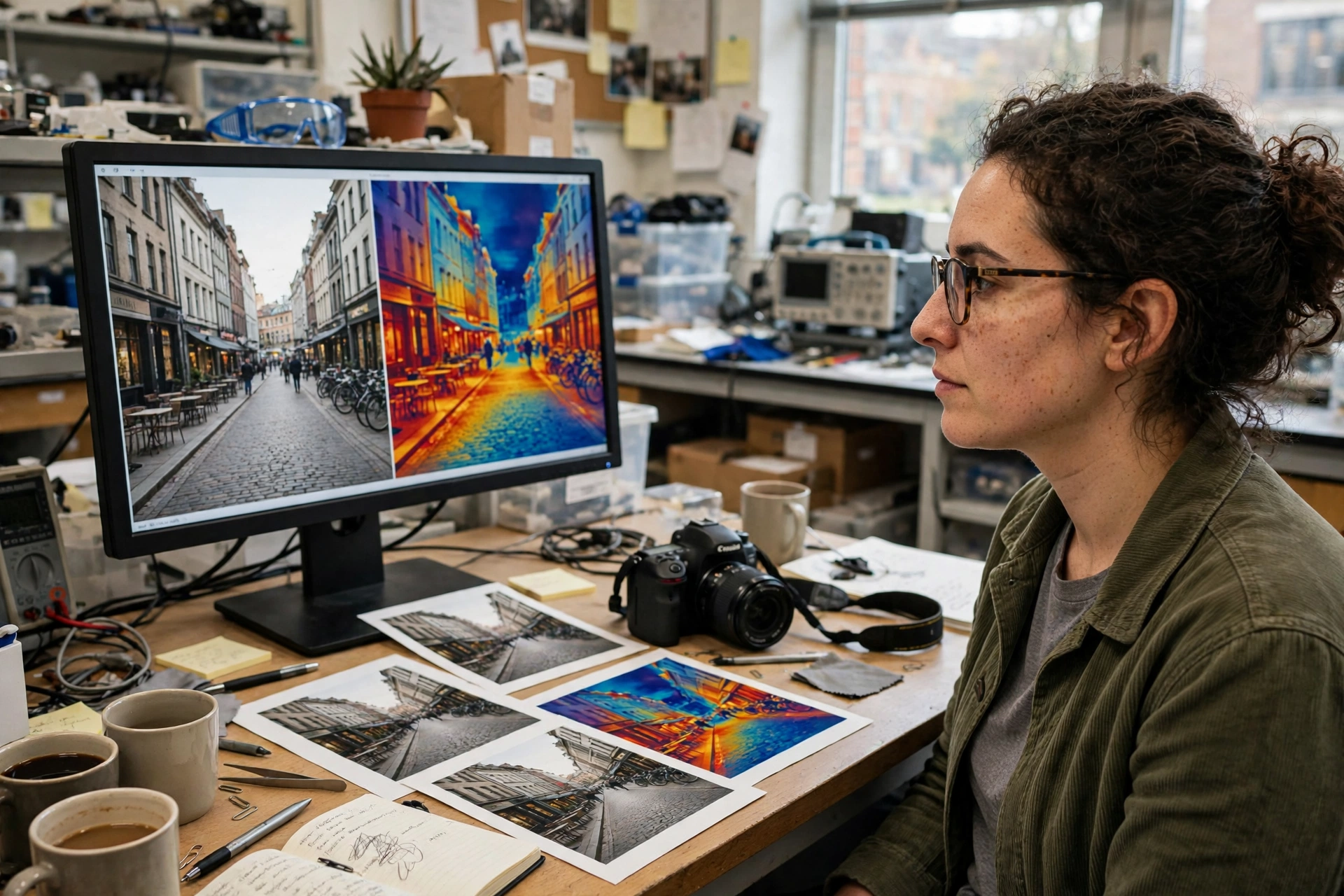
苹果于2026年11月19日完成了Depth Pro 2的发布,公布了代码仓库和一个2350万参数的焦距估算器,从而补齐了一个由四个模型组成的家族,这些模型以米为单位估算照片或视频中每个像素的距离。
大多数手机深度功能按远近对像素排序。度量深度则更严格。模型必须说出一个门口在4.2米之外、它后面的一道栅栏在9.8米之外,而且只使用一个普通摄像头,没有激光,也没有第二个镜头。Depth Pro 2接受一张照片、一段完整视频或一路实时信号,并以输入的完整分辨率工作,而不是先缩小画面。这种输出可用于机器人、增强现实测量和视频编辑等工作,在这些场景中,相对排序不足以将物体放置到场景中。
从97MB到3.5GB的四种尺寸
这个家族的跨度很大。DepthPro2-S有2400万参数,下载大小为97MB。DepthPro2-B有9700万参数,为386MB。DepthPro2-L有3.34亿参数,为1.3GB。最大的DepthPro2-H有8.72亿参数,为3.5GB,是苹果示例中的默认选择。每种尺寸都共用同一个焦距估算器,它与主模型一起加载,并在文件没有可靠的相机元数据时以像素为单位预测相机的焦距。没有这个数字,像素距离就无法诚实地换算成米。
此次发布是分阶段到来的,仓库的时间戳讲述了这个过程。模型卡仓库于11月3日出现在Hugging Face上。四个权重仓库随后在11月5日跟进,Core ML导出版本在11月9日到来。代码和独立的焦距估算器在11月19日落地,这一天整套工具才变得可以端到端使用。苹果没有发布新闻稿,因此主要来源是模型卡、GitHub仓库,以及由Peiyun Hu、Vladlen Koltun和六位合著者撰写的研究论文,该论文以arXiv预印本2611.26603发布。
深度图背后的多视图Transformer
在模型卡之下,一个多视图Transformer联合处理一帧或多帧画面,一个DPT解码器为每一帧预测逆深度图。联合处理多帧正是视频模式稳定性的来源。苹果报告称,Depth Pro 2在清晰度上优于此前的单帧和多帧工作,清晰度以边界F1分数衡量,该分数检查预测的深度边缘与真实边缘的吻合程度;在时间一致性上也更优,时间一致性以帧间抖动衡量。这些是苹果自己报告的结果,截至11月20日,尚无关于这个新家族的独立基准发表。
实际细节很朴素。代码在英伟达和苹果图形处理器上以bfloat16运行,在CPU上以float32运行。仓库包含一个Mac实时深度演示,需要苹果芯片、macOS 15或更高版本以及Xcode 16或更高版本。研究人员可以先在笔记本电脑上用97MB的S模型起步,将输出与一间测量过的房间对照,然后再为更大的尺寸付出下载和内存的代价。
研究许可证,写得明明白白
权重以苹果机器学习研究模型许可证发布,用于非商业的科学研究和学术开发。这一条款决定了今天谁可以使用Depth Pro 2。大学实验室可以在其基础上构建并发表结果,而产品团队不能将其装进商业应用中出售。苹果将这一限制写在模型卡本身上,因此与宽松许可证的深度模型相比,评估它的团队不会有任何含糊之处。
这个家族的下一次测试将来自苹果自己的页面之外,届时研究团队会在标准数据集上发布并排的深度图和误差测量。自11月19日起,运行这些测试所需的代码、权重和焦距估算器都已公开。
苹果模型卡上的速度表显示了为什么需要四种尺寸。苹果在一块英伟达B200上以bfloat16测量了一段32帧的片段,S模型处理640乘480视频的速度为每秒347帧,处理1080p的速度为每秒44.8帧。B模型在较小尺寸下记录为每秒269.7帧,在1080p下为每秒23.6帧。L模型记录为150.1和9.1,H模型在较小尺寸下为95.9。内存占用上升得同样陡峭,从S模型在较小分辨率下的1.9GiB,到L模型在4K下超过80GiB。团队先按硬件、再按清晰度选择尺寸。
焦距估算器在论文中有自己的速度数字,在同一块B200硬件上处理1080p为每秒118帧,而最小的深度模型在论文测量设置下流式处理1080p视频为每秒53帧。两张已公布的表格使用了不同的测试设置,这正是数字不同的原因,苹果将两者都印了出来,而不是合并。无论如何,估算器都不是瓶颈。它与主模型一起运行一次,并为下载增加94MB。分阶段推出的类似情形,本周也出现在新加坡首架自主电动飞机的报道中,该计划同样以有日期的步骤从组件走向完整的飞机。
Depth Pro 2还承接了一个有名有姓的前身。苹果最初的Depth Pro被定位为零样本度量单目深度的基础模型,无需针对数据集训练即可从单张图像生成高分辨率深度图。第二代将这一想法从静态图像扩展到视频和实时信号,并增加了第一代模型未曾被评判的时间一致性测量。评估过初代模型的研究团队现在可以用全部四种新尺寸重跑他们的测试集,并公布比较结果。
在影像技术之外,本网还报道了亿航在日本的载人飞行,那里的相机与传感系统同样是测试的一部分。
English
Apple completed its Depth Pro 2 release on November 19, 2026, publishing the code repository and a 23.5 million parameter focal-length estimator that finished a family of four models estimating the distance of every pixel in a photo or video in meters.
Most phone depth features rank pixels by closeness. Metric depth is stricter. The model has to say that a doorway sits 4.2 meters away and a fence behind it sits 9.8 meters away, using one ordinary camera with no laser and no second lens. Depth Pro 2 takes a single photo, a whole video or a live feed, and it works at the input’s full resolution rather than shrinking the frame first. That output feeds work in robotics, augmented reality measurement and video editing, where a relative ranking is not enough to place an object in a scene.
Four sizes from 97 megabytes to 3.5 gigabytes
The family spans a wide range. DepthPro2-S has 24 million parameters and a 97 megabyte download. DepthPro2-B has 97 million parameters at 386 megabytes. DepthPro2-L has 334 million parameters at 1.3 gigabytes. DepthPro2-H, the largest, has 872 million parameters at 3.5 gigabytes and is the default in Apple’s examples. Every size shares the same focal-length estimator, which loads alongside the main model and predicts the camera’s focal length in pixels when the file carries no reliable camera metadata. Without that number, pixel distances cannot be converted into meters honestly.
The release arrived in stages, and the repository timestamps tell the story. The model card repository appeared on Hugging Face on November 3. The four weight repositories followed on November 5, and Core ML exports came on November 9. The code and the standalone focal estimator landed on November 19, which is the date the set became usable end to end. Apple posted no press release, so the primary sources are the model card, the GitHub repository and the research paper by Peiyun Hu, Vladlen Koltun and six co-authors, posted as arXiv preprint 2611.26603.
A multi-view transformer behind the depth maps
Under the card, a multi-view transformer processes one or more frames jointly, and a DPT decoder predicts an inverse depth map for each frame. Processing frames together is what gives the video mode its steadiness. Apple reports that Depth Pro 2 outperforms prior single-frame and multi-frame work on sharpness, measured by a Boundary F1 score that checks how well predicted depth edges line up with real edges, and on temporal consistency, measured as jitter between frames. Those are Apple’s own reported results, and no independent benchmark of the new family had been published as of November 20.
The practical details are plain. The code runs in bfloat16 on NVIDIA and Apple graphics processors and in float32 on a CPU. The repository includes a Mac live-depth demonstration that needs Apple silicon, macOS 15 or later and Xcode 16 or later. A researcher can start with the 97 megabyte S model on a laptop, check the output against a measured room, and only then spend the download and memory on the larger sizes. Sports measurement offers a rough parallel from this week’s flagship, in the Kingston Allen rushing record coverage, where a number only counts once it can be checked against the field.
Research license, stated plainly
The weights ship under the Apple Machine Learning Research Model license, for non-commercial scientific research and academic development. That term decides who can use Depth Pro 2 today. A university lab can build on it and publish results, while a product team cannot ship it inside a commercial app. Apple states the limit on the model card itself, so there is no ambiguity for teams evaluating it against permissively licensed depth models.
The family’s next test will come from outside Apple’s own pages, when research groups publish side-by-side depth maps and error measurements on standard datasets. The code, the weights and the focal estimator needed to run those tests have all been public since November 19.
The speed table on Apple’s model card shows why four sizes exist. Measured by Apple on an NVIDIA B200 in bfloat16 on a 32-frame clip, the S model processes 640 by 480 video at 347 frames per second and 1080p at 44.8 frames per second. The B model records 269.7 frames per second at the smaller size and 23.6 at 1080p. The L model records 150.1 and 9.1, and the H model 95.9 at the smaller size. Memory use climbs just as steeply, from 1.9 gibibytes for the S model at the smaller resolution to more than 80 gibibytes for the L model at 4K. A team picks its size by hardware first and by sharpness second.
The focal estimator has its own speed figure in the paper, 118 frames per second at 1080p on the same B200 hardware, against 53 frames per second for the smallest depth model streaming 1080p video in the paper’s measurement setup. The two published tables use different test setups, which is why the numbers differ, and Apple prints both rather than merging them. Either way, the estimator is not the bottleneck. It runs once alongside the main model and adds 94 megabytes to the download.
A similar staged rollout appeared in the NTU Singapore electric aircraft program, which moved from components to a complete aircraft in dated steps.
Depth Pro 2 also follows a named predecessor. Apple’s original Depth Pro was presented as a foundation model for zero-shot metric monocular depth, producing high-resolution maps from a single image without dataset-specific training. The second generation extends that idea from still images to video and live feeds, and adds the temporal consistency measurement the first model was not judged on. Research groups that evaluated the original can now rerun their test sets against all four new sizes and publish the comparison.
本报道的其他版本也刊登在 News Today World, Manhattan Mogul, Newsy USA, Revista Minutos 和 Le Miroir Francais。

Watch the Short on YouTube:



























Be First to Comment