
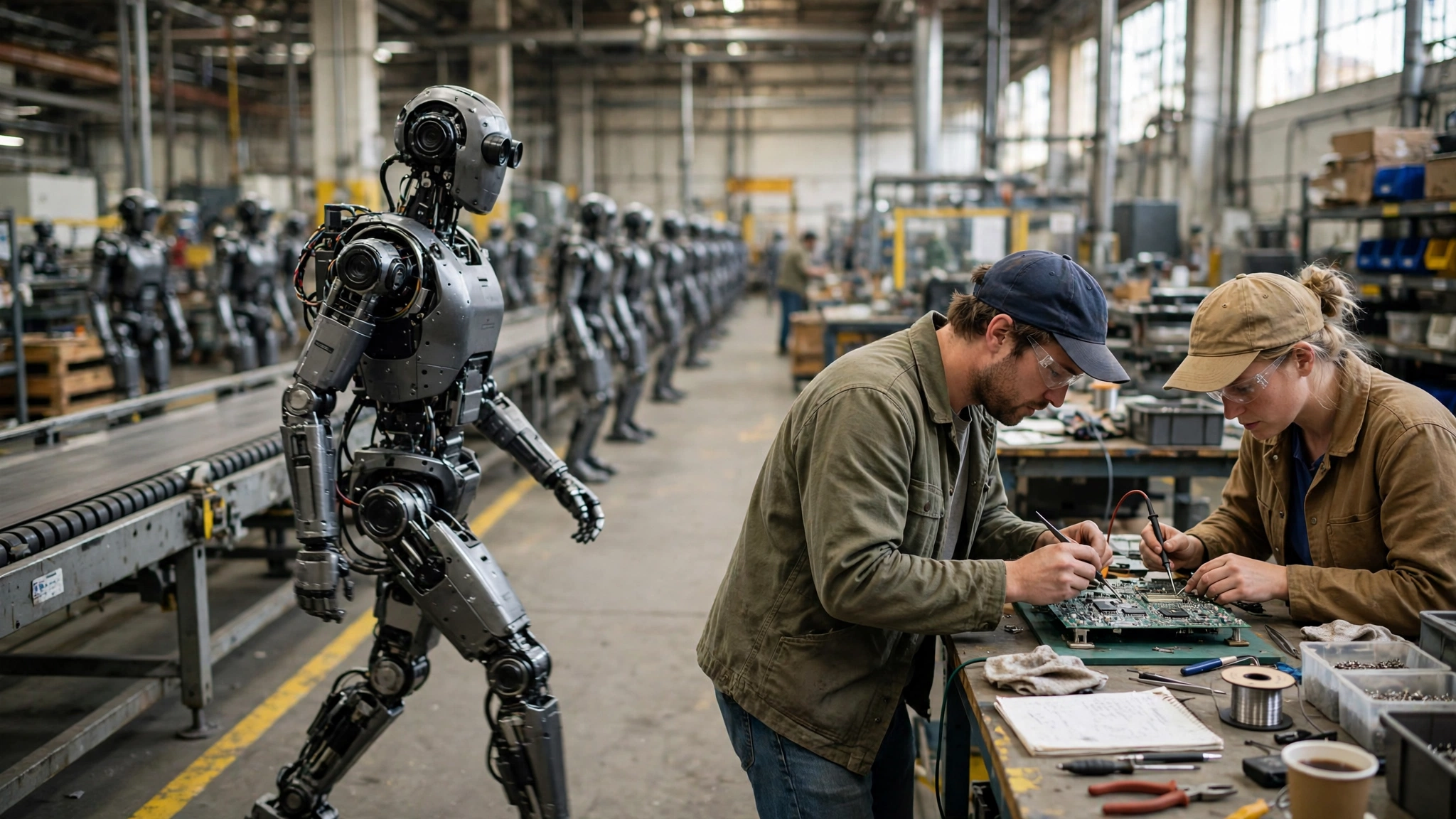
埃隆-马斯克在11月22日表示,特斯拉下一代AI5芯片将先用于Optimus人形机器人和人工智能训练超级计算机,而特斯拉的汽车继续使用现有的AI4硬件。这一安排把最新的芯片放进了机器人项目,而不是汽车。
马斯克给出的理由很直接。在他看来,AI4已经能让完全自动驾驶的表现比人类驾驶员更安全,所以车队不需要新芯片。这一判断也覆盖了无人驾驶出租车车队,包括特斯拉正在生产的、没有方向盘的Cybercab。如果汽车继续用AI4,特斯拉的无人驾驶推广就不必等AI5按时到位。
Optimus面对的是另一个问题。一台在家庭或工厂里工作的人形机器人,要看懂一个从未见过的房间,要拿起没有被专门编程处理过的物品,还要在任务出错时自己恢复。马斯克在特斯拉第三季度财报电话会上说,AI5的计算能力大约是AI4的十倍。公司表示,这部分多出来的算力会先用在机器人身上。本站的科技栏目近期也在跟踪算力竞争,例如ChatGPT Space向Plus用户开放共享工作区,以及Baseten的bison-1在决策指数中居首。
2027年4月与弗里蒙特生产线
这款芯片在2026年4月完成流片,也就是设计定稿并送去制造的节点。马斯克提出的时间是2027年4月前后把AI5装进Optimus,芯片的大批量生产在那一年逐步爬坡。特斯拉已经在加利福尼亚州弗里蒙特建起了一座大批量生产Optimus的工厂,所以生产线在新大脑到来之前就已经存在。早期机器人用现有硬件生产,装AI5的机器随后跟上。
这个项目挂着的产能目标很大。特斯拉的目标是到2027年底达到每周最多20000台机器人的产能,对外交付也预计在同一时间窗口开始。这个数字应该被看作产能目标,而不是销售预测。不过它能说明公司如何规划弗里蒙特的扩建,也能解释芯片决定为什么现在就要定下来,一条按这个规模规划的生产线,需要提前很久就把计算芯片的供应定好。
其他人形机器人项目也在同时扩产。在韩国,Persona AI的焊接人形机器人正在由专业焊工训练,准备与HD现代合作做船厂工作。特斯拉自己的无人驾驶出租车业务也在汽车一侧继续扩大,11月19日达拉斯开放了Cybercab公众乘坐,这是继奥斯汀之后的第二座城市。
训练计算机也用同一款芯片
AI5的第三个去处是特斯拉的训练超级计算机,也就是教驾驶模型和机器人模型的集群。把同一款推理芯片同时放进机器人和训练系统,能简化软件工作,工程师可以在与现场运行硬件一致的设备上测试模型。这也让特斯拉的芯片订单集中在一款设计、三个产品线上,在谈制造量时更有分量。
对现在的特斯拉车主来说,实际结论很简单。他们的车不需要等一次芯片更换,才能得到公司已经承诺的功能,因为特斯拉说这些功能会发布在AI4平台上。对机器人项目来说,要盯的日期就是马斯克自己说出的那几个,2027年4月前后的AI5整合,以及那一年年底的弗里蒙特产能目标。
English
Elon Musk said on November 22 that Tesla’s next-generation AI5 chip will power the company’s Optimus humanoid robots and its AI training supercomputers, while Tesla vehicles keep running on the current AI4 hardware. The split puts the newest silicon in the robot program, not in the cars.
The reasoning Musk gave was blunt. In his view, AI4 already delivers Full Self-Driving performance safer than a human driver, so the vehicle fleet does not need the new chip. That position covers the robotaxi fleet too, including the Cybercab, which Tesla is building to run without a steering wheel. If the cars stay on AI4, Tesla’s driverless rollout does not depend on AI5 arriving on time.
Optimus is a different problem. A humanoid robot working in a home or a factory has to read a room it has never seen, handle objects it was not specifically programmed for, and recover when a task goes sideways. Musk said on Tesla’s third-quarter earnings call that AI5 offers roughly ten times the computing power of AI4. The robot, not the car, is where the company says that headroom will be used first.
April 2027 and the Fremont production line
The chip reached tape-out in April 2026, the point where a design is finished and sent for manufacturing. Musk has pointed to integration into Optimus around April 2027, with high-volume chip production ramping through that year. Tesla has already begun building Optimus units at a high-volume facility in Fremont, California, so the production line exists before the new brain does. Early robots run on current hardware; the AI5 machines would follow.
The production target attached to the program is large. Tesla is aiming for capacity of up to 20,000 robots per week by the end of 2027, with external deliveries also expected in that window. Treat that as a capacity goal rather than a sales forecast. Still, the number tells you how the company is sizing the Fremont build-out, and it explains why the chip decision came now: a line planned at that scale needs its compute supply settled well before it runs at speed.
Other humanoid programs are scaling in parallel. In South Korea, Persona AI’s welding humanoids are being trained by professional welders for shipyard work with HD Hyundai, and Tesla’s own robotaxi operation keeps expanding on the vehicle side – public Cybercab rides opened in Dallas on November 19, the second city after Austin.
Training computers get the same chip
The third destination for AI5 is Tesla’s training supercomputers, the clusters that teach the driving and robot models. Putting the same inference chip in the robot and in the training stack simplifies the software work: engineers can test a model on hardware that matches what will run it in the field. It also concentrates Tesla’s chip orders on one design across three product lines, which helps when negotiating manufacturing volume.
For owners of current Tesla cars, the practical read is simple. Their vehicles are not waiting on a chip swap to gain features the company has already promised, because Tesla says AI4 is the platform those features will ship on. For the robot program, the dates to watch are the ones Musk named himself: AI5 integration around April 2027, and the Fremont capacity target at the end of that year.
同一报道也发表在News Today World, Manhattan Mogul, Newsy USA, The American Newsroom, Revista Minutos and Le Miroir Francais。
Watch the Short on YouTube:


































Be First to Comment