
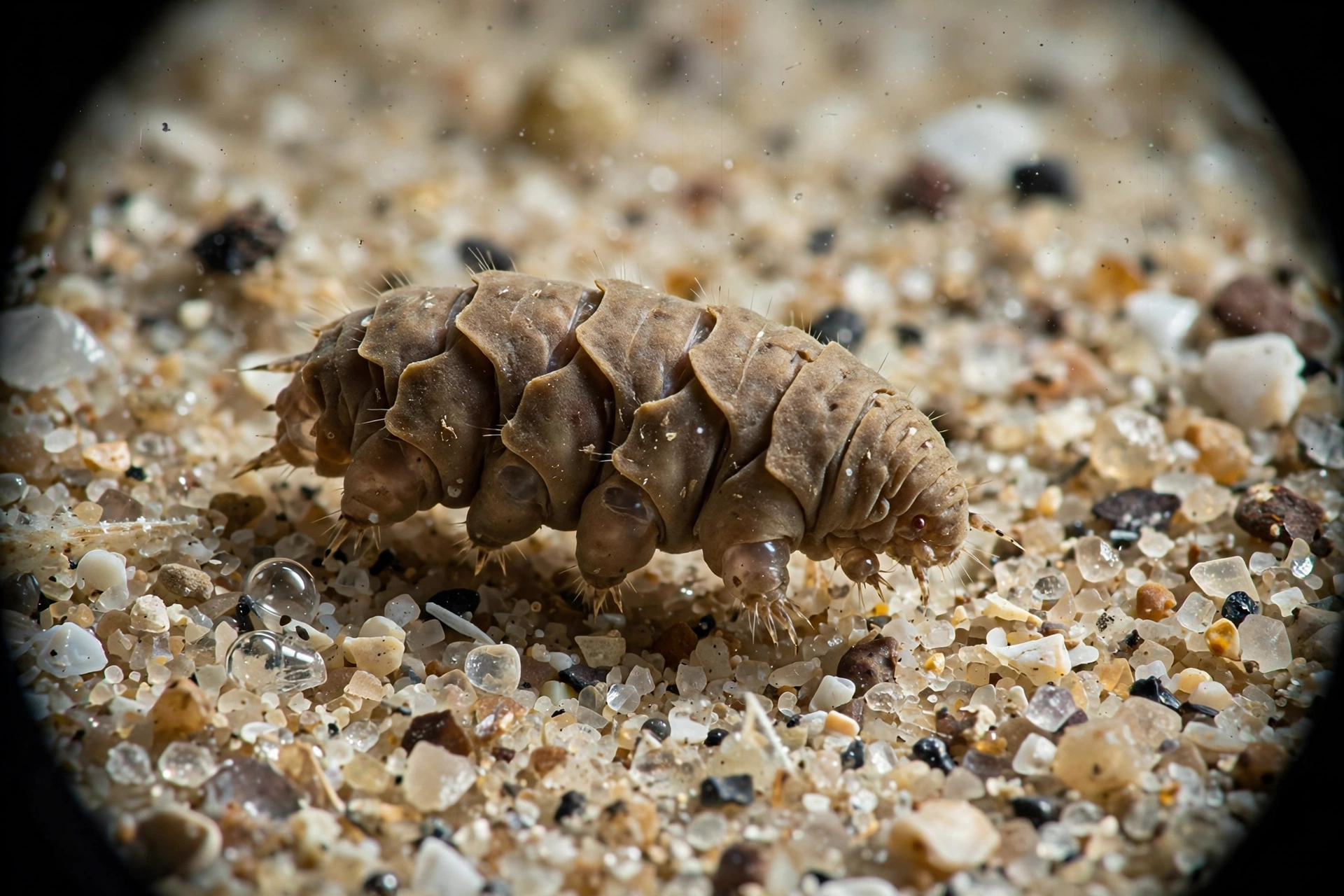
科学界新发现的两个缓步动物物种,Megastygarctides hekatae 和 Parastygarctus potercha,已根据在东热带大西洋森戈尔海山(Senghor Seamount)采集的沉积物得到描述,森肯贝格研究所(Senckenberg)在发表于《ZooKeys》期刊的一项研究中宣布了这一消息。研究团队检查了样本中的 219 只缓步动物个体,并在该海山上识别出 20 个不同的分类单元,相比之下,北部约 100 公里处的一个深海参照站点只有两个分类单元。
缓步动物是微小的动物,大多数体长远不足一毫米,以能在杀死几乎所有其他生物的条件下存活而闻名。海洋种类生活在海底的沙粒和沉积物之间。这两个新物种属于铠甲缓步动物,这一类群的身体带有坚硬的板片,两者都是在等待关注已久的沉积物中发现的。一艘名为流星号(Meteor)的科考船在 2009 年对该海山的考察中采集了这些样本,这座海山从佛得角群岛外的大西洋海底隆起。
Megastygarctides hekatae 及其生殖刺
第一个新物种带有一个研究人员称之为在缓步动物中极为罕见的特征:生殖刺,这是一种短小的中空突起,带有小钩,与内部生殖器官相连。它的正模标本是一只体长 193.3 微米的成熟雌性,来自海山中央山顶水面以下 102.4 米处,栖息在由破碎贝壳和珊瑚材料组成的粗沙中。在约 100 米深处,这是 Megastygarctides 属中任何缓步动物迄今为止最深的记录,该属现在共有七个已知物种。
第二个物种还要更小。Parastygarctus potercha 的正模标本雌性体长 69.0 微米,宽 21.0 微米,大约相当于一根人类头发纵向劈开的宽度。它表现出幼态持续(pedomorphism),意思是成体保留了近亲只在幼年时才有的身体特征。在这个物种中,这些特征是它的小体型和减少的爪子数量。该属现在共有八个已知物种。本站近期的报道还包括费利佩六世参观塞万提斯沉浸式展览等文化活动。
一座海山上的 20 个分类单元
更广泛的数量统计是其他研究人员会引用的发现。在 219 个标本中,有 212 个来自森戈尔海山山顶,深度约为 100 至 130 米。研究团队将它们归入 20 个分类单元,其中包括三个科学界已知的物种:Chrysoarctus briandi、Quisarctus armatus 和 Raiarctus colurus。参照站点深度近 3,300 米,位于北部约 100 公里处,其细泥质沉积物中产生了两个分类单元。作者指出样本量不同,因此这种对比是一个有力的迹象,而不是统计学上的证明,他们在论文中明确说明了这一点。
第一作者罗曼·特罗希姆丘克(Roman Trokhymchuk)说:”我们在森戈尔海山乘坐科考船流星号考察期间采集的沉积物样本中检测到了这两个新物种。”他在莱顿的 Naturalis 生物多样性中心和威廉港的森肯贝格海洋研究所(Senckenberg am Meer)工作。”因此,我们的研究首次对这座海山的海洋缓步动物群进行了系统调查。我们共识别出 20 个不同的分类单元。这支持了我们的假设,即这类海底山脉也是海洋缓步动物特别丰富的栖息地。”
森肯贝格海洋研究所德国海洋生物多样性研究中心的亚历山大·基内克(Alexander Kieneke)从对比站点的角度提出了同样的观点。他说,高原与深海海底之间的差异进一步证明,海山即使对肉眼几乎看不见的生物来说,也可以是生物多样性的绿洲。本站近期的其他报道,例如教皇良十四世接见国际自行车联盟人士,同样关注了专门领域的最新动态。
这篇论文发表于《ZooKeys》第 1295 卷,第 333 至 358 页,数字对象标识符为 10.3897/zookeys.1295.205902,同时更新了这两个属的鉴定检索表。这听起来像文书工作,确实也是,但检索表是下一次考察用来命名其样本中发现物种的工具。没有更新的检索表,未来样本中的一个新物种只会是罐子里一个没有名字的标本。
这个时间线中有一堂耐心课。这些沉积物是在 2009 年 9 月流星号 M79/3 航次期间打捞上来的,当时该船在佛得角地区使用多管取样器作业。十六年后,森肯贝格和 Naturalis 的专家逐粒完成了对它的研究。博物馆和研究所的收藏中保存着许多这样的样本,每一个都是对一个无需再航行回去的地方的调查。
森戈尔海山的所有标本,包括显微镜载玻片和扫描电子显微镜样品台,都存放在缓步动物收藏中,供未来的研究人员重新检查。这两个新名字现在已经成为永久记录的一部分,《ZooKeys》第 1295 卷中更新的检索表将成为下一次海山调查统计其自身分类单元时使用的参考。
English
Two New Tardigrade Species Found on an Atlantic Seamount
Two tardigrade species new to science, Megastygarctides hekatae and Parastygarctus potercha, have been described from sediment collected at Senghor Seamount in the eastern tropical Atlantic, Senckenberg announced in a study published in the journal ZooKeys. The team examined 219 individual tardigrades from the samples and identified 20 different taxa on the seamount, against just two taxa at a deep-sea reference site about 100 kilometers to the north.
Tardigrades are microscopic animals, most of them well under a millimeter long, known for surviving conditions that kill almost everything else. The marine kinds live between grains of sand and sediment on the seafloor. These two belong to the armored tardigrades, a group whose bodies carry hard plates, and both were found in sediment that has been waiting a long time for attention. A research vessel called Meteor collected the samples during a 2009 expedition to the seamount, which rises from the Atlantic floor off the Cape Verde Islands.
Megastygarctides hekatae and its genital spines
The first new species carries a feature the researchers call extremely rare in tardigrades: genital spines, short hollow projections with small hooks that connect to the internal reproductive organs. Its holotype, a mature female 193.3 micrometers long, came from the seamount’s central summit at 102.4 meters below the surface, in coarse sand made of broken shell and coral material. At about 100 meters down, it is the deepest record so far for any tardigrade in the genus Megastygarctides, which now holds seven known species.
The second species is smaller still. The holotype female of Parastygarctus potercha measures 69.0 micrometers long and 21.0 micrometers wide, about the width of a human hair split lengthwise. It shows pedomorphism, which means the adults keep physical traits that relatives carry only when young. In this species those traits are its small body size and a reduced number of claws. Its genus now holds eight known species.
Twenty taxa on one seamount
The wider count is the finding other researchers will cite. Of the 219 specimens, 212 came from the Senghor Seamount summit, at depths of roughly 100 to 130 meters. The team sorted them into 20 taxa, including three species already known to science: Chrysoarctus briandi, Quisarctus armatus and Raiarctus colurus. The reference station, nearly 3,300 meters deep and about 100 kilometers north, produced two taxa in its sediment of fine ooze. The authors note the sample sizes differ, so the contrast is a strong indication rather than a statistical proof, and they say so in the paper.
“We detected the two new species in sediment samples collected during an expedition aboard the research vessel Meteor at Senghor Seamount,” said lead author Roman Trokhymchuk, who works at the Naturalis Biodiversity Center in Leiden and at Senckenberg am Meer in Wilhelmshaven. “Our study thus provides the first systematic investigation of the marine tardigrade fauna at this seamount. We identified a total of 20 different taxa. This supports our hypothesis that such undersea mountains also represent particularly species-rich habitats for marine tardigrades.”
Alexander Kieneke of the German Centre for Marine Biodiversity Research at Senckenberg am Meer made the same point from the comparison site. The difference between the plateau and the deep-sea floor, he said, is further evidence that seamounts can be oases of biodiversity even for organisms that are barely visible to the naked eye. Seamount ecology has been a live subject on this site this month, most recently in the Bikar and Bokak atoll survey, where sharks made up a third of reef fish weight at one Pacific site. The Senghor result works at the opposite end of the size scale, in animals a thousand times smaller than a reef shark.
The paper, ZooKeys volume 1295, pages 333 to 358, DOI 10.3897/zookeys.1295.205902, also updates the identification keys for both genera. That sounds like bookkeeping, and it is, but keys are the tool the next expedition uses to name what comes up in its own samples. Without an updated key, a new species in a future sample is just an unnamed specimen in a jar.
There is a patience lesson in the timeline. The sediment was hauled up in September 2009 during cruise M79/3 of the Meteor, working the Cabo Verde region with a multiple corer. Sixteen years later, specialists at Senckenberg and Naturalis finished working through it grain by grain. Museum and institute collections hold many such samples, and each one is a survey of a place nobody has to sail back to. Cataloguing work on a different frontier ran on this site yesterday as well, in the Fermi catalog mapping 450 gamma-ray sources, where the raw material was also an archive waiting for a fresh method.
All of the Senghor specimens, including the microscope slides and scanning electron microscope stubs, are deposited in the Tardigrada collection for future researchers to re-examine. The two new names are now part of the permanent record, and the updated keys in ZooKeys 1295 are the reference the next seamount survey will use when it counts its own taxa.
读者也可以在 News Today World, American Morning Post, Revista Minutos, Le Miroir Francais 和 Mario-Max Magazine 阅读本报道的其他版本。

Watch the Short on YouTube:
































Be First to Comment