
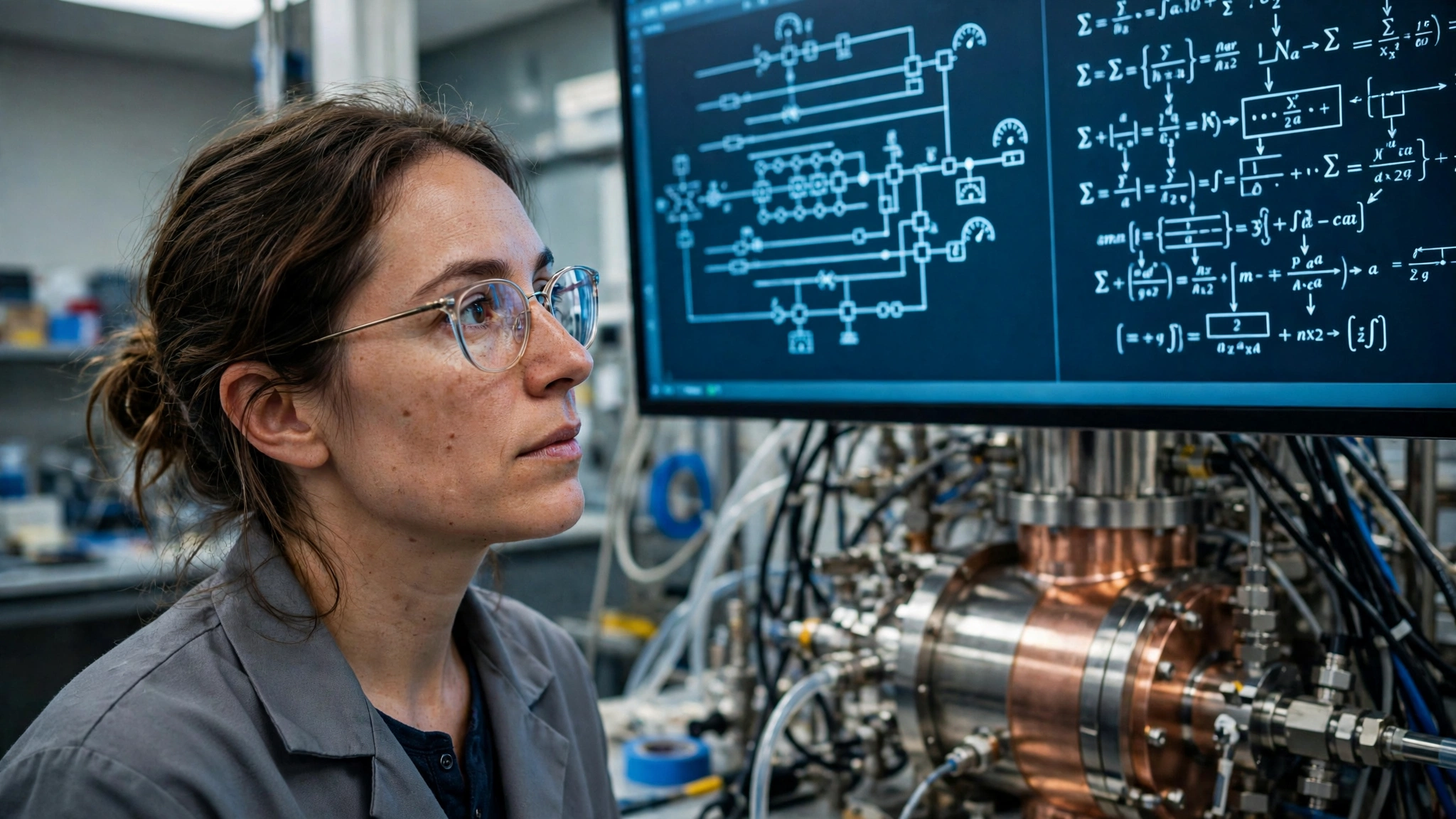
谷歌DeepMind于2026年11月23日发表博客文章称,Gemini 4智能体团队将一个量子反正弦程序的成本降低了290倍,每一项结果都在Lean定理证明器中得到了正确性证明。
这项工作记录在论文《用AI发现形式化验证的量子程序》中,该论文于11月9日发布在arXiv上,编号为2611.09822。作者名单包括来自谷歌DeepMind和Google Quantum AI的25位研究人员,其中包括Sergey Shirobokov、Ben Jaderberg和Ryan Babbush。DeepMind正在GitHub上开源Lean库、问题规格和已验证的解法,其他团队可以重新运行证明,并在这些电路的基础上继续工作。
智能体团队工作的Lean库
面向真实科学的量子电路规模太大,无法用测试来验证。经典计算机只能检查小型的或受限的版本,而今天的量子处理器对完整程序来说又太小。团队用证明绕开了这一限制。研究人员在Lean中将每个问题写成形式化规格,涵盖程序必须计算什么、精度必须达到多少,以及成本如何计算。智能体团队随后提出程序,每个提案都必须附带经机器检查的正确性与成本证明。Lean的报错信息会反馈到下一轮提案中。
本站相关报道:亚马逊Prime Air在纳什维尔附近的朱丽叶山开通无人机配送、YYForce人形机器人Six Seven在新加坡诺富特酒店担任礼宾员、优步、Nuro与Lucid在旧金山湾区启动全无人驾驶出租车测试。
该库将一门用于量子程序和经典控制流的语言,与一套量子霍尔逻辑配对。量子霍尔逻辑是一种形式系统,通过从程序必须产生的结果出发进行推理,来证明程序的行为。它建立在Mathlib和Lean-QuantumInfo包之上。Mathlib是Lean的社区数学库。一个共享笔记本收集了在同一问题上并行工作的不同智能体团队所验证的想法。
反正弦成本下降290倍,Grover搜索加速2.57倍
反正弦结果是论文中最大的单个数字。反正弦是一个将数字加载进量子态的程序,许多其他量子算法都依赖它。此前最好的方法时空成本高于1.08乘以10的8次方。智能体达到了3.70乘以10的5次方,使用3698个非Clifford T门,跨越100个量子比特。这是超过290倍的降低。对Grover算法,即无序列表的标准搜索程序,团队为一种特定的并行实现找到了2.57倍的加速。
接下来是聚变。该电路计算惯性约束聚变的某项性质,这种方法用激光压缩氢燃料直至其点火。智能体团队在博客文章的数字中将计算成本降低了11.8倍,论文表格按其时空度量给出10.9倍。内存从5650个纠错量子比特降至4338个。
细胞色素P450的内存从481降至333个量子比特
两项化学结果补全了这组工作。对一种常见的光敏分子,团队通过简化算法跟踪粒子位置和电力的方式,使量子模拟便宜了8倍。论文对这一非玻恩-奥本海默动力学案例给出的数字是8.08倍,跨越6057个逻辑量子比特。对细胞色素P450,即分解大多数人类药物、处于药物设计工作核心的酶,改进为2.5倍。那里的内存从481个量子比特降至333个,智能体用更精简的设计替换了庞大的内存查找。
这篇论文中成本的含义是精确的。它将逻辑量子比特的数量与操作数量结合计算,即量子比特数乘以T门数,Clifford门按近乎免费处理。这一度量对容错量子计算来说是诚实的,因为T门主导着纠错账单。在这一度量上更便宜的电路,需要更小的机器,或者同一台机器运行更短的时间。作者坦言,改进后的聚变电路仍然需要超过第一代纠错量子计算机可能提供的资源。这一进展缩小了差距,但没有消除差距。
DeepMind将这项工作与同月早些时候的另一项成果并列。其AlphaProof Code系统形式化验证了Signal加密的安全性,这是智能体系统与证明检查器配对的又一案例,处理的是单靠测试无法判定正确性的问题。
论文、Lean库、问题规格和已验证的解法已随11月23日的文章公开,代码发布在GitHub上。谷歌之外的量子团队现在可以拿同样的五个问题,在自己的机器上运行证明,并尝试用自己的智能体团队击败已公布的成本。这一方法可以走出量子领域。任何一个候选答案可以由形式系统而非意见来检验的领域,都可以使用同样的循环。
English
Google DeepMind published a blog post on November 23, 2026, stating that teams of Gemini 4 agents cut the cost of a quantum arcsin routine by 290 times, with every result proved correct in the Lean theorem prover.
The work is described in the paper Discovering formally verified quantum programs with AI, posted to arXiv on November 9 under identifier 2611.09822. The author list runs to 25 researchers from Google DeepMind and Google Quantum AI, including Sergey Shirobokov, Ben Jaderberg and Ryan Babbush. DeepMind is open-sourcing the Lean library, the problem specifications and the verified solutions on GitHub, so other groups can rerun the proofs and build on the circuits.
The Lean library the agent teams worked in
Quantum circuits for real science are too large to test. A classical computer can only check small or restricted versions, and today’s quantum processors are far too small for the full programs. The team worked around that limit with proof instead of testing. Researchers wrote each problem in Lean as a formal specification covering what the program must compute, how accurate it must be and how its cost is counted. Agent teams then proposed programs, and each proposal had to arrive with machine-checked proofs of correctness and cost. Lean’s error messages fed back into the next round of proposals.
The library pairs a language for quantum programs and classical control flow with a quantum Hoare logic, a formal system for proving what a program does by reasoning from the result it must produce. It builds on Mathlib, the community mathematics library for Lean, and on the Lean-QuantumInfo package. A shared notebook collected the verified ideas from separate agent teams working on the same problem in parallel.
Arcsin fell 290 times and Grover search 2.57 times
The arcsin result is the largest single number in the paper. Arcsin is a routine that loads numbers into quantum states, and many other quantum algorithms depend on it. The previous best method carried a spacetime cost above 1.08 times 10 to the power of 8. The agents reached 3.70 times 10 to the power of 5, using 3,698 non-Clifford T gates across 100 qubits. That is a reduction of more than 290 times. For Grover’s algorithm, the standard search routine for an unsorted list, the teams found a 2.57 times speedup for one specific parallel implementation.
Fusion came next. The circuit calculates a property of inertial confinement fusion, the approach that compresses hydrogen fuel with lasers until it ignites. The agent teams cut the computing cost by 11.8 times in the blog post’s figure, and the paper’s table gives 10.9 times on its spacetime measure. Memory fell from 5,650 error-corrected qubits to 4,338. Readers who follow agent research will notice the same pattern as in the loop transformer work Z.ai shipped in GLM-5.4, where a model is asked to do more work per pass rather than simply run larger.
Cytochrome P450 memory fell from 481 to 333 qubits
Two chemistry results round out the set. For a common light-sensitive molecule, the teams made the quantum simulation 8 times cheaper by simplifying how the algorithm tracks particle positions and electric forces. The paper’s figure for that non-Born-Oppenheimer dynamics case is 8.08 times, across 6,057 logical qubits. For Cytochrome P450, an enzyme that breaks down most human medicines and sits at the center of drug design work, the improvement was 2.5 times. Memory there fell from 481 qubits to 333, after the agents replaced bulky memory lookups with a leaner design.
Cost in this paper has a precise meaning. It combines the number of logical qubits with the number of operations, counted as qubits multiplied by T gates, with Clifford gates treated as near free. That measure is the honest one for fault-tolerant quantum computing, because T gates dominate the error-correction bill. A cheaper circuit on this measure needs a smaller machine, or the same machine for less time. The authors are plain that the improved fusion circuit still needs more resources than the first error-corrected quantum computers are likely to offer. The gain narrows the gap. It does not close it.
DeepMind placed this work next to an earlier result from the same month. Its AlphaProof Code system formally verified the security of Signal’s encryption, another case of agent systems paired with a proof checker on a problem where testing alone cannot settle correctness. The habit is spreading across labs, as the medical model evaluations Ant Group published with LingSante also lean on formal, checkable scoring rather than on demonstrations.
The paper, the Lean library, the problem specifications and the verified solutions are public as of the November 23 post, with the code released on GitHub. Quantum groups outside Google can now take the same five problems, run the proofs on their own machines and try to beat the published costs with their own agent teams.
The method travels beyond quantum work. Any field where a proposed answer can be checked by a formal system, rather than by opinion, can use the same loop of agent teams proposing and a prover disposing. Compiler design, chip verification and protocol security all have that shape, and the Signal encryption result named in the post shows DeepMind already applying it outside physics. For quantum computing itself, the practical effect is a shorter list of excuses. Hardware still has to grow, but the algorithms waiting for that hardware are now measurably cheaper than they were in October, and the proofs are public files that any rival group can inspect line by line.
本报道的其他版本也刊登于News Today World, Revista Minutos, Le Miroir Francais, Manhattan Mogul, Newsy USA。








Be First to Comment