
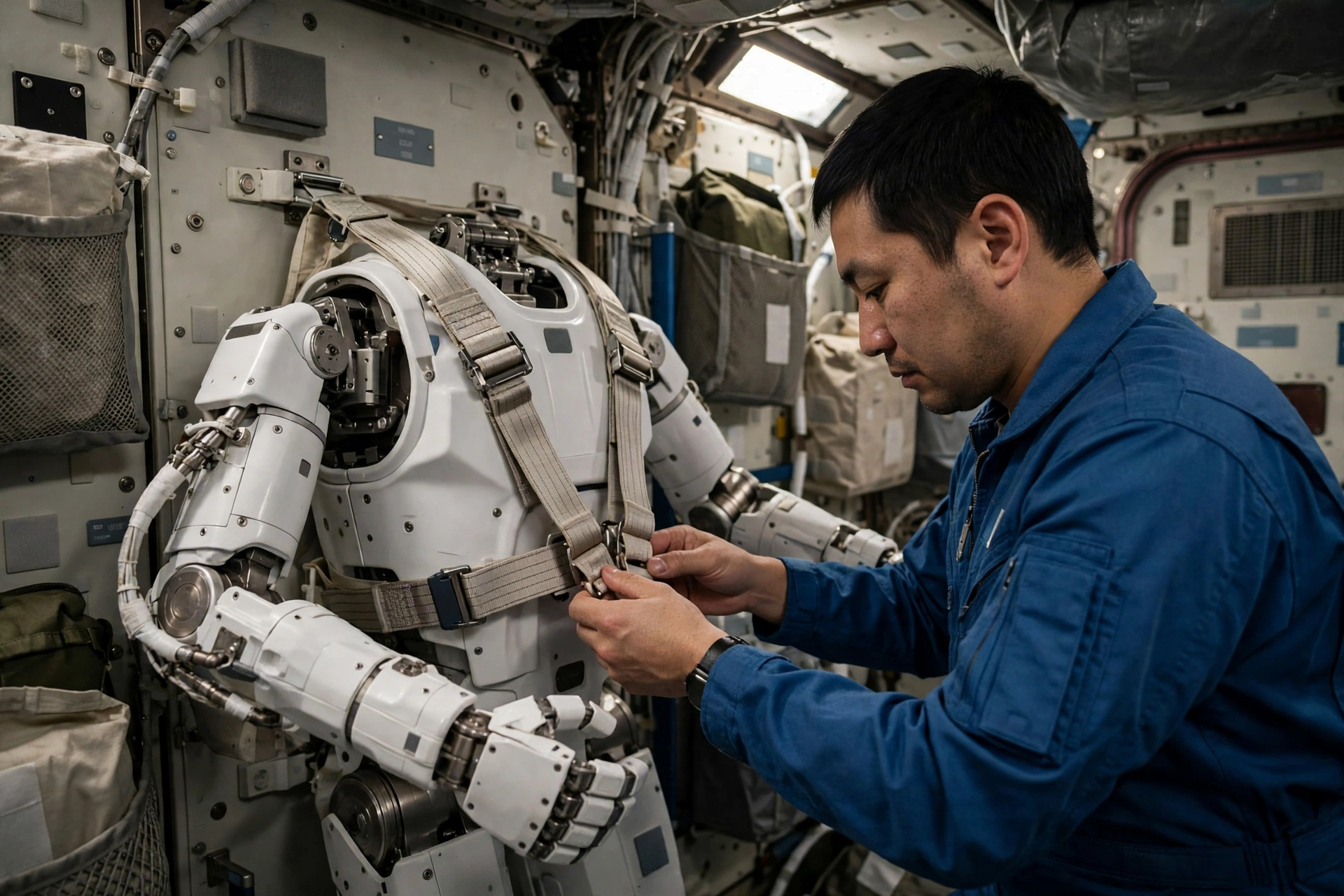
2026年11月24日,进步MS-36货运飞船于莫斯科时间13时17分搭乘联盟-2.1b火箭,从拜科努尔31号发射场发射升空,向国际空间站运送超过2.4公吨的货物。在这批货物之中,有一台名为Teledroid的人形机器人,它的任务是在空间站外部工作,在宇航员出舱活动之前提前准备好作业现场。
飞船顺利进入预定轨道,与火箭第三级分离,并展开了天线和太阳能电池翼。这些步骤确认飞行按计划进行。Teledroid目前仍作为货物固定在飞船内,等待抵达空间站的小型研究舱。它的到来将补齐一套分两次运送的实验设备,也将开启空间站外部机器人作业的一次重要测试。
为出舱活动提供支持的机器人化身
Teledroid是一台为空间站外部工作设计的机器人化身。操作员无论是在空间站内,还是在地面任务控制中心,只要穿上装有复制型主控装置的特殊服装,机器人就会复制操作员的动作,用自己的手臂和双手完成工作。部分任务设计为自主运行,不需要操作员逐步引导每一个动作。
它最初的任务都是准备性工作。在宇航员出舱之前,机器人先行准备作业现场,打开外壳,安装设备,让宇航员出舱后可以直接处理需要本人到场的工作。整个实验的主要目标十分明确,就是减少宇航员在空间站外部停留的时间。出舱的每一小时都需要大量规划和保障,体力消耗也很大,机器人提前完成的准备工作,都能实实在在地还给宇航员。
根据开发方NPO Android Technics的项目记录,Teledroid由该公司与RSC Energia联合开发,用于测试出舱活动的操作支持技术。完整的实验设备包括构成宇航员工作站的复制型主控装置、一台计算模块、机器人本体和一台外部相机。进步MS-35已在2026年9月将工作站和其他部件送达空间站,因此这套系统的控制部分已经在轨道上等待机器人到来。近期本站关于韩国电动空中出租车认证和蚂蚁集团开源人工智能模型的报道,也显示出机器人与自主系统正在多个行业同步推进。
彼得·杜布罗夫与安娜·基基娜的准备工作
宇航员的准备工作早在发射之前就已经开始。根据2026年10月28日的更新,彼得·杜布罗夫和安娜·基基娜当时正在安装设备,并利用机器人的虚拟模型准备首批任务。两人在水下训练中演练了实体操作环节,练习如何将Teledroid搬运到空间站外部,如何将其安装在作业现场,以及如何接通它的通信系统。
水下训练是地面上模拟失重工作的标准方式,他们演练的顺序,也正是机器人拆包检查之后真实部署时要遵循的顺序。工作站9月送达,任务10月用虚拟模型准备,机器人11月发射升空,三个步骤连成一条完整的时间线,而对接是把最后一块拼图送到位的那一步。
Teledroid此行并不孤单。进步MS-36还搭载了Aseptik、Kaskad和Orbita-MG三项实验所需的设备,以及宇航员的生活物资。这样的货物组合是货运飞行的常态,也恰好反映了2026年空间机器人的位置:一台实验人形机器人,与食物、给养和实验室设备一起,搭乘一艘多年来沿着成熟航线飞行的飞船前往空间站。
复制型控制方式是这项实验的核心。操作员穿上主控装置活动自己的手臂,机器人的手臂随之跟随,因此可以用自然的人体动作操作那些原本为人类双手和人类臂展设计的设备。自主任务负责那些流程已知、可以重复的步骤,人工引导则留给需要临场判断的环节。飞行的下一步已经有明确的日期和时间。进步MS-36预计于11月26日莫斯科时间15时10分与空间站小型研究舱对接。
English
The Progress MS-36 cargo spacecraft launched from Baikonur Site 31 at 13:17 Moscow time on November 24, 2026, on a Soyuz-2.1b rocket, carrying more than 2.4 metric tons of cargo to the International Space Station. Among that cargo is Teledroid, a humanoid robot built to work on the outside of the station and to prepare worksites ahead of cosmonaut spacewalks.
The spacecraft reached its intended orbit, separated from the third stage, and deployed its antennas and solar arrays. Those steps confirm the flight is proceeding as planned. Teledroid remains secured as cargo on its way to the station Small Research Module, and its arrival completes an experiment kit that was delivered in two parts.
Teledroid is a robot avatar designed for work on the station exterior. An operator aboard the station, or at mission control on the ground, wears a special suit fitted with a copy-type master device, and the robot copies the operator movements with its own arms and hands. Some tasks are designed to run autonomously, without an operator guiding each motion.
Its first intended tasks are preparation tasks. Before a spacewalk, the robot prepares a worksite, opening casing and installing equipment, so the crew finds the slow setup work already done when they go outside. The main goal of the experiment is stated plainly: reducing the time cosmonauts spend outside the station. Every hour outside requires extensive planning and support and carries a real physical cost, and any preparation a robot finishes in advance goes directly back to the crew.
The robot was developed jointly by NPO Android Technics and RSC Energia to test operational-support technologies for spacewalks, according to the developer project record. The full experiment kit includes the copy-type master device that forms the cosmonaut workstation, a computing module, the robot itself and an external camera. Progress MS-35 delivered the workstation and other elements in September 2026, so the control side of the system has been waiting on orbit for the robot to arrive.
The crew preparation began well before launch. In an update on October 28, 2026, Pyotr Dubrov and Anna Kikina were installing the equipment and preparing initial tasks with virtual models of the robot. The two also rehearsed in underwater training, practicing how to carry Teledroid outside the station, install it at a worksite and connect its communications. Underwater training is the standard way to rehearse weightless work on the ground, and the sequence they practiced is the sequence the real deployment will follow once the robot is unpacked and checked.
Teledroid shares its ride with more ordinary cargo. Progress MS-36 also carries equipment for the Aseptik, Kaskad and Orbita-MG experiments, plus provisions for the crew. That mix is typical of a cargo flight and a fair picture of space robotics in 2026: one experimental humanoid traveling alongside food, supplies and laboratory equipment on a vehicle that has flown established routes for years.
For readers following the station program, the sequence from here is easy to track. The cargo spacecraft is in transit, the workstation delivered in September is installed, the first tasks were prepared with virtual models in October, and the robot itself is now in orbit. Each element of the experiment has arrived or is arriving in the order the plan required, and the docking joins the final element to the rest of the system.
The copy-type control method is the heart of the experiment. The operator moves his or her own arms while wearing the master device, and the robot arms follow, which allows natural human gestures on hardware designed for human hands and human reach. Autonomous tasks cover the repeatable steps with a known sequence, while guided control is kept for the moments where human judgment matters. The next step of the flight already has a date and a time. Progress MS-36 is expected to dock with the Small Research Module on November 26 at 15:10 Moscow time.
本报道也刊登于News Today World, Manhattan Mogul, Newsy USA, American Morning Post, Revista Minutos and Le Miroir Francais。
Watch the Short on YouTube:






Be First to Comment