
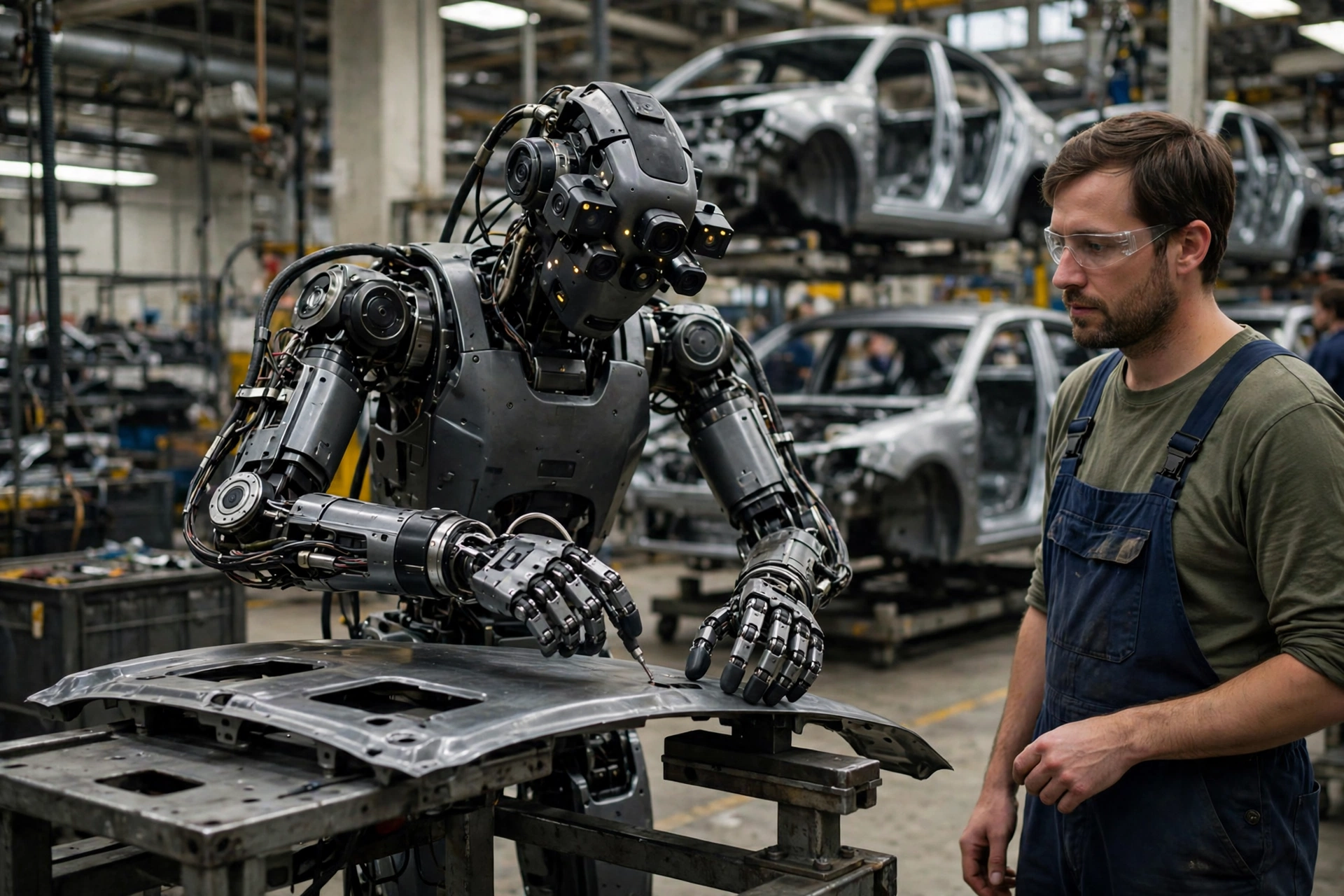
开普勒机器人已将其前行者K2人形机器人,昵称大黄蜂,投入上海上汽通用汽车工厂工作,机器人在生产线上执行质量检查并处理装配任务。工厂视频显示,K2在车间内移动,检查零部件并与人类员工并肩工作,公司称这次亮相标志着工业场景测试的开始。
K2为工厂工作而造。它有加固的肢体结构以保证耐用性,每只手有11个自由度的触觉操作器,指尖装有柔性传感器,对精密零件有类似人类的触感。电池续航最长八小时,足以覆盖一个完整班次,它可以装载冲压件、操作机械夹具,并通过模仿与强化学习相结合的方式适应新任务。基于云的认知系统让它能快速学习新任务,并以全身协调的方式配合动作,而感知与任务规划软件让它可以自主工作,同时与人共享空间。
上汽通用工厂正是人形机器人能发挥价值的地方。汽车工厂里有长长的重型零件生产线、严格的公差与持续的检查,一台能拿起零件、检查并放到正确位置的机器人,可以接过人类工人手中的重复性工作。K2已经证明它能处理精细检查,在复杂的工厂地面上找到路线,并在无人陪同的情况下搬运沉重的汽车零部件。谷歌新一代人工智能模型的发布同样显示,支撑机器人学习的模型能力正在快速提升。
质量检查是K2最先展示的工作。机器人沿着生产线移动,用传感器查看零件,标出不符合标准的零件。这项工作需要稳定的眼力与稳定的手,而且生产线上的每一辆车都要经过检查。K2还处理装配操作,装载冲压件并操作需要在同一动作中兼顾力量与精度的夹具。机器人通过观察学习。它的软件结合模仿,即复制人类展示的任务,与强化学习,即通过练习任务并获得结果反馈来改进。这种结合让它无需全面重新编程就能适应新零件或新工位。公司称K2只需少量再训练就能承担新任务,而这一说法将决定工厂是买一台机器人还是一支机器人队伍。
人形机器人正同时到达整个行业的工厂地面。波士顿动力正在将其阿特拉斯人形机器人送入格芯运营的芯片工厂,现场测试将于明年初开始。ROBOTERA人形机器人已经在广东的邮政枢纽分拣包裹,公司称每小时分拣超过1500件。K2是这个群体中最新的成员,而汽车工厂是比分类线更难的考验,因为零件更重,公差更严格。开普勒已将前行者K2的基础价格定在约3万美元。对一台人形机器人来说这个价格很低,公司正把它作为制造商的实用采购而非展示机器来推广。以这个价格,工厂可以用低于一台带工作单元的工业机械臂的成本,在生产线上部署一台机器人,而人形机器人可以在工位之间移动,而不是固定在一个地点。
公司称K2在某些工作上可以达到或超过数名人类工人的工作量,正把机器人瞄准需要人手从事重复性工作的工厂。K2比前代K1在硬件与软件上都有全面提升。开普勒表示其雄心不止于汽车工厂,认为机器人可以用于教育、研究、安保、物流与危险户外工作。在仓库里,K2可以搬运货物与管理库存。在教室里,它可以支持互动学习。在危险场所,它的防水性能与耐极端温度能力让它可以在人不应前往的地方工作。人工智能模型提升芯片设计效率的进展也表明,机器人背后的芯片与算法正在同步变强。
每台工厂机器人之后都会出现的问题是,生产线上的人会怎样。K2接手的工作是重复性与体力要求高的那种,而围绕它增长的岗位是机器人维护、编程、人工智能训练与监督。这些岗位需要不同的技能,购买人形机器人的工厂将需要能让它们持续运转的人。K2为与人类并肩工作而非隔在围栏后而造,其传感器与软件旨在保障共享空间的安全。开普勒尚未表示计划生产多少台K2机器人,也没有说明上汽通用的测试何时从试验转为永久部署。来自上海的视频显示一台机器人在真实生产线上做着真实的工作,公司将观察它在完整生产排期中的表现。
English
Kepler’s Humanoid Starts Work at a Shanghai Car Plant
Kepler Robotics has put its Forerunner K2 humanoid robot, nicknamed Bumblebee, to work at the SAIC-GM automotive plant in Shanghai, where the robot is performing quality checks and handling assembly jobs on the production line. A video from the plant shows the K2 moving through the factory, inspecting parts and working beside human staff, and the company says the debut marks the start of scenario-based testing across industrial settings.
The K2 is built for factory work. It has a reinforced limb structure for durability, tactile manipulators with 11 degrees of freedom in each hand, and flexible fingertip sensors that give it a human-like touch on delicate parts. Its battery runs for up to eight hours, long enough to cover a full shift, and it can load stamped parts, work mechanical fixtures and adapt to new tasks through a mix of imitation and reinforcement learning. A cloud-based cognitive system lets it learn new tasks fast and coordinate its movements with full-body awareness, while its perception and task-planning software let it work on its own and still share space with people.
The SAIC-GM plant is the kind of place where a humanoid earns its keep. Car plants run long lines of heavy parts, tight tolerances and constant inspection, and a robot that can pick up a part, check it and set it down in the right place takes a repetitive job off a human worker. The K2 has already shown it can handle intricate inspections, find its way through a complex factory floor and manage heavy automotive components without a handler at its side.
Quality checks are the job the K2 was shown doing first. The robot moves along the line, looks at parts with its sensors, and flags the ones that do not meet the standard. That is work that needs a steady eye and a steady hand, and it is work that a plant has to do on every car that passes. The K2 also handles assembly operations, loading stamped parts and working fixtures that need strength and precision in the same motion. The robot learns by watching. Its software combines imitation, where it copies a task shown by a human, with reinforcement learning, where it improves by practicing the task and getting feedback on the result. That combination is what lets it adapt to a new part or a new station without a full reprogramming. The company says the K2 can take on new tasks with little retraining, and that is the claim that will decide whether plants buy one robot or a fleet of them.
Humanoid robots are reaching factory floors across the industry at the same time. Boston Dynamics is sending its Atlas humanoid into chip plants run by GlobalFoundries, with on-site testing starting early next year. ROBOTERA humanoids are already sorting parcels at postal hubs in Guangdong, where the company reports more than 1,500 parcel inductions per hour. The K2 is the newest arrival in that group, and the car plant is a harder test than a sorting line because the parts are heavier and the tolerances are tighter.
Kepler has set the base price of the Forerunner K2 at about 30,000 dollars. That is low for a humanoid robot, and the company is pitching it as a practical buy for manufacturers rather than a showcase machine. At that price, a plant can put a robot on a line for less than the cost of a single industrial robot arm with its cell, and the humanoid can move between stations instead of staying bolted to one spot. The company says the K2 can match or pass the workload of several human workers on certain jobs, and it is aiming the robot at factories that need hands for repetitive work. The K2 is a step up from its predecessor, the K1, with better hardware and software throughout. Kepler has said its ambitions go beyond car plants, and it sees the robot working in education, research, security, logistics and hazardous outdoor jobs. In a warehouse, the K2 could move goods and manage stock. In a classroom, it could support interactive learning. In a hazardous site, its waterproofing and resistance to extreme temperatures would let it work where people should not go.
The question that follows every factory robot is what happens to the people on the line. The work the K2 takes on is the repetitive and physically demanding kind, and the roles that grow around it are in robot maintenance, programming, AI training and oversight. Those are jobs that need different skills, and plants that buy humanoids will need people who can keep them running. The K2 is built to work beside humans rather than behind a fence, and its sensors and software are designed to keep that shared space safe. Kepler has not said how many K2 robots it plans to build or when the SAIC-GM testing will move from a trial to a permanent deployment. The video from Shanghai shows a robot doing real work on a real line, and the company will be watching how it holds up over a full production schedule.
这篇报道的版本还见于News Today World, Manhattan Mogul, Newsy USA, The American Newsroom, Revista Minutos and Le Miroir Francais。


































Be First to Comment