
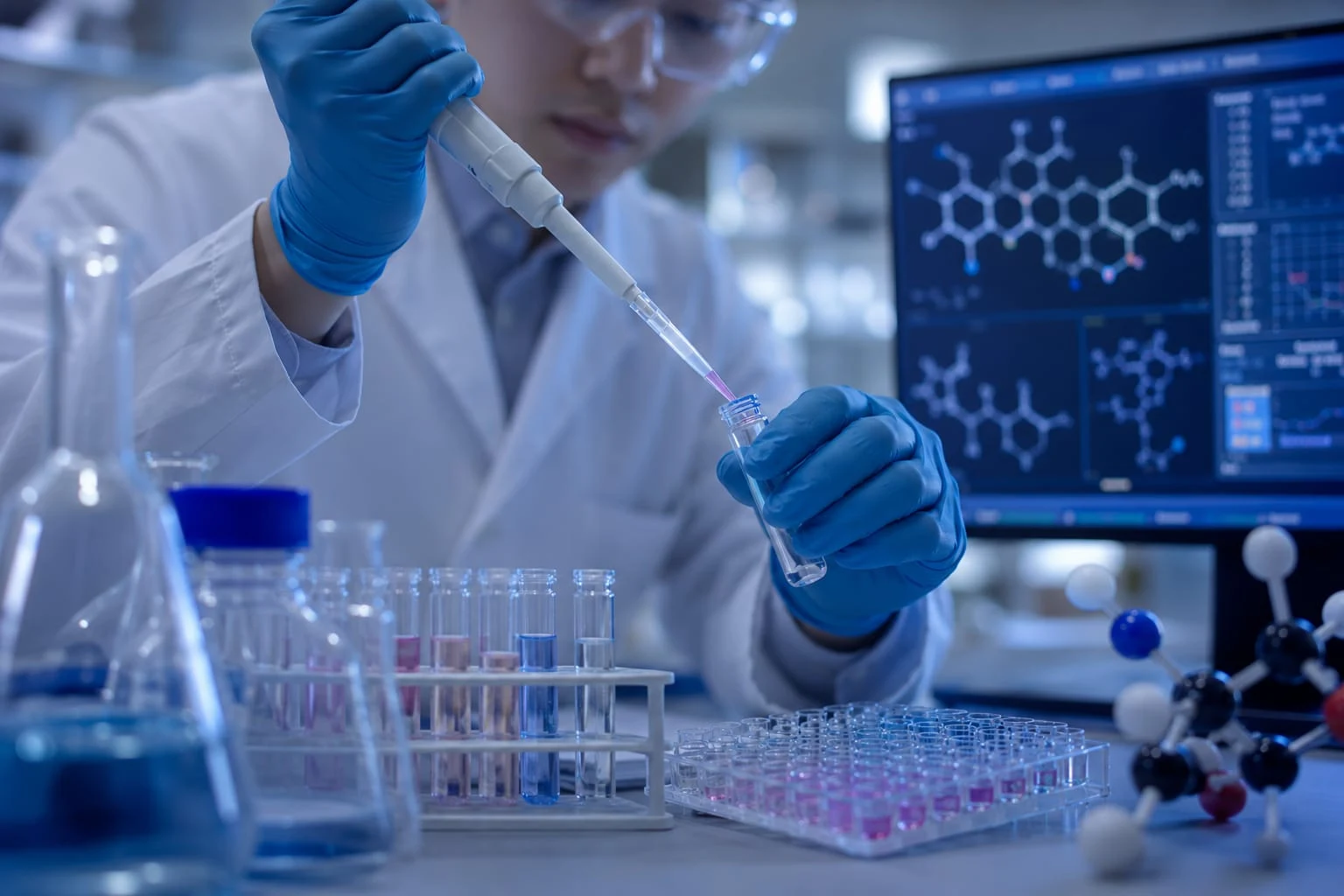
OpenAI于2026年11月20日推出MedChemBench。这是一个包含99道题的基准测试, 题目取材于117篇已发表的论文和专利, 涵盖761个不同的分子结构。该公司最新模型GPT-6.2 Astra在xhigh推理设置下获得了84.5%的可用分数。
这项测试针对一类具体工作。药物化学家改进分子的一个性质时, 另一个性质往往会变差: 一个化合物对与疾病相关的蛋白质作用很强, 却可能吸收不良, 或在体内分解过快。OpenAI设计题目时要求模型把分子结构与实验证据联系起来, 再解释结果, 比较化合物并预测性质。本站近期的科技报道还包括医院配送机器人报道。
每道题给模型提供研究人员在某个项目节点上掌握的背景: 生物靶点, 目标, 已研究的化合物和选定的实验结果。评分分为四个部分。第一部分检查分子结构, 即由图纸和化学基团组装的分子中原子连接和指定立体化学是否正确。第二部分评判科学推理, 即选择某个化合物的解释。第三部分考察排序和选择, 模型选出的化合物是否符合既定要求。第四部分是性质预测, 按与原始材料中数值和类别的接近程度评分, 接近的答案可得部分分数。
其中一道题来自PRMT5抑制剂的研究, PRMT5是一种在癌症药物发现中被研究的蛋白质。模型收到结构和早期结果后, 要预测三个相关化合物的表现: 在细胞中阻断PRMT5的强度, 穿过细胞屏障的难易程度, 以及被肝酶分解的速度。被扣留的结果显示出分化: 化合物23以更低浓度阻断PRMT5, 化合物24则更容易穿过屏障且分解更慢。
另一道题要求模型从一个中心结构和两个连接基团组装分子, 同时保留一个18原子环。在xhigh设置下, GPT-6 Astra在十次回答中全部正确重建了该化合物, 而GPT-5.6 Sol和GPT-5.6 Luna十次全部失败, 一个生成了15原子环, 另一个把分子拆成两个不相连的碎片。在整个结构部分, GPT-6 Astra在xhigh下获得95.4%的可用分数, 其选择和预测部分约为一半。完整表格中, GPT-6.2 Astra为84.5%, GPT-6 Astra为83.3%, GPT-6.1 Sol为82.0%, GPT-6.1 Terra为75.1%, GPT-5.6 Sol为58.2%。OpenAI在文章中说明了局限: 结果不能证明模型能发现新药或改进实验室决策, 题目来自已发表材料, 模型在训练中可能已经见过。本站的自动驾驶出租车报道同样关注技术评测的实际边界。
基准背后的技术论文报告了60390份评分回答, 覆盖11个GPT模型和61种模型与努力程度的组合, 每项任务在每种组合下保留十份回答。正因如此, 18原子环的结果被表述为十次全对, 而不是一次幸运的答对。
English
OpenAI introduced MedChemBench on November 20, 2026, a benchmark of 99 problems drawn from 117 published papers and patents, covering 761 distinct molecular structures, and its newest model, GPT-6.2 Astra, earned 84.5% of the available credit at the xhigh reasoning setting.
The benchmark tests a specific kind of work. Medicinal chemists improve one property of a molecule and often watch another property get worse: a compound can act strongly against a disease-related protein and still be poorly absorbed, or break down too quickly in the body. OpenAI built the problems so a model has to connect a molecule’s structure with experimental evidence, then explain results, compare compounds and predict properties.
Four graded components in MedChemBench
Each problem hands the model the context researchers had at a chosen point in a program: the biological target, the goals, the compounds studied so far and selected experimental findings. Grading then splits into four parts. The first checks molecular structures, meaning correct atom connections and specified stereochemistry in molecules assembled from drawings and chemical groups. The second grades scientific reasoning, the explanations offered for choosing one compound over another.
The third part covers ranking and selection, whether the model’s compound choices meet the stated requirements. The fourth covers property predictions, scored by how closely they match the numerical values and categories in the source material, with partial credit for close answers. Measurements already supplied in the prompt also have to be reproduced correctly.
One problem in the set comes from research on inhibitors of PRMT5, a protein studied in cancer drug discovery. The model receives structures and earlier results, then predicts how three related compounds will behave: how strongly they block PRMT5 in cells, how readily they cross a cell barrier and how quickly liver enzymes break them down. The withheld results showed a split outcome, with compound 23 blocking PRMT5 at a lower concentration while compound 24 crossed the barrier more readily and broke down more slowly.
The 18-atom ring test
A second problem asks models to assemble a molecule from a central structure and two attached groups while preserving an 18-atom ring. At xhigh, the highest reasoning setting shared by all eleven models OpenAI evaluated, GPT-6 Astra reconstructed that compound correctly in all ten of its responses. GPT-5.6 Sol and GPT-5.6 Luna failed in all ten of theirs, one producing a 15-atom ring and the other splitting the molecule into two disconnected fragments.
Across the structure component, GPT-6 Astra earned 95.4% of the available credit at xhigh. Its selection and prediction work was weaker, at about half the available credit for choosing compounds and for predicting numerical properties. OpenAI notes that the categories use different tasks and scoring rules, so the percentages are not direct measures of one another, but the gap inside a single model’s results is the clearest finding in the release.
The full table puts GPT-6.2 Astra at 84.5% at xhigh, GPT-6 Astra at 83.3%, GPT-6.1 Sol at 82.0%, GPT-6.1 Terra at 75.1% and GPT-5.6 Sol at 58.2%. At max effort, GPT-6 Astra reached 83.8%. Higher reasoning settings improved scores across the eleven models, and the published figure plots each score against output tokens, reasoning included.
OpenAI states the limits in its own post. The results do not establish whether models can discover new drugs or improve laboratory decisions. Prior exposure to the published sources cannot be ruled out, since the problems come from papers and patents a frontier model may have seen in training. Each response was a single attempt, with no tools, no feedback and no new experiments.
The scale of the underlying run is worth holding next to the headline score. The technical paper behind the benchmark reports 60,390 graded responses across 11 GPT models and 61 model-and-effort conditions, with ten retained responses for each task in every condition. That is why the 18-atom ring result is stated as ten out of ten rather than as a single lucky answer: the grading kept repeated attempts, so a model had to be right consistently, not once.
The authors also ran a check aimed at the contamination question. They added source DOI or patent identifiers to all 99 prompts for nine models at xhigh, to see whether naming the paper changed the answers. The benchmark paper, dated November 9, predates the GPT-6.2 Astra result, which comes from the November 20 announcement rather than from the paper’s own eleven-model table.
For working chemists, the split result maps onto a familiar division of labor. Reading a structure correctly and explaining what an assay showed are tasks a junior researcher can be checked on quickly. Choosing the next compound and predicting its numbers are the judgment calls a project leader signs off on. A benchmark that grades the two halves separately tells a lab where a model can draft and where a person still has to decide, which is more useful than a single blended score.
Agent tooling is heading the same way in a different field. This site covered Gemini tool retrieval in the Interactions API on November 19, a change that lets an agent load a tool’s full schema only at the moment it needs that tool. MedChemBench strips tools away entirely – one attempt, no feedback – so its scores measure unaided reasoning, and any lab that later gives a model instruments and iteration should expect different numbers, for better or worse, on the same 99 problems.
The benchmark still gives research teams a shared yardstick that did not exist last week. A hospital deployment covered on this site, a robot adding daily specimen runs in Indiana, shows applied systems doing narrow jobs well; MedChemBench is aimed at the earlier, messier stage where a chemist decides which compound deserves the next round of lab time. OpenAI says it will share updates as its models advance, and the 99 problems are published with the November 20 announcement for other labs to run.
本报道的其他版本也刊登在 News Today World, Manhattan Mogul, Newsy USA, The American Newsroom, Revista Minutos 和 Le Miroir Francais。


































Be First to Comment