
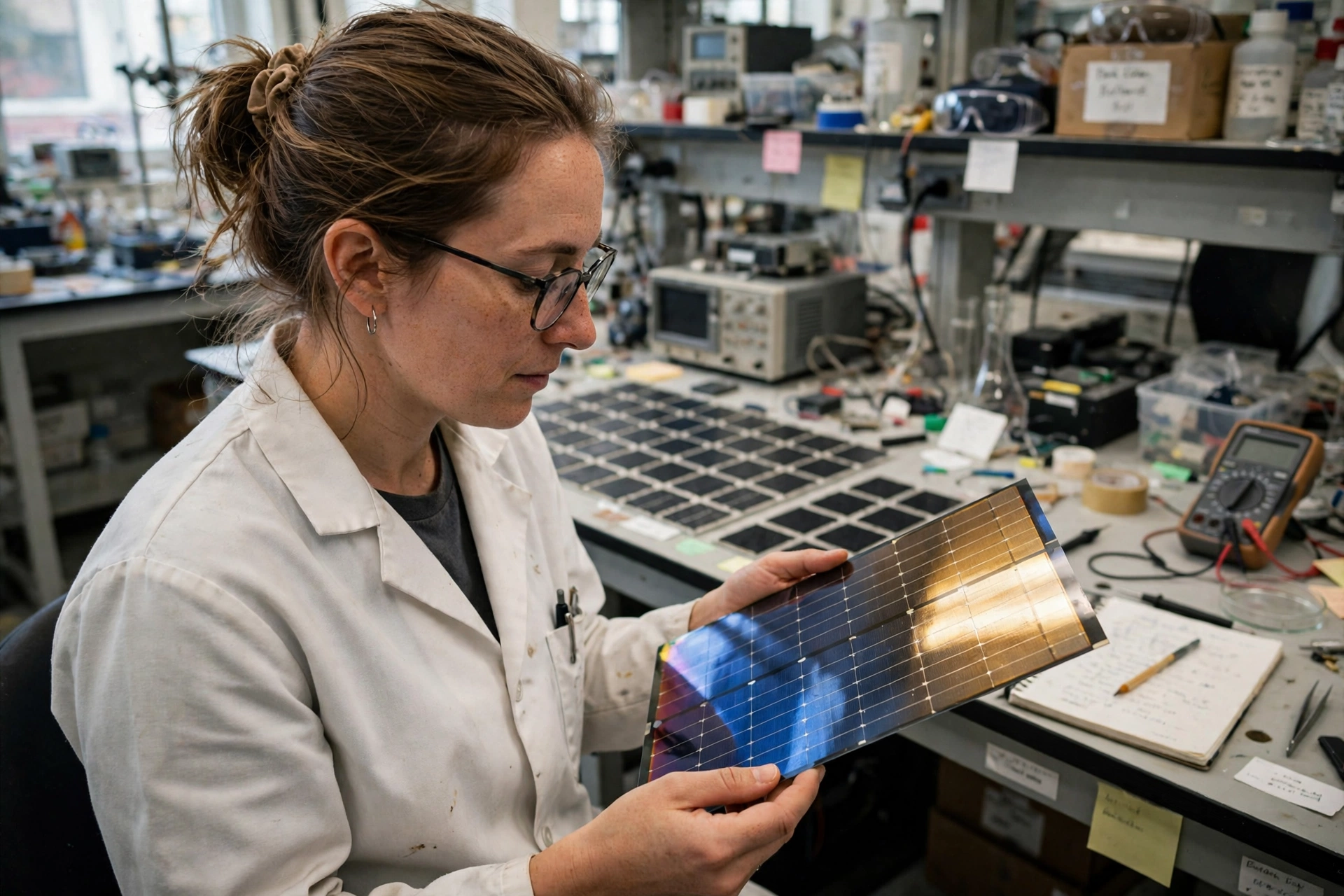
一项11月18日发表于《自然》的研究中,一块钙钛矿太阳能电池达到27.96%的认证光电转换效率。同一方法扩展到单片钙钛矿-硅叠层电池,产生34.71%的认证稳定功率输出。钙钛矿电池用十多年实验室工作,弥合了与标准硅之间的大部分效率差距。进展在一个具体位置放慢,即钙钛矿层与电子传输层相遇的界面。电荷必须干净地穿过这道边界。保护表面的处理往往会减慢穿越,加快穿越的处理往往让表面暴露。该领域把这一权衡称为这篇论文要攻克的瓶颈。
作者由董、崔和陈领衔,引入了一类含杂原子、全共轭的甲脒界面调制分子。这些分子构建出论文所称的能带边缘扩展异质界面。通俗地说,界面获得了离域的电子连通性,电荷能更自由地穿过,同时界面非辐射复合受到抑制,非辐射复合是能量以热而不是电流形式损失的一条路径。标题数字经过认证,这在太阳能研究中很重要。这块倒置钙钛矿电池记录了27.96%的认证效率和27.84%的稳定功率输出。稳定输出是电池在稳定运行中保持的数字,而不是测量扫描中的短暂峰值,因此两个数字之间的小差距本身就是好迹象。本站读者也可阅读卢森堡艺术家协会沙龙报道。
效率之外还有耐久性。器件在遵循ISOS-L测试协议、一个太阳辐照下连续最大功率点跟踪2000小时后,保持了初始效率的95%以上。在最大功率点保持输出这么久,是比把电池放在架子上存放更严苛的测试,钙钛矿器件过去恰恰常在这种持续负荷下挣扎。叠层电池把两个吸收层堆叠起来,各自捕捉阳光光谱的不同部分。钙钛矿与硅配对是最受关注的组合,因为硅工厂已经规模化存在。34.71%的认证稳定输出使这一叠层结果跻身该配对已发表的最强数字之列,作者把能带边缘扩展呈现为一种可以跨器件类型迁移的方法,而不是对某一种电池设计的修补。
论文的DOI为10.1038/s41586-026-11427-1,发表于《自然》2026年。它的下一个考验是钙钛矿研究熟悉的那个,实验室认证电池中有效的调制分子,在电池做得更大、连成组件并在户外经历季节性的冷热和雨水后,是否仍有效。一些背景能解释为什么单一界面受到这么多关注。太阳能电池在几个可预测的位置损失能量,层间边界是代价最高的位置之一。钙钛矿层中由阳光产生的电子必须经电子传输层离开并到达电路。如果边界困住它们,或让它们的能量以热的形式漏走,无论吸收层本身多好,效率都会下降。非辐射复合就是这种泄漏的名字,在不堵住出口的前提下抑制它,正是这些调制分子设计要取得的平衡。倒置电池是27.96%结果所用的结构,它翻转通常的层序,有助于稳定性和在其他材料之上制造。这也是叠层结果自然地从单电池工作跟来的原因,单片叠层把钙钛矿电池直接建在硅电池上,每个内部界面的质量决定组合输出能保留多少。2000小时的稳定性数字值得与效率数字同样的重视。最大功率点跟踪让器件在持续、匹配一个太阳的光源下,始终保持在输出功率最大的电压。这是一种加速的工作寿命,而不是静置测试。通过这一轮仍保持起始效率95%以上,回应了自钙钛矿电池首次拿到高分以来一直跟着它的批评,即早期器件会在几天或几周内衰减。这些都不会在今天把一块新面板装上屋顶。认证电池是实验室器件,论文没有宣布产品、价格或工厂。它给制造商的是一份经过测试的界面配方,附有经认证的测量,其他实验室可以重复、挑战和改进。本站其他报道包括教皇利奥十四世周五祈祷分享。
English
A perovskite solar cell reached a certified power-conversion efficiency of 27.96 percent in a study published in Nature on November 18, 2026. The same approach, extended to a monolithic perovskite-silicon tandem cell, produced a certified stabilized power output of 34.71 percent.
Perovskite cells have closed most of the efficiency gap with standard silicon in little more than a decade of lab work. The gains have slowed at one specific place: the interface where the perovskite layer meets the electron transporting layer. Charge has to cross that boundary cleanly. Treatments that protect the surface tend to slow the crossing, and treatments that speed the crossing tend to leave the surface exposed. The field calls that trade-off the bottleneck this paper attacks.
Dong and colleagues in Nature, November 18
The authors, led by Dong, Cui and Chen, introduced a family of heteroatom-containing, fully conjugated formamidinium interfacial modulators. Those molecules build what the paper calls a band-edge-extended heterointerface. In plain terms, the interface gains delocalized electron connectivity, so charge moves across it more freely, while interfacial non-radiative recombination, a route by which energy is lost as heat instead of current, is suppressed.
The headline numbers are certified, which matters in solar research. The inverted perovskite cell recorded a certified efficiency of 27.96 percent and a stabilized power output of 27.84 percent. Stabilized output is the figure a cell holds in steady operation, rather than a brief peak during a measurement sweep, so the small gap between the two numbers is itself a good sign.
Durability came with the efficiency. The devices kept more than 95 percent of their initial efficiency after 2,000 hours of continuous maximum-power-point tracking under one-sun irradiation, following the ISOS-L testing protocol. Holding output at the maximum power point for that long is a sterner test than storing a cell on a shelf, and perovskite devices have often struggled under exactly that kind of steady load.
Solar is not the only energy story with a New York angle this week. Our New York weekend plans for November 20-22 cover the city’s holiday markets opening, many of them lit and heated through the coldest weekends of the year, when power demand climbs.
A certified 34.71 percent tandem output
Tandem cells stack two absorbers so each catches a different part of the sunlight spectrum. Pairing perovskite with silicon is the most closely watched combination, because silicon factories already exist at scale. A certified stabilized output of 34.71 percent puts this tandem result among the strongest published figures for the pairing, and the authors present band-edge extension as a method that transfers across device types rather than a fix for one cell design.
Context from this week’s other science coverage helps set the scale. The ancient teeth that showed Homo erectus lived in a rainforest rewrote a timeline in human evolution, while this paper moves a percentage point in a lab. Both kinds of progress count, and both were checked the same way, through peer review and independent measurement.
The paper carries the DOI 10.1038/s41586-026-11427-1 and appears in Nature (2026). Its next test is the familiar one for perovskite research: whether modulators that work in certified lab cells keep working when cells are made larger, joined into modules and left outdoors through seasons of heat, cold and rain.
Some background explains why a single interface draws this much attention. A solar cell loses energy in a few predictable places, and the boundary between layers is one of the most expensive. Electrons generated by sunlight in the perovskite layer have to leave through the electron transporting layer to reach the circuit. If the boundary traps them or lets their energy leak away as heat, efficiency falls no matter how good the absorber itself is. Non-radiative recombination is the name for that leak, and suppressing it without blocking the exit route is the balance the modulators are designed to strike.
An inverted cell, the architecture used for the 27.96 percent result, flips the usual layer order, which can help with stability and with manufacturing on top of other materials. That is also why the tandem result follows naturally from the single-cell work: a monolithic tandem builds the perovskite cell directly on a silicon cell, so the quality of each internal interface decides how much of the combined output survives.
The 2,000-hour stability figure deserves the same care as the efficiency figure. Maximum-power-point tracking holds a device at the voltage where it delivers the most power, continuously, under a light source matched to one sun. It is an accelerated working life rather than a resting test. Keeping more than 95 percent of the starting efficiency through that run addresses the criticism that has followed perovskite cells since their first high scores, namely that early devices faded within days or weeks.
None of this puts a new panel on a roof today. The certified cells are laboratory devices, and the paper does not announce a product, a price or a factory. What it gives manufacturers is a tested recipe for the interface, published with certified measurements that other laboratories can repeat, challenge and improve.
读者也可以在 News Today World, Manhattan Mogul, Newsy USA, Revista Minutos 和 Le Miroir Francais 阅读本报道的其他版本。
Watch the Short on YouTube:


































Be First to Comment