
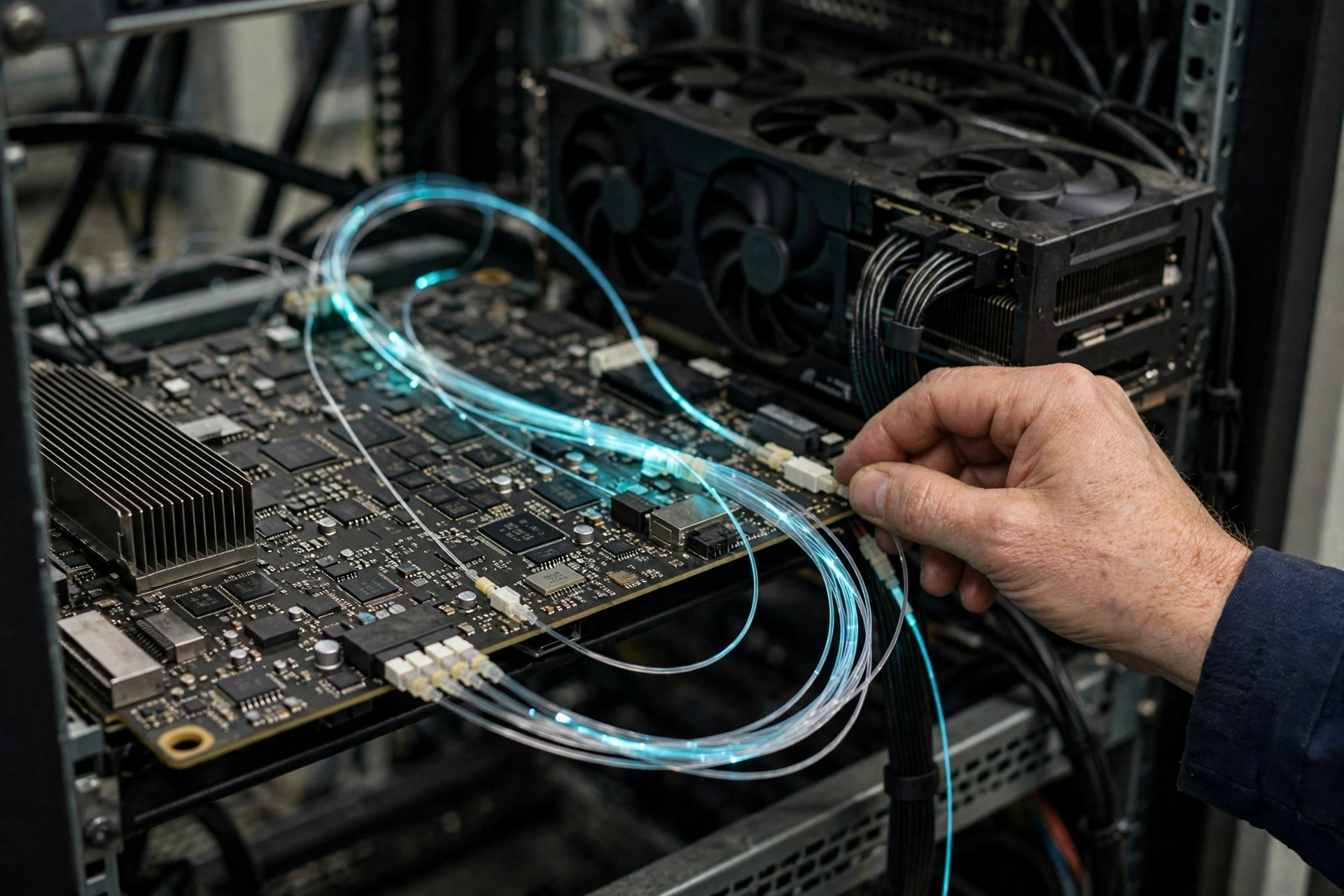
德国公司Q.ANT于2026年11月17日在芝加哥举行的SC26大会上发布了光子处理器NPU Gen 2+,并现场演示了一套混合系统:这款新芯片与一颗AMD图形处理器协同工作,共同运行了一个大型语言模型。Q.ANT总部位于斯图加特,该公司制造的处理器用光而不是电子进行计算。
Gen 2+新增的一项能力是离散傅里叶变换,而且它以光学方式在单次通过中完成这项运算。在普通电子硬件上,数据量较大时,傅里叶变换需要一连串计算,并占用模型相当一部分能耗。在Q.ANT的芯片上,这项变换是在光穿过处理器内置光学元件的过程中完成的。傅里叶变换是信号处理和图像处理的基础,也为语言模型的构建提供了另一种方法。Q.ANT表示,这次演示用运行在光子芯片上的傅里叶方法,替代了计算量很大的注意力层。需要说明的是,这只是一次大会演示,并非已经上市的产品,公司也没有公布与单独使用图形处理器相比的速度或能耗数据。
定位是协处理器,不是替代品
Gen 2+的前一代产品是2025年推出的NPU Gen 2,可以用光完成矩阵乘法和非线性运算。新芯片基于薄膜铌酸锂光子电路,通过PCIe接口安装到标准服务器中。Q.ANT计划在2027年下半年推出同时搭载Gen 2和Gen 2+的商用系统。首席执行官米夏埃尔·弗尔奇表示,当傅里叶变换能够原生地用光来完成时,开发者就获得了一种重塑人工智能模型数学结构的工具,而参数更少、所需数据更少的精简模型,将使下一波人工智能应用变得负担得起。软件副总裁乌茨·巴赫尔则表示,当复杂运算可以直接通过光的物理特性完成时,程序员可以去探索不同的算法,而不只是优化现有代码。
开发者不必等到拿到硬件才开始工作。2026年9月,Q.ANT发布了开源软件开发工具包,提供C和Python语言接口、示例应用、文档以及基于CPU的模拟环境,公司正在为Gen 2+扩展这套工具。与IONOS合作的光子计算试点项目,则为超出模拟环境需求的团队提供真实硬件。Q.ANT成立于2018年,在斯图加特拥有自己的薄膜铌酸锂芯片试产线,并在慕尼黑和美国得克萨斯州奥斯汀设有办事处。该公司在2025年完成了欧洲光子计算领域规模最大的A轮融资,其早期系统已安装在多家科学计算中心。接下来值得关注的证据是一组公开实测结果:运行时间、功耗读数,以及与同一模型单独在AMD显卡上运行的对比。关注芯片与人工智能行业的读者可以浏览本报科技栏目,也可以在关于我们页面了解本报的双语出版方式。
English
Q.ANT, a German company, unveiled its NPU Gen 2+ photonic processor on November 17, 2026, at the SC26 conference in Chicago, and demonstrated a hybrid system in which the new chip works beside an AMD graphics processor to run a large language model. Q.ANT is based in Stuttgart and builds processors that compute with light instead of electrons.
The capability the Gen 2+ adds is the Discrete Fourier Transform, performed optically in a single pass. On ordinary electronic hardware, a Fourier transform at large data volumes takes a sequence of calculations and a real share of a model’s energy budget. On Q.ANT’s chip, the transform happens as light passes through an optical component built into the processor. Fourier transforms sit underneath signal processing and image processing, and they also offer another way to build parts of a language model. Q.ANT says the demonstration replaced a computationally intensive attention layer with a Fourier-based approach running on the photonic chip. Two limits need stating plainly: this was a conference demonstration, not a shipped product, and the company published no speed or energy figures comparing the hybrid system against a graphics processor alone.
A co-processor, not a replacement
The Gen 2+ builds on the NPU Gen 2, launched in 2025, which handled matrix multiplication and non-linear operations in light. The new chip sits on a thin-film lithium niobate photonic circuit and connects to a standard server through PCIe. Q.ANT plans to offer commercial systems that combine Gen 2 and Gen 2+ processors in the second half of 2027. Chief executive Michael Fortsch said that with the Fourier transform performed natively in light, developers gain a tool to reshape the mathematics of AI models, and that leaner models with fewer parameters and less data are what will make the next wave of AI affordable. Vice president of software Utz Bacher said that when a complex operation can be performed directly through the physics of light, programmers can explore different algorithms instead of only optimizing existing code.
Developers do not need the hardware to start. In September 2026 Q.ANT released an open-source software development kit with APIs for C and Python, example applications, documentation and a CPU-based simulation environment, and the company is now extending the kit for the Gen 2+. A photonic pilot with IONOS gives access to real hardware for teams that outgrow the simulator. Q.ANT was founded in 2018, runs its own thin-film lithium niobate chip pilot line in Stuttgart, and keeps offices in Munich and Austin, Texas. It raised Europe’s largest Series A for photonic computing in 2025, and its earlier systems are installed at scientific computing centers. The next evidence to look for is a published measurement: a timed run, a power reading, and a comparison against the same model on the AMD card alone. Readers can follow chip and AI industry coverage in this paper’s Technology section.
本文最初刊登于News Today World,并同步发表于Manhattan Mogul、American Morning Herald、The American Newsroom、Revista Minutos和Le Miroir Français。


































Be First to Comment