
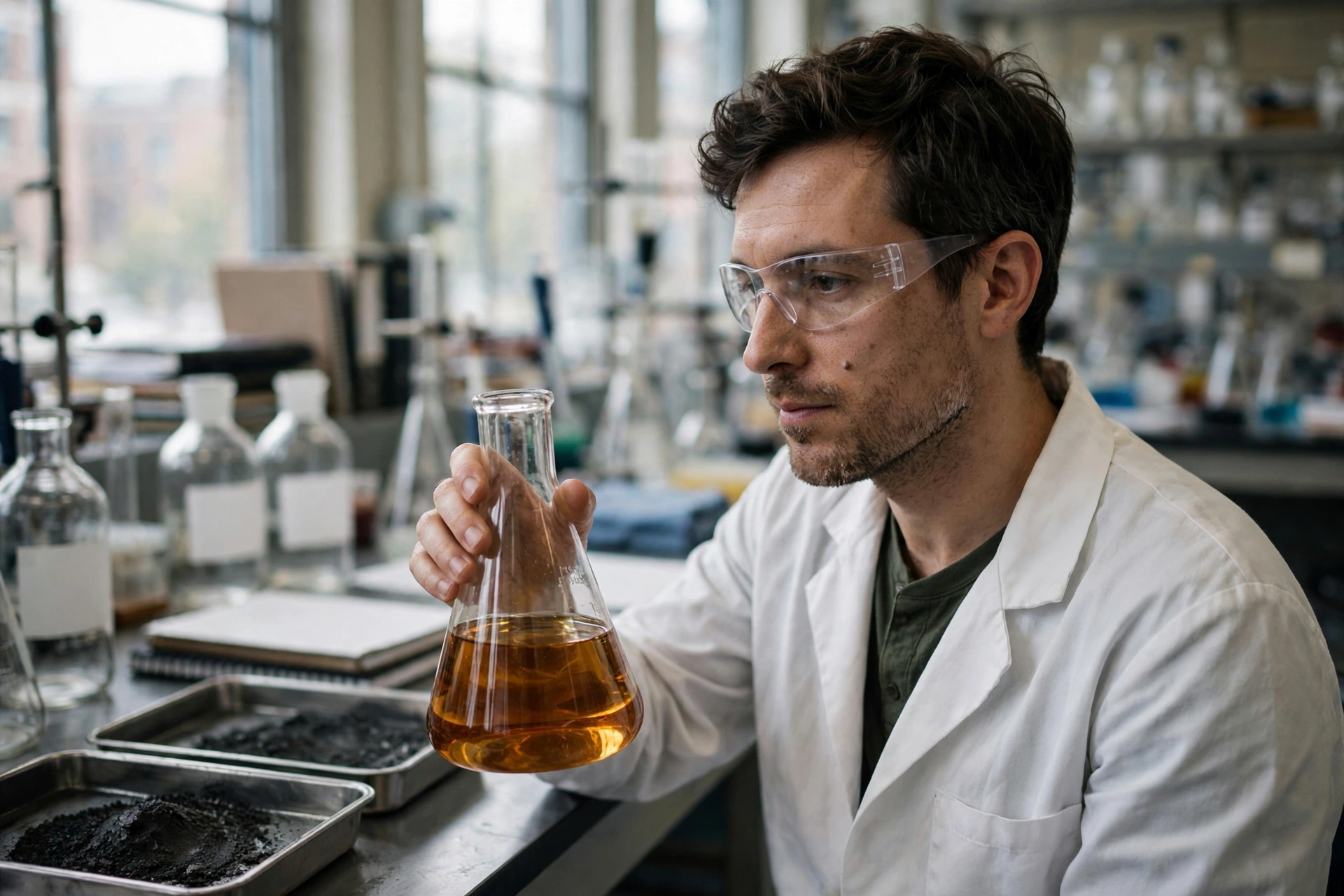
哥伦比亚大学研究人员在室温下20分钟内,从镍铁合金矿中提取了98%的镍和82%的钴,同行评审工作发表在《ACS Sustainable Resource Management》上,并于11月18日星期三报道。约90%的镍在前五分钟内被提取出来。
精矿来自第一大西洋镍钴公司在纽芬兰与拉布拉多的Pipestone XL项目。镍铁合金是一种天然镍铁钴合金,受测精矿镍品位为63%,其中几乎全部镍都位于一种不含硫的单一矿物中。这一化学特性正是整个故事的关键。
冷运行并自我循环的浸出工艺
哥伦比亚工艺在室温和普通大气压下用铈盐溶液溶解镍。没有熔炼炉,也没有热硫酸预处理。两种铈盐在镍铁合金精矿上进行了测试,表现几乎相同:20分钟内镍提取率分别为97.5%和98.1%。
铈不会被消耗。在浸出中,活性形态的铈交出电荷溶解金属,自身变为耗尽形态。随后电化学电池用电将耗尽的铈转化回活性形态,返回浸出环节再次使用。哥伦比亚展示了多次再生循环,因此铈是可回收的载体,而不是用完即弃的试剂。
对照测试突出了结果有多少属于铈本身。在同一精矿和同样20分钟内,一种常见的铁基浸出溶液提取了38%的镍,单独用酸只提取了8%。本站经济科技报道之外,读者可参看纽约假日快闪活动指南。
对比样本慢得多
研究用同一工艺测试了来自明尼苏达州Tamarack项目的硫化镍精矿。那些样本在60分钟后镍提取率达到59%至82.5%,时间是三倍,其中消耗最大的样本铈用量是镍铁合金的16倍以上。最好的硫化物结果为84%,且需要先进行热硫酸预处理。
差别是结构性的。在硫化物精矿中,镍矿物镍黄铁矿占材料的37%至40%,同时还有大量磁黄铁矿,这是一种含镍很少的硫化铁。活性硫化物消耗铈却不释放镍。镍铁合金没有硫化物来浪费试剂,这就是它浸出快、铈用量少的原因。
甚至一种来自Pipestone XL的粗糙、仅经磁选的预浮选精矿,也在20分钟内释放了77%的镍,而只有5.6%的铁溶解。这种选择性在工厂里很重要,因为它意味着早期廉价的分离步骤已经能产出可用的原料。
丰富且价格低的试剂
铈是稀土元素中最丰富的一种,在地壳中比铜更常见,也是最便宜的之一。据美国地质调查局数据,2025年氧化铈平均价格为每公斤1.71美元。行业估计2026年前后的产量远高于需求,在美国,铈作为副产品产于加利福尼亚州芒廷帕斯矿和犹他州白台地磨坊。相关国际报道见费利佩六世接受六国大使国书。
这项研究由美国能源部ARPA-E MINER项目资助,该项目支持关键矿产生产的新方法。曾领导该项目、现为第一大西洋顾问的道格拉斯-威克斯博士说,结果展示了铈精炼的成功测试:约98%的镍和82%的钴在20分钟内、室温下被提取,无需熔炼或硫酸。
规模化可能是什么样
哥伦比亚作者做了工厂测算。在预计每天生产160吨镍的规模下,计算出的浸出体积约为104立方米,他们称这一尺寸与实用的搅拌槽运行兼容。快速动力学正是让这个数字变小的原因:20分钟的浸出所需槽体体积,远小于把材料保持数小时的工艺。
第一大西洋和哥伦比亚现在共同开发这项技术,作为一条国内精炼路线,目标是在北美生产1级镍金属或电池级硫酸镍。精矿本身在精炼前平均品位就很高,这缩短了矿山与精炼厂之间的链条。合作方宣布的下一步是向商业生产推进的进一步开发工作,同行评审的提取数据,98%镍、82%钴、20分钟,是它在更大规模上必须保持的基准。
English
Columbia University researchers extracted 98 percent of the nickel and 82 percent of the cobalt from awaruite concentrate in 20 minutes at room temperature, in peer-reviewed work published in ACS Sustainable Resource Management and reported on Wednesday, November 18. About 90 percent of the nickel came out in the first five minutes.
The concentrate came from First Atlantic Nickel and Cobalt’s Pipestone XL project in Newfoundland and Labrador. Awaruite is a natural nickel-iron-cobalt alloy, and the tested concentrate graded 63 percent nickel, with nearly all of that nickel sitting in a single mineral that contains no sulfur. That chemistry turns out to be the whole story.
A leach that runs cold and loops back on itself
The Columbia process dissolves the nickel with a cerium salt solution at room temperature and ordinary atmospheric pressure. There is no smelting furnace and no hot sulfuric acid pretreatment. Two cerium salts were tested on the awaruite concentrate, and they performed almost identically: 97.5 percent and 98.1 percent nickel extraction in 20 minutes.
The cerium is not consumed. In the leach, cerium in its active form gives up its charge to dissolve the metal and drops into its spent form. An electrochemical cell then uses electricity to convert the spent cerium back to the active form, which returns to the leach and goes again. Columbia demonstrated multiple regeneration cycles, so the cerium works as a recyclable carrier rather than a reagent that gets used up.
Control tests underlined how much of the result belongs to the cerium itself. On the same concentrate and in the same 20 minutes, a common iron-based leaching solution extracted 38 percent of the nickel, and acid on its own extracted 8 percent.
The comparison samples were much slower
The study ran the same process against nickel sulfide concentrates from the Tamarack project in Minnesota. Those samples reached 59 to 82.5 percent nickel extraction after 60 minutes, three times as long, and the hungriest of them consumed more than 16 times as much cerium as the awaruite. The best sulfide result, 84 percent, required a hot sulfuric acid pretreatment first.
The difference is structural. In the sulfide concentrates, the nickel mineral pentlandite makes up 37 to 40 percent of the material, alongside a large share of pyrrhotite, an iron sulfide that carries little nickel. Reactive sulfides consume cerium without releasing nickel. Awaruite has no sulfides to waste the reagent on, which is why it leaches fast and sips cerium instead.
Even a rough, pre-flotation magnetic-only concentrate from Pipestone XL gave up 77 percent of its nickel in 20 minutes while only 5.6 percent of its iron dissolved. That selectivity matters at a plant, because it means the early, cheap separation steps already produce a workable feed.
Materials results like this one pair naturally with the solar capacity figures India reported this week: batteries and stainless steel both need nickel in quantity, and the supply chain question is shifting from finding metal to refining it cleanly at home.
An abundant reagent at a low price
Cerium is the most abundant of the rare earth elements, more common in the Earth’s crust than copper, and one of the cheapest. Cerium oxide averaged 1.71 US dollars per kilogram in 2025, according to the US Geological Survey. Industry estimates put 2026-era production well above demand, and in the United States cerium is produced as a by-product at the Mountain Pass mine in California and the White Mesa Mill in Utah.
The research was funded by the US Department of Energy’s ARPA-E MINER program, which backs new ways to produce critical minerals. Dr. Douglas Wicks, who directed that program and now advises First Atlantic, said the results show “the successful test of cerium refining: approximately 98% of the nickel and 82% of the cobalt extracted in 20 minutes, at room temperature, without smelting or sulfuric acid.”
What scale could look like
The Columbia authors did the plant arithmetic. At a projected production scale of 160 tonnes of nickel per day, the calculated leach volume is about 104 cubic meters, a size they describe as compatible with practical stirred-tank operation. Fast kinetics are what make that number small: a 20-minute leach needs far less tank volume than a process that holds material for hours.
First Atlantic and Columbia are now developing the technology together as a domestic refining route, aimed at producing Class 1 nickel metal or battery-grade nickel sulfate in North America. The concentrate itself averages high grades before refining, which shortens the chain between mine and refinery.
There is a parallel with the photonic computing work covered this week, where the gain also came from swapping a hot, power-hungry step for a cooler physical process. Here the swap is a furnace and an acid plant traded for a room-temperature tank and an electric regeneration cell. The next announced step from the partners is further development work toward commercial production, with the peer-reviewed extraction figures – 98 percent nickel, 82 percent cobalt, 20 minutes – as the benchmark it has to hold at larger scale.
读者也可以在News Today World、Manhattan Mogul、Billionaire Herald、The American Newsroom、Revista Minutos、Le Miroir Français阅读本报道。
















































Be First to Comment